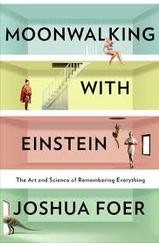
Moonwalking with Einstein: The Art and Science of Remembering Everything
Author: Joshua Foer
ISBN: 1-101-46763-0
APA Style Citation
Foer, J. (2011). Moonwalking with Einstein: The Art and Science of Remembering Everything. Penguin Group, New York, New York.
Author: Joshua Foer
ISBN: 1-101-46763-0
APA Style Citation
Foer, J. (2011). Moonwalking with Einstein: The Art and Science of Remembering Everything. Penguin Group, New York, New York.


| |||||||||
Book Description
In Moonwalking with Einstein, author Joshua Foer spends one year training for the American Memory Olympics after observing the competition, and talking to some of the participants. Those who train insist that they are not savants and that anyone can learn to be a memory champion if they are willing to put in the hard work. Foer accepts the challenge and prepares for the competition.
Foer claims there is no scientific evidence to support what we commonly refer to as photographic (eidetic) memory. He suggests that individuals with excellent memories simply spend time concentrating on specific items, which leads to the ability to complete feats that display like photographic memory. He argues however, that these individuals do not take “snapshots” of the world as was previously believed, but instead used specific methods for improving memory. Foer explains that in nearly all disciplines there are people who seem to have unbelievable memories, waiters who do not need to write down orders, those who can determine the sex of a chicken in a few seconds, or musicians who can recall a long musical score with seemingly little effort. In some cases specific brain differences have been found in these individuals. In one example, the author writes that experienced London cabbies were found to have a larger posterior hippocampus than average, likely resulting from the vast cognitive map for locations and buildings they posses. Foer contends that in each of these scenarios, individuals who are experts in their fields simply work more quickly because they know what is important and what is not, thereby eliminating time and energy being wasted on unimportant information.
During his training, Foer adopts many memory techniques from the experts; one that is commonly used is chunking. Chunking works by associating what one is trying to learn with what they already know in long-term memory. Foer cites a runner named S.F. who has an amazing memory for numbers. S.F. took meaningless numbers and chunked them into running times, doing this dramatically improved his ability to recall random digits. Foer argues that S.F. does what memory experts do, which is not attributable to an outstanding memory but rather, the skill of taking new information and making it relevant. One’s experience aids memory in the future regardless of what that past experience, it is up to individuals to determine how to use their own expertise. Champion chess players use chunking to break up the chessboard into sections, they look at the borders between squares more than other (lower ranked) players and chunk the board into larger sections. Everyone has an excellent memory for something. Perhaps the difficulty is finding the proper cue for retrieving any given memory.
During his year of training, Foer finds himself memorizing license plates, information from obituaries, and other seemingly random information to practice his new skills. He wears blacked out goggles with small openings so that he is not distracted and reads endlessly from encyclopedias. He also immerses himself in the unique culture of those who participate in the Memory Olympics.
The memory experts with whom Foer trains argue that a focus on memory used to be the most important part of one’s education. Before books and other written works were readily available, stories and information was passed through word of mouth and ancient scripts carry many messages referring to the importance of memorization. This skill has been lost over many generations and now people read for quantity rather than quality, often forgetting most of what they have just read. Foer hopes to bring a bit of this back as he prepares himself for the competition. As the year progresses, he reaches a plateau, but then goes on to memorize a deck of cards in under 2 minutes. After he experiences improvements, he moves from wanting to just compete in the Memory Olympics to wanting to be competitive.
Foer also describes detriments related to losing one’s memory. He discusses the cases of E.P., Henry Molaison, and Clive Wearing (for more on Clive Wearing see Books for Psychology Class review for Forever Today) who both suffer from anterograde amnesia (which prevents the creation any new memories). Foer visits E.P. who is cognitively alert, but unaware of his memory problems. He believes that the president is FDR and reads the paper each morning even though by the time he has finished reading any given article, he has already forgotten the headline. He may eat breakfast three or four times in a day because he forgets that he has already had breakfast. He can however take a walk around the block by himself and trace a five-pointed star. In part, he can do these later activities because his procedural memory remains intact. Procedural memories, which are unlikely to me impacted by amnesia, deal with how to do something whereas episodic memories deal with the where and when of a person’s life and help individuals recall significant events. Finally, Semantic memories are what people know and are more free-floating (not associated with a specific event). Episodic memories are the type most likely to be impacted by amnesia. Semantic memories may also be damaged depending on the extent of the amnesia. Recent memories are the first to go for those with amnesia as well as those who suffer from Alzheimer’s because more recent memories have weaker neural networks and are more easily damaged.
On the flip side of the memory coin, are those individual who have an uncanny recollection for specific events yet score very low on traditional I.Q. tests. Daniel Tamment is known as a super savant. He learned Icelandic in one week and amazed the world by his ability to memorize numbers and calculate dates. Daniel claimed to use no mnemonic devices or other memory techniques; his Book Born on Blue Day became an international best seller. Foer met with Tamment to determine if he possesses a different set of skills than the mental athletes Foer met while training for the Memory Olympics. Tamment had an epileptic seizure at age 4 and attributes his “gift” to this experience. Tamment explains that he has synesthesia, and that for him numbers take on a unique shape, texture, and emotional tone. Tamment claims to have this experience for every number up to 10,000, which allows him to easily recall numbers. Foer challenges the idea that Tamment is a savant who does not use memory techniques. Tamment claims that he sees numbers as colors, which aid in recall, but when pressed by Foer to describe certain numbers, he cannot replicate the same colors he described in previous discussions. Kim Peek, the savant who inspired the film Rain Man, has Foer more convinced. Peek has an I.Q. of 87 and is socially deficient but not autistic. Peek has an odd shaped cerebellum and no corpus callosum, which may be what allows him to read two pages at the same time with two different eyes and retain nearly everything he has read. Peek cannot explain how or why he remembers information so well and when asked by Foer about his memory simply says, “I don’t know, I just remember”. Peek’s abilities are amazing and widespread but his feats are consistent with the type of abilities found in many other savants (albeit more extreme). There is some speculation that savant syndrome may be the result of damage to the left hemisphere because the abilities of savants are most often right brain activities.
Ultimately, Foer goes on to win the American Memory Championship. He is best at memorizing decks of cards and does this by placing the cards in his multiple memory palaces, using the method of loci. He uses his parent’s house as one location and places the cards to be recalled in different rooms of the house. In one of his strange visual images he pictures himself Moonwalking with Einstein. He is easily able to recall the cards by their placement in the memory palace and the strange visual connections he has created which catapults him to the championship. He goes on to compete in the World Memory Championship and places 13th out of 37 competitors, however, only the top 10 finishers are named “Grand Masters”. After the competition Foer, wonders how the year of memory training will help him in his everyday life. He indicates that it has helped him remember grocery lists and people’s names, but he has not used the techniques very often and still finds himself to be forgetful. In one case for example, he drove to dinner with his friends and took the subway home. He is now in agreement with those he met on the first day of the memory competition who indicated that anyone could learn to do this well; he just questions the everyday necessity of it all.
Other Related Resources
Book website
http://joshuafoer.com/moonwalking-with-einstein/
Daniel Tamment: TED talk
http://www.ted.com/talks/daniel_tammet_different_ways_of_knowing?language=en
Memory Champs: They’re just like the rest of us: NPR Podcast
http://www.npr.org/2011/02/23/134003962/Moonwalking-With-Einstein
Joshua Foer explaining Moonwalking with Einstein
https://www.youtube.com/watch?v=Kor0wFR72xc
TED Talk: Josh Foer
https://mail.google.com/mail/u/1/#inbox/14c99f35420ed7fd?projector=1
The Art of Memory Blog: By Joshua Foer
http://blog.artofmemory.com/moonwalking-with-einstein-joshua-foer-1745.html
Kim Peek: The Real Rainman
https://www.youtube.com/watch?v=DLpCfHH1OVU
Introduction to Memory Techniques
http://www.mindtools.com/memory.html
Project H.M.: The Brain Observatory
http://thebrainobservatory.ucsd.edu/hm
Clive Wearing
https://www.youtube.com/watch?v=Vwigmktix2Y
Psychological Figures and Concepts
John Dewey
Hermann Ebbinghaus
Anders Erikson
Sigmund Freud
Sir Francis Galton
George Miller
Willder Penfield
Daniel Tamment
Clive Wearing
Eidetic memory
Anterograde amnesia
Retrograde amnesia
Hippocampus
Medial temporal lobe
Declarative memory (Explicit)
Non-Declarative (Implicit)
Episodic memory
Semantic memory
Procedural memory
Implicit memory
“Magic number 7”
Infantile amnesia
Neural pruning
Elaborative rehearsal
Method of loci
Deliberate practice
Savant syndrome
Transcranial magnetic stimulation
Synesthesia
In Moonwalking with Einstein, author Joshua Foer spends one year training for the American Memory Olympics after observing the competition, and talking to some of the participants. Those who train insist that they are not savants and that anyone can learn to be a memory champion if they are willing to put in the hard work. Foer accepts the challenge and prepares for the competition.
Foer claims there is no scientific evidence to support what we commonly refer to as photographic (eidetic) memory. He suggests that individuals with excellent memories simply spend time concentrating on specific items, which leads to the ability to complete feats that display like photographic memory. He argues however, that these individuals do not take “snapshots” of the world as was previously believed, but instead used specific methods for improving memory. Foer explains that in nearly all disciplines there are people who seem to have unbelievable memories, waiters who do not need to write down orders, those who can determine the sex of a chicken in a few seconds, or musicians who can recall a long musical score with seemingly little effort. In some cases specific brain differences have been found in these individuals. In one example, the author writes that experienced London cabbies were found to have a larger posterior hippocampus than average, likely resulting from the vast cognitive map for locations and buildings they posses. Foer contends that in each of these scenarios, individuals who are experts in their fields simply work more quickly because they know what is important and what is not, thereby eliminating time and energy being wasted on unimportant information.
During his training, Foer adopts many memory techniques from the experts; one that is commonly used is chunking. Chunking works by associating what one is trying to learn with what they already know in long-term memory. Foer cites a runner named S.F. who has an amazing memory for numbers. S.F. took meaningless numbers and chunked them into running times, doing this dramatically improved his ability to recall random digits. Foer argues that S.F. does what memory experts do, which is not attributable to an outstanding memory but rather, the skill of taking new information and making it relevant. One’s experience aids memory in the future regardless of what that past experience, it is up to individuals to determine how to use their own expertise. Champion chess players use chunking to break up the chessboard into sections, they look at the borders between squares more than other (lower ranked) players and chunk the board into larger sections. Everyone has an excellent memory for something. Perhaps the difficulty is finding the proper cue for retrieving any given memory.
During his year of training, Foer finds himself memorizing license plates, information from obituaries, and other seemingly random information to practice his new skills. He wears blacked out goggles with small openings so that he is not distracted and reads endlessly from encyclopedias. He also immerses himself in the unique culture of those who participate in the Memory Olympics.
The memory experts with whom Foer trains argue that a focus on memory used to be the most important part of one’s education. Before books and other written works were readily available, stories and information was passed through word of mouth and ancient scripts carry many messages referring to the importance of memorization. This skill has been lost over many generations and now people read for quantity rather than quality, often forgetting most of what they have just read. Foer hopes to bring a bit of this back as he prepares himself for the competition. As the year progresses, he reaches a plateau, but then goes on to memorize a deck of cards in under 2 minutes. After he experiences improvements, he moves from wanting to just compete in the Memory Olympics to wanting to be competitive.
Foer also describes detriments related to losing one’s memory. He discusses the cases of E.P., Henry Molaison, and Clive Wearing (for more on Clive Wearing see Books for Psychology Class review for Forever Today) who both suffer from anterograde amnesia (which prevents the creation any new memories). Foer visits E.P. who is cognitively alert, but unaware of his memory problems. He believes that the president is FDR and reads the paper each morning even though by the time he has finished reading any given article, he has already forgotten the headline. He may eat breakfast three or four times in a day because he forgets that he has already had breakfast. He can however take a walk around the block by himself and trace a five-pointed star. In part, he can do these later activities because his procedural memory remains intact. Procedural memories, which are unlikely to me impacted by amnesia, deal with how to do something whereas episodic memories deal with the where and when of a person’s life and help individuals recall significant events. Finally, Semantic memories are what people know and are more free-floating (not associated with a specific event). Episodic memories are the type most likely to be impacted by amnesia. Semantic memories may also be damaged depending on the extent of the amnesia. Recent memories are the first to go for those with amnesia as well as those who suffer from Alzheimer’s because more recent memories have weaker neural networks and are more easily damaged.
On the flip side of the memory coin, are those individual who have an uncanny recollection for specific events yet score very low on traditional I.Q. tests. Daniel Tamment is known as a super savant. He learned Icelandic in one week and amazed the world by his ability to memorize numbers and calculate dates. Daniel claimed to use no mnemonic devices or other memory techniques; his Book Born on Blue Day became an international best seller. Foer met with Tamment to determine if he possesses a different set of skills than the mental athletes Foer met while training for the Memory Olympics. Tamment had an epileptic seizure at age 4 and attributes his “gift” to this experience. Tamment explains that he has synesthesia, and that for him numbers take on a unique shape, texture, and emotional tone. Tamment claims to have this experience for every number up to 10,000, which allows him to easily recall numbers. Foer challenges the idea that Tamment is a savant who does not use memory techniques. Tamment claims that he sees numbers as colors, which aid in recall, but when pressed by Foer to describe certain numbers, he cannot replicate the same colors he described in previous discussions. Kim Peek, the savant who inspired the film Rain Man, has Foer more convinced. Peek has an I.Q. of 87 and is socially deficient but not autistic. Peek has an odd shaped cerebellum and no corpus callosum, which may be what allows him to read two pages at the same time with two different eyes and retain nearly everything he has read. Peek cannot explain how or why he remembers information so well and when asked by Foer about his memory simply says, “I don’t know, I just remember”. Peek’s abilities are amazing and widespread but his feats are consistent with the type of abilities found in many other savants (albeit more extreme). There is some speculation that savant syndrome may be the result of damage to the left hemisphere because the abilities of savants are most often right brain activities.
Ultimately, Foer goes on to win the American Memory Championship. He is best at memorizing decks of cards and does this by placing the cards in his multiple memory palaces, using the method of loci. He uses his parent’s house as one location and places the cards to be recalled in different rooms of the house. In one of his strange visual images he pictures himself Moonwalking with Einstein. He is easily able to recall the cards by their placement in the memory palace and the strange visual connections he has created which catapults him to the championship. He goes on to compete in the World Memory Championship and places 13th out of 37 competitors, however, only the top 10 finishers are named “Grand Masters”. After the competition Foer, wonders how the year of memory training will help him in his everyday life. He indicates that it has helped him remember grocery lists and people’s names, but he has not used the techniques very often and still finds himself to be forgetful. In one case for example, he drove to dinner with his friends and took the subway home. He is now in agreement with those he met on the first day of the memory competition who indicated that anyone could learn to do this well; he just questions the everyday necessity of it all.
Other Related Resources
Book website
http://joshuafoer.com/moonwalking-with-einstein/
Daniel Tamment: TED talk
http://www.ted.com/talks/daniel_tammet_different_ways_of_knowing?language=en
Memory Champs: They’re just like the rest of us: NPR Podcast
http://www.npr.org/2011/02/23/134003962/Moonwalking-With-Einstein
Joshua Foer explaining Moonwalking with Einstein
https://www.youtube.com/watch?v=Kor0wFR72xc
TED Talk: Josh Foer
https://mail.google.com/mail/u/1/#inbox/14c99f35420ed7fd?projector=1
The Art of Memory Blog: By Joshua Foer
http://blog.artofmemory.com/moonwalking-with-einstein-joshua-foer-1745.html
Kim Peek: The Real Rainman
https://www.youtube.com/watch?v=DLpCfHH1OVU
Introduction to Memory Techniques
http://www.mindtools.com/memory.html
Project H.M.: The Brain Observatory
http://thebrainobservatory.ucsd.edu/hm
Clive Wearing
https://www.youtube.com/watch?v=Vwigmktix2Y
Psychological Figures and Concepts
John Dewey
Hermann Ebbinghaus
Anders Erikson
Sigmund Freud
Sir Francis Galton
George Miller
Willder Penfield
Daniel Tamment
Clive Wearing
Eidetic memory
Anterograde amnesia
Retrograde amnesia
Hippocampus
Medial temporal lobe
Declarative memory (Explicit)
Non-Declarative (Implicit)
Episodic memory
Semantic memory
Procedural memory
Implicit memory
“Magic number 7”
Infantile amnesia
Neural pruning
Elaborative rehearsal
Method of loci
Deliberate practice
Savant syndrome
Transcranial magnetic stimulation
Synesthesia
| implicit_demo_ppt_1.pptx |
 RSS Feed