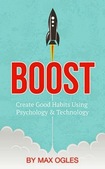
Boost: Create Good Habits Using Psychology and Technology
Author: Max Ogles
ISBN: 13: 978-1505245059
APA Style Citation
Ogles, M. (2014). Boost: Create Good Habits Using Psychology and Technology.
Author: Max Ogles
ISBN: 13: 978-1505245059
APA Style Citation
Ogles, M. (2014). Boost: Create Good Habits Using Psychology and Technology.

| boost-open_your_class_with_this_tomorrow.pdf |
Book Description
Part I: How to Create Good Habits
Boost is a great book for an introductory psychology student. It may serve as a good summer reading assignment prior to the start of the school year and is appropriate for any student regardless of reading level or prior experience with psychology. The Kindle version of the book is free through Amazon (paperback $7.99). The book also comes with a free app to follow through on the recommendations made throughout the book (see resources). Author Max Ogles is a technology entrepreneur who has created a variety of behavioral modification programs, web platforms, and apps. He is not an academic psychologist, but seeks to combine technology and psychology in a way that will help to improve people’s daily lives in realistic and simple ways. The book is broken into eight chapters and each ends with a quick summary of the main points and a recommendation for an app that can help to facilitate the life change highlighted in the chapter. The two largest sections of the book are, How to Start Habits and How to Make Habits Last.
Ogles discusses that when setting a goal, regardless of how lofty, one must begin with a reasonable smaller goal that can eventually evolve into a larger goal. Ogles recounts a time in which he was determined to run a marathon but had to begin by running 3 or 4 miles at a time before he could even begin to consider 26.2 miles. Smaller goals are incredibly important in moving towards larger goals because without them, the goal seems too distant and is often insurmountable. Researchers at the University of Toronto found that those who set reasonable proximal goals were more likely to be successful in reaching larger distal goals. These principles can easily be applied to any goal, such as reading more often, doing “spring cleaning”, engaging in more healthy activities, or eating better.
Technology is a part of our everyday world, and although we often hear about how it detracts from attention or studying, Ogles focuses on how technology can help us to become more efficient and successful in reaching the goals we identify as important. Ogles describes a platform called If This Then That (IFTTT). Registering is easy and free, because you simply select channels that are of interest to you such as Recipes for a Healthy Lifestyle or Manage your Social Media, and create an If This Then That alert system that focuses on your particular interests by sending you updates through your phone or social media accounts. These triggers are intended to provide alerts to help individuals live better and more efficiently by keeping up with news stories that meet their specific interests. Often triggers such as going out to dinner causes us to eat poorly, or our favorite television show causes us to sit for too long rather than exercise. Pavlov’s classic studies regarding conditioning demonstrate the value of triggers and expectations in behavior and we can use this knowledge to help create triggers that lead to healthy living while removing triggers that are detrimental. Triggers can be internal or external and while IFTTT focuses on external triggers with time and experience we can internalize these connections.
University of Rochester psychologists Todd Thrash and Andrew Elliot created a framework to study inspiration. They examined over 30 personality traits to determine which traits were most closely linked to inspiration. They found that openness to experience, self-esteem, and creativity were the top traits associated with inspiration. While some individuals believe that these characteristics are predetermined, Ogles provides recommendations for slowly developing or increasing these traits. To become more open, try a new food, listen to a new radio station, or go to a new restaurant. To improve self-esteem, stop comparing yourself to others who have more than you, instead, focus on the things you have and appreciate them. A gratitude log is a good way to change one’s focus from what they do not have to what they do. There is an app that allows you to keep a gratitude journal on your phone, Gratitude Journal for iPhone (see resources). In order to increase creativity, Ogles recommends limiting iPhone use with an app called Mobile Flow (see resources), which eliminates distractions by limiting your smart phone functionality, allowing you more time to be creative (creativity often strikes when we are not otherwise engaged). He also encourages readers to try something they have never tried before such as a new activity, traveling to a new place, or reading a book that is about a topic you might otherwise not have picked up.
Ogles recommends delivering rewards on a variable-ratio schedule to encourage the continuation of a desired behavior and explains how his psychologist father used to reward he and his sisters periodically for playing the piano as children to encourage their musical behavior. He also recommends providing rewards early and removing them if the desired behavior is not performed. Because of people’s inherent distaste for loss, it is more likely that the behavior will continue. Stickk.com (see resources) allows you to set a goal and identify a charity you would like to send money to if you do not reach your goal. This app acts on loss aversion and allows the charity of your choice to benefit from your loss if you do not live up to your goals. Ogles does warn about the overjustification effect and encourages people to check in frequently to make sure that the goal they have set is truly what they want to accomplish.
Part II: Why Good Habits Don't Last
Ogles cites the numbers of individuals who have heart bypass surgery each year, many of whom can prevent future heart attacks by improving their exercise and diet. Very few of these people succeed at changing these habits, in part because they are so well engrained and as such difficult to change. Ogles cites his own failed attempt at running. Often we fail at these types of goals because we do not truly enjoy eating healthy or going for a run, but we know we should do it, even as we dread each moment. We often overestimate our own self-control and fail as a result. Two recommendations for making activities more enjoyable are to simplify the activity (if you want to eat healthier begin with eating a single piece of kale) and changing your attitude (smile while your doing the activity even if you are not enjoying it). Ogles also recommends trying to find others who are involved in the same activities that you want to improve on. The Internet is a great source for social networking with those that you have a common interest. If you have a fit bit, connect with other friends and make your fitness goals public. The community of support and contact with others trying to reach a similar goal can make the goal more attainable. The Coach.me app (see resources) allows you to find someone, often at no cost that can help you achieve your goal.
Because helping others actually makes us feel better, altruism is a great way to help others and ourselves at the same time. Research suggests that those who donate time and/or money to charity actually make more money themselves. This holds true even when accounting for socioeconomic and familial differences. An app that can serve this dual goal is www.charitymiles.org. This app uses the GPS on your phone to track the distance of your run and donates money from corporate sponsors to charities who pay for each mile that you run.
Ogles indicates that in order to reach one’s goals, frequently checking in is also extremely important. While often individuals focus only on whether or not the behavior was completed, he indicates that the quality of the behavior is equally important. If a student has a goal of completing their homework each night before they watch television, but the quality of their homework is poor, they have not really accomplished their goal. Ogles recommends a quality check, which might be as simple as a three point system (1-completed task, 2-completed task well, 3-completed the task to the best of my ability). In addition, he encourages people to not think of goals as binary. He uses the example of an individual who wants to stop drinking Coke; they have a bad day at work and have a coke when they get home. This might be considered a failure but there must be leniency in goal setting. This person might say, “I will allow myself a one cheat day” and then they can maintain the desired behavior even after the perceived “failure”. Keep checking in and asking, “how often am I exhibiting the desired behavior and how well am I doing it”? These simple questions will help to stay on track. Ogles has created an accessible book that can help individuals change their life for the better in simple and well-described steps. The technology resources available should help create habits and may appeal to the psychology student of today who is connected to their technology to guide and inform their life decisions more than ever before.
Other Related Resources
Book Website: 117 apps to help you create good habits
http://maxogles.com/exclusive
Max Ogles Blog:
http://www.maxogles.com
Max Ogles Facebook:
http://www/facebook.com/max.ogles
Twitter
http://www/twitter.com/maxogles
Apps
If This Then That: An app that sends alerts to create triggers that promote desired behaviors.
https://ifttt.com/recipes
Gratitude Journal for iPhone: An app that can be used to reduce the impact of relative deprivation and improve self-esteem.
http://getgratitude.co
Mobile Flow: An app that limits the functionality of an iPhone to increase focus and creativity.
http://www.themobileflow.com
Stickk.com: An app that works on loss aversion by allowing having you donate money to a charity of your choosing if you do not reach your goal.
http://www.stickk.com
Coach.me: An app that can find someone who is an expert in the area in which you wish to improve who can provide support and expertise to you while you pursue a goal.
http://www.coach.me
Charity Miles: An app that donates money to a charity of your choice for each mile you run by accessing the GPS on your phone.
www.charitymiles.org
Psychological Figures and Concepts
Solomon Asch
Ivan Pavlov
B.F. Skinner
Altruism
Conformity
Creativity
Facial-Feedback Hypothesis
Goals (Proximal and Distal)
Goal-Setting
Intrinsic Motivation
Loss Aversion
Motivation
Openness to Experience
Overjustification Effect
Relative Deprivation
Self-Control
Self-Esteem
Variable-Ratio Schedules of Reinforcement
Part I: How to Create Good Habits
Boost is a great book for an introductory psychology student. It may serve as a good summer reading assignment prior to the start of the school year and is appropriate for any student regardless of reading level or prior experience with psychology. The Kindle version of the book is free through Amazon (paperback $7.99). The book also comes with a free app to follow through on the recommendations made throughout the book (see resources). Author Max Ogles is a technology entrepreneur who has created a variety of behavioral modification programs, web platforms, and apps. He is not an academic psychologist, but seeks to combine technology and psychology in a way that will help to improve people’s daily lives in realistic and simple ways. The book is broken into eight chapters and each ends with a quick summary of the main points and a recommendation for an app that can help to facilitate the life change highlighted in the chapter. The two largest sections of the book are, How to Start Habits and How to Make Habits Last.
Ogles discusses that when setting a goal, regardless of how lofty, one must begin with a reasonable smaller goal that can eventually evolve into a larger goal. Ogles recounts a time in which he was determined to run a marathon but had to begin by running 3 or 4 miles at a time before he could even begin to consider 26.2 miles. Smaller goals are incredibly important in moving towards larger goals because without them, the goal seems too distant and is often insurmountable. Researchers at the University of Toronto found that those who set reasonable proximal goals were more likely to be successful in reaching larger distal goals. These principles can easily be applied to any goal, such as reading more often, doing “spring cleaning”, engaging in more healthy activities, or eating better.
Technology is a part of our everyday world, and although we often hear about how it detracts from attention or studying, Ogles focuses on how technology can help us to become more efficient and successful in reaching the goals we identify as important. Ogles describes a platform called If This Then That (IFTTT). Registering is easy and free, because you simply select channels that are of interest to you such as Recipes for a Healthy Lifestyle or Manage your Social Media, and create an If This Then That alert system that focuses on your particular interests by sending you updates through your phone or social media accounts. These triggers are intended to provide alerts to help individuals live better and more efficiently by keeping up with news stories that meet their specific interests. Often triggers such as going out to dinner causes us to eat poorly, or our favorite television show causes us to sit for too long rather than exercise. Pavlov’s classic studies regarding conditioning demonstrate the value of triggers and expectations in behavior and we can use this knowledge to help create triggers that lead to healthy living while removing triggers that are detrimental. Triggers can be internal or external and while IFTTT focuses on external triggers with time and experience we can internalize these connections.
University of Rochester psychologists Todd Thrash and Andrew Elliot created a framework to study inspiration. They examined over 30 personality traits to determine which traits were most closely linked to inspiration. They found that openness to experience, self-esteem, and creativity were the top traits associated with inspiration. While some individuals believe that these characteristics are predetermined, Ogles provides recommendations for slowly developing or increasing these traits. To become more open, try a new food, listen to a new radio station, or go to a new restaurant. To improve self-esteem, stop comparing yourself to others who have more than you, instead, focus on the things you have and appreciate them. A gratitude log is a good way to change one’s focus from what they do not have to what they do. There is an app that allows you to keep a gratitude journal on your phone, Gratitude Journal for iPhone (see resources). In order to increase creativity, Ogles recommends limiting iPhone use with an app called Mobile Flow (see resources), which eliminates distractions by limiting your smart phone functionality, allowing you more time to be creative (creativity often strikes when we are not otherwise engaged). He also encourages readers to try something they have never tried before such as a new activity, traveling to a new place, or reading a book that is about a topic you might otherwise not have picked up.
Ogles recommends delivering rewards on a variable-ratio schedule to encourage the continuation of a desired behavior and explains how his psychologist father used to reward he and his sisters periodically for playing the piano as children to encourage their musical behavior. He also recommends providing rewards early and removing them if the desired behavior is not performed. Because of people’s inherent distaste for loss, it is more likely that the behavior will continue. Stickk.com (see resources) allows you to set a goal and identify a charity you would like to send money to if you do not reach your goal. This app acts on loss aversion and allows the charity of your choice to benefit from your loss if you do not live up to your goals. Ogles does warn about the overjustification effect and encourages people to check in frequently to make sure that the goal they have set is truly what they want to accomplish.
Part II: Why Good Habits Don't Last
Ogles cites the numbers of individuals who have heart bypass surgery each year, many of whom can prevent future heart attacks by improving their exercise and diet. Very few of these people succeed at changing these habits, in part because they are so well engrained and as such difficult to change. Ogles cites his own failed attempt at running. Often we fail at these types of goals because we do not truly enjoy eating healthy or going for a run, but we know we should do it, even as we dread each moment. We often overestimate our own self-control and fail as a result. Two recommendations for making activities more enjoyable are to simplify the activity (if you want to eat healthier begin with eating a single piece of kale) and changing your attitude (smile while your doing the activity even if you are not enjoying it). Ogles also recommends trying to find others who are involved in the same activities that you want to improve on. The Internet is a great source for social networking with those that you have a common interest. If you have a fit bit, connect with other friends and make your fitness goals public. The community of support and contact with others trying to reach a similar goal can make the goal more attainable. The Coach.me app (see resources) allows you to find someone, often at no cost that can help you achieve your goal.
Because helping others actually makes us feel better, altruism is a great way to help others and ourselves at the same time. Research suggests that those who donate time and/or money to charity actually make more money themselves. This holds true even when accounting for socioeconomic and familial differences. An app that can serve this dual goal is www.charitymiles.org. This app uses the GPS on your phone to track the distance of your run and donates money from corporate sponsors to charities who pay for each mile that you run.
Ogles indicates that in order to reach one’s goals, frequently checking in is also extremely important. While often individuals focus only on whether or not the behavior was completed, he indicates that the quality of the behavior is equally important. If a student has a goal of completing their homework each night before they watch television, but the quality of their homework is poor, they have not really accomplished their goal. Ogles recommends a quality check, which might be as simple as a three point system (1-completed task, 2-completed task well, 3-completed the task to the best of my ability). In addition, he encourages people to not think of goals as binary. He uses the example of an individual who wants to stop drinking Coke; they have a bad day at work and have a coke when they get home. This might be considered a failure but there must be leniency in goal setting. This person might say, “I will allow myself a one cheat day” and then they can maintain the desired behavior even after the perceived “failure”. Keep checking in and asking, “how often am I exhibiting the desired behavior and how well am I doing it”? These simple questions will help to stay on track. Ogles has created an accessible book that can help individuals change their life for the better in simple and well-described steps. The technology resources available should help create habits and may appeal to the psychology student of today who is connected to their technology to guide and inform their life decisions more than ever before.
Other Related Resources
Book Website: 117 apps to help you create good habits
http://maxogles.com/exclusive
Max Ogles Blog:
http://www.maxogles.com
Max Ogles Facebook:
http://www/facebook.com/max.ogles
http://www/twitter.com/maxogles
Apps
If This Then That: An app that sends alerts to create triggers that promote desired behaviors.
https://ifttt.com/recipes
Gratitude Journal for iPhone: An app that can be used to reduce the impact of relative deprivation and improve self-esteem.
http://getgratitude.co
Mobile Flow: An app that limits the functionality of an iPhone to increase focus and creativity.
http://www.themobileflow.com
Stickk.com: An app that works on loss aversion by allowing having you donate money to a charity of your choosing if you do not reach your goal.
http://www.stickk.com
Coach.me: An app that can find someone who is an expert in the area in which you wish to improve who can provide support and expertise to you while you pursue a goal.
http://www.coach.me
Charity Miles: An app that donates money to a charity of your choice for each mile you run by accessing the GPS on your phone.
www.charitymiles.org
Psychological Figures and Concepts
Solomon Asch
Ivan Pavlov
B.F. Skinner
Altruism
Conformity
Creativity
Facial-Feedback Hypothesis
Goals (Proximal and Distal)
Goal-Setting
Intrinsic Motivation
Loss Aversion
Motivation
Openness to Experience
Overjustification Effect
Relative Deprivation
Self-Control
Self-Esteem
Variable-Ratio Schedules of Reinforcement
 RSS Feed