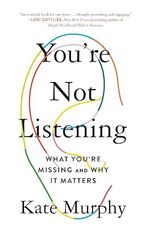
You’re Not Listening: What You’re Missing and Why It Matters
Author: Kate Murphy
ISBN-10: 1250779871
ISBN-13: 978-1250779878
APA Style Citation
Murphy, K. (2019). You’re not listening: What you’re missing and why it matters. Celadon Books.
Buy This Book
https://www.amazon.com/Youre-Not-Listening-Missing-Matters/dp/1250779871
Author: Kate Murphy
ISBN-10: 1250779871
ISBN-13: 978-1250779878
APA Style Citation
Murphy, K. (2019). You’re not listening: What you’re missing and why it matters. Celadon Books.
Buy This Book
https://www.amazon.com/Youre-Not-Listening-Missing-Matters/dp/1250779871

| youre_not_listening_activity.pdf |
Book Description
In today's fast-paced culture, the art of listening is often overshadowed by the clamor of speaking. However, author Kate Murphy argues that listening may, in fact, be more crucial than speaking. Listening transcends mere auditory reception; it entails attentiveness and thoughtful response. Through effective listening, individuals can revolutionize their lives, fostering wisdom and deep connections with others. Murphy delves into the research on listening and shares insights gleaned from various interviews.
Loneliness Epidemic: Researchers warn of a growing epidemic of loneliness in modern society, affecting individuals despite their online connections. The essence of connectedness lies in reciprocal listening and response. Instances like the hiring of actors by companies in Japan to provide companionship highlight the dire consequences of a lack of genuine listening. Loneliness is a pervasive issue that impacts individuals regardless of gender or age. Generation Z, being the first to grow up immersed in digital screens, faces heightened levels of loneliness compared to other generations.
Neuroscience of Listening: Studies utilizing fMRI scans have unveiled a significant correlation between the synchronization of brain activity in both speaker and listener and the effectiveness of communication. This phenomenon underscores the profound influence of our social interactions on cognitive processes. Attachment theory sheds light on this, suggesting that our capacity for listening and forming connections in adulthood is deeply rooted in early experiences. From the moment we are born, there exists an innate desire for our brains to sync with others, laying the foundation for how we perceive, think, and react based on the individuals we listen to and connect with throughout our lives. Our upbringing undoubtedly shapes our initial approach to relationships, but it does not determine our destiny. Through conscious effort and practice, people can improve their listening skills.
Challenges of Listening: Defining listening proves challenging, but curiosity emerges as a crucial element. Securely attached individuals exhibit curiosity and a greater openness to new information and experiences, mitigating loneliness. In long-term relationships, there's a tendency for individuals to lose their curiosity about each other, leading to a lack of attentive listening. Assumptions often act as barriers, hindering genuine understanding. True listening goes beyond mere nods or surface-level responses; it involves providing descriptive and evaluative feedback. It's a skill that requires awareness, focus, and experience to decipher the underlying messages effectively.
Obstacles to Effective Listening: The speech-thought differential highlights our tendency to think faster than others speak, leading to mental distractions during conversations. Effective listening involves constantly evaluating the validity of others' messages and understanding their motivations. Listening to opposing views triggers a response similar to being chased by a bear, as evidenced by brain scans showing heightened activity in threat-response regions. Individuals with an overactive amygdala find it particularly difficult to engage in careful listening. However, embracing opposing views is essential for personal growth. Coping with contradictory ideas and gray areas is essential for personal growth and understanding.
Self-Listening and Internal Dialogue: The way you engage in internal dialogue significantly influences how you perceive and interpret others' words. Individuals with a critical inner voice may interpret external communication differently from those with a tendency to blame others internally. Despite its importance, people often avoid introspection. Cognitive behavioral therapy offers strategies to modify self-talk, thereby enhancing interpersonal understanding and communication. When someone shares their feelings, it's important to provide support rather than solutions. Good listeners understand the value of asking meaningful questions and recognize that individuals reveal their true selves through their words and actions.
Physical and Emotional Aspects of Listening: The interplay between auditory processing, attention spans, and social dynamics reveals the intricate relationship between communication, distraction, and interpersonal connections in modern society. The right-ear advantage highlights the complexities of language comprehension and emotional perception. While, distractions, exemplified by declining attention spans and incessant device usage, undermines meaningful communication. Embracing silence emerges as a counterbalance, with cultures like Japan and Nordic countries valuing it as a sign of deeper relationships.
In conclusion, the skill of listening, often neglected in today's digital age, holds immense transformative power. Through genuine listening, individuals can combat loneliness, foster understanding, and deepen connections with others. Developing exceptional listening skills requires awareness, patience, and consistent practice akin to honing a sport or musical instrument. While total mastery may be unattainable, everyone can benefit from the effort!
Other Related Resources
Author’s Website
https://www.journalistkatemurphy.com/
BookLab by Bjorn- 7 Key Lessons from You’re Not Listening by Kate Murphy | Book Review
https://www.youtube.com/watch?v=Biw7NUJVo84
The Guardian- You’re Not Listening by Kate Murphy review – a modern epidemic of self-absorbed talk
https://www.theguardian.com/books/2020/jan/11/youre-not-listening-kate-murphy-review
Psychological Concepts and Figures
Judith Coche
Charles Darwin
Sigmund Freud
Carl Jung
Daniel Kahneman
Jean Piaget
Carl Rogers
Oliver Sacks
Amos Tversky
Robert Zajonc
Active listening
Algorithms
Amygdala
Auditory cortex
Closeness-communication bias
Cognitive behavioral therapy
Cognitive complexity
Cohort
Collective monologue
Confirmation bias
Conversational sensitivity
Couples group therapy
Dopamine
Dunbar’s number
Expectancy bias
fMRI
Focused interview
Linguistic relativity
McGurk Effect
Qualitative research
Quantitative research
Secure attachment
Self-monitoring
Social exchange theory
Vestibular system
Wernicke’s area
In today's fast-paced culture, the art of listening is often overshadowed by the clamor of speaking. However, author Kate Murphy argues that listening may, in fact, be more crucial than speaking. Listening transcends mere auditory reception; it entails attentiveness and thoughtful response. Through effective listening, individuals can revolutionize their lives, fostering wisdom and deep connections with others. Murphy delves into the research on listening and shares insights gleaned from various interviews.
Loneliness Epidemic: Researchers warn of a growing epidemic of loneliness in modern society, affecting individuals despite their online connections. The essence of connectedness lies in reciprocal listening and response. Instances like the hiring of actors by companies in Japan to provide companionship highlight the dire consequences of a lack of genuine listening. Loneliness is a pervasive issue that impacts individuals regardless of gender or age. Generation Z, being the first to grow up immersed in digital screens, faces heightened levels of loneliness compared to other generations.
Neuroscience of Listening: Studies utilizing fMRI scans have unveiled a significant correlation between the synchronization of brain activity in both speaker and listener and the effectiveness of communication. This phenomenon underscores the profound influence of our social interactions on cognitive processes. Attachment theory sheds light on this, suggesting that our capacity for listening and forming connections in adulthood is deeply rooted in early experiences. From the moment we are born, there exists an innate desire for our brains to sync with others, laying the foundation for how we perceive, think, and react based on the individuals we listen to and connect with throughout our lives. Our upbringing undoubtedly shapes our initial approach to relationships, but it does not determine our destiny. Through conscious effort and practice, people can improve their listening skills.
Challenges of Listening: Defining listening proves challenging, but curiosity emerges as a crucial element. Securely attached individuals exhibit curiosity and a greater openness to new information and experiences, mitigating loneliness. In long-term relationships, there's a tendency for individuals to lose their curiosity about each other, leading to a lack of attentive listening. Assumptions often act as barriers, hindering genuine understanding. True listening goes beyond mere nods or surface-level responses; it involves providing descriptive and evaluative feedback. It's a skill that requires awareness, focus, and experience to decipher the underlying messages effectively.
Obstacles to Effective Listening: The speech-thought differential highlights our tendency to think faster than others speak, leading to mental distractions during conversations. Effective listening involves constantly evaluating the validity of others' messages and understanding their motivations. Listening to opposing views triggers a response similar to being chased by a bear, as evidenced by brain scans showing heightened activity in threat-response regions. Individuals with an overactive amygdala find it particularly difficult to engage in careful listening. However, embracing opposing views is essential for personal growth. Coping with contradictory ideas and gray areas is essential for personal growth and understanding.
Self-Listening and Internal Dialogue: The way you engage in internal dialogue significantly influences how you perceive and interpret others' words. Individuals with a critical inner voice may interpret external communication differently from those with a tendency to blame others internally. Despite its importance, people often avoid introspection. Cognitive behavioral therapy offers strategies to modify self-talk, thereby enhancing interpersonal understanding and communication. When someone shares their feelings, it's important to provide support rather than solutions. Good listeners understand the value of asking meaningful questions and recognize that individuals reveal their true selves through their words and actions.
Physical and Emotional Aspects of Listening: The interplay between auditory processing, attention spans, and social dynamics reveals the intricate relationship between communication, distraction, and interpersonal connections in modern society. The right-ear advantage highlights the complexities of language comprehension and emotional perception. While, distractions, exemplified by declining attention spans and incessant device usage, undermines meaningful communication. Embracing silence emerges as a counterbalance, with cultures like Japan and Nordic countries valuing it as a sign of deeper relationships.
In conclusion, the skill of listening, often neglected in today's digital age, holds immense transformative power. Through genuine listening, individuals can combat loneliness, foster understanding, and deepen connections with others. Developing exceptional listening skills requires awareness, patience, and consistent practice akin to honing a sport or musical instrument. While total mastery may be unattainable, everyone can benefit from the effort!
Other Related Resources
Author’s Website
https://www.journalistkatemurphy.com/
BookLab by Bjorn- 7 Key Lessons from You’re Not Listening by Kate Murphy | Book Review
https://www.youtube.com/watch?v=Biw7NUJVo84
The Guardian- You’re Not Listening by Kate Murphy review – a modern epidemic of self-absorbed talk
https://www.theguardian.com/books/2020/jan/11/youre-not-listening-kate-murphy-review
Psychological Concepts and Figures
Judith Coche
Charles Darwin
Sigmund Freud
Carl Jung
Daniel Kahneman
Jean Piaget
Carl Rogers
Oliver Sacks
Amos Tversky
Robert Zajonc
Active listening
Algorithms
Amygdala
Auditory cortex
Closeness-communication bias
Cognitive behavioral therapy
Cognitive complexity
Cohort
Collective monologue
Confirmation bias
Conversational sensitivity
Couples group therapy
Dopamine
Dunbar’s number
Expectancy bias
fMRI
Focused interview
Linguistic relativity
McGurk Effect
Qualitative research
Quantitative research
Secure attachment
Self-monitoring
Social exchange theory
Vestibular system
Wernicke’s area
 RSS Feed