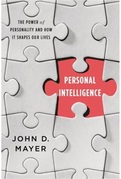
Author: John D. Mayer
ISBN: 978-0-374-23085-2
APA Style Citation
Mayer, J. (2014). Personal Intelligence: The Power of Personality and How it Shapes out Lives. New York, New York: Scientific America/Farrar, Straus and Giroux.
ISBN: 978-0-374-23085-2
APA Style Citation
Mayer, J. (2014). Personal Intelligence: The Power of Personality and How it Shapes out Lives. New York, New York: Scientific America/Farrar, Straus and Giroux.

| open_your_class_4_per_int.pdf |
Book Description
John Mayer’s research is perhaps most well known for serving as the basis for Daniel Goleman’s book Emotional Intelligence, but he argues that while personal and emotional intelligence overlap, they are indeed different entities. Compared with personal intelligence, emotional Intelligence involves a more specific ability to perceive, understand and reason about emotion and it draws upon different brain areas than personal intelligence.
Personal Intelligence opens with an evolutionary explanation regarding the benefits for longevity if one determines how to read and respond well to others. Individuals with this skill are likely to have more positive interactions and ultimately live longer. Mayer describes the historical contributions of Freud, Jung, Adler, and Allport to the history of personality analysis. He defines personal intelligence as “a mental capacity we use to guide our lives – to reason about ourselves and other people and to draw out information about personality and reason about it.” In new situations we often use past experiences to deduce what a person’s appearance, possessions, and behaviors may indicate about that individual. Mayer believes that there are four main areas involved with personal intelligence: identifying information, forming models, guiding personal choices, and systemizing plans. Personal intelligence allows us to decode faces, judge the traits and motives of others, and interact with them smoothly. Individuals high in personal intelligence evaluate others more accurately while also recognizing their own limitations and identifying areas for potential personal growth. These individuals also recognize the usefulness of revising one’s perception of others when necessary to adjust for errors in judgment or changes in others personalities.
Mayer addresses the need for empirical testing to avoid the criticism found with other personality theories such as Howard Gardner’s multiple intelligences, and provides evidence that brain science can tell us much about personality just as it has with other personal characteristics. He cites a study that allowed observers into the living quarters of individuals who then made assumptions about the dwellers personalities. Those with higher levels of personal intelligence were more accurate in their assessments of those who lived in the spaces that were viewed.
Personal intelligence also relates to the construction of our own identities (self-knowledge), which are constructed from social feedback, observing our own conduct, and looking inward. Those high in personal intelligence know when their feelings are more or less trustworthy and accept information important to their self-image regardless of whether is might be positive or critical. High levels of personal intelligence also motivates individuals to seek careers that best match their personalities and allows them learn to adapt to new situations. Mayer uses the example of Beethoven, who once he realized he was going deaf, learned to play music based on vibrations. As he learned to overcome his own personal challenge he also improved his personal intelligence because he became more compassionate and understanding of others. Those with high personal intelligence set reasonable and obtainable goals and are aware of their own limits and constraints. They also can picture their future selves, which may cause them to behave in the present more closely to the way they wish to behave.
Mayer addresses the interactions of genetic and environmental interactions in the development of personal intelligence, but he is careful to point out that genes do not impact behavior directly. Mirror neurons might play an important role in one’s ability to read and respond to others well and those who are easily able to do this have smoother interactions with others. Individuals with autism may have trouble with mirror neurons and as a result have more difficulty with reading others and interacting in a socially appropriate manner and generally score much lower in personal intelligence assessments. While these individuals can learn to improve social interactions, their genes may limit their potential growth.
Mayer and his colleague Peter Caruso created the Test of Personal Intelligence (TOPI) to measure skills associated with personal intelligence such as detecting cues about other people, understanding traits, and evaluating a person’s goals. Individuals who score high in one category generally also score high in other categories. Some personalities such as narcissists however score low on the TOPI scales in part because they lack the skill to accurately evaluate personality in themselves and others.
In addition to introducing and explaining the concept of personal intelligence, this book provides a concise review of the history and changing philosophies regarding personality. It is a great resource for psychology instructors to supplement information in the both the personality and history of psychology units.
Other Related Resources
Personal Intelligence “The Quiz”
http://personalintelligence.info/the-quiz/topi-demo-abc/
Journal of Imagination, Cognition and Personality: Vol. 27 (3) 209-232, 2007-2008.
Personal Intelligence
Practical Intelligence Can Mean the Difference: Society for Industrial and Organizational Psychology
http://www.siop.org/Media/News/practical.aspx
Psychological Figures and Concepts
Solomon Asch
Alfred Adler
Gordon Allport
Daryl Bem
Alfred Binet
David Buss
Paul Costa and Robert McCrae
Angela Duckworth
Erik Erikson
Sigmund Freud
Howard Gardner
William James
Carl Jung
Abraham Maslow
Henry Murray
Carl Rogers
Charles Spearman
Robert Sternberg
Edward Thorndike
Wilhelm Wundt
Philip Zimbardo
Overjustification effect
The Big Five
Factor analysis
Procedural/semantic/episodic memories
Stream of consciousness
Defense mechanisms
Thematic Apperception Test
Moral development
Individualistic vs. Collectivist cultures
Mirror neurons
False-belief test
Grit
John Mayer’s research is perhaps most well known for serving as the basis for Daniel Goleman’s book Emotional Intelligence, but he argues that while personal and emotional intelligence overlap, they are indeed different entities. Compared with personal intelligence, emotional Intelligence involves a more specific ability to perceive, understand and reason about emotion and it draws upon different brain areas than personal intelligence.
Personal Intelligence opens with an evolutionary explanation regarding the benefits for longevity if one determines how to read and respond well to others. Individuals with this skill are likely to have more positive interactions and ultimately live longer. Mayer describes the historical contributions of Freud, Jung, Adler, and Allport to the history of personality analysis. He defines personal intelligence as “a mental capacity we use to guide our lives – to reason about ourselves and other people and to draw out information about personality and reason about it.” In new situations we often use past experiences to deduce what a person’s appearance, possessions, and behaviors may indicate about that individual. Mayer believes that there are four main areas involved with personal intelligence: identifying information, forming models, guiding personal choices, and systemizing plans. Personal intelligence allows us to decode faces, judge the traits and motives of others, and interact with them smoothly. Individuals high in personal intelligence evaluate others more accurately while also recognizing their own limitations and identifying areas for potential personal growth. These individuals also recognize the usefulness of revising one’s perception of others when necessary to adjust for errors in judgment or changes in others personalities.
Mayer addresses the need for empirical testing to avoid the criticism found with other personality theories such as Howard Gardner’s multiple intelligences, and provides evidence that brain science can tell us much about personality just as it has with other personal characteristics. He cites a study that allowed observers into the living quarters of individuals who then made assumptions about the dwellers personalities. Those with higher levels of personal intelligence were more accurate in their assessments of those who lived in the spaces that were viewed.
Personal intelligence also relates to the construction of our own identities (self-knowledge), which are constructed from social feedback, observing our own conduct, and looking inward. Those high in personal intelligence know when their feelings are more or less trustworthy and accept information important to their self-image regardless of whether is might be positive or critical. High levels of personal intelligence also motivates individuals to seek careers that best match their personalities and allows them learn to adapt to new situations. Mayer uses the example of Beethoven, who once he realized he was going deaf, learned to play music based on vibrations. As he learned to overcome his own personal challenge he also improved his personal intelligence because he became more compassionate and understanding of others. Those with high personal intelligence set reasonable and obtainable goals and are aware of their own limits and constraints. They also can picture their future selves, which may cause them to behave in the present more closely to the way they wish to behave.
Mayer addresses the interactions of genetic and environmental interactions in the development of personal intelligence, but he is careful to point out that genes do not impact behavior directly. Mirror neurons might play an important role in one’s ability to read and respond to others well and those who are easily able to do this have smoother interactions with others. Individuals with autism may have trouble with mirror neurons and as a result have more difficulty with reading others and interacting in a socially appropriate manner and generally score much lower in personal intelligence assessments. While these individuals can learn to improve social interactions, their genes may limit their potential growth.
Mayer and his colleague Peter Caruso created the Test of Personal Intelligence (TOPI) to measure skills associated with personal intelligence such as detecting cues about other people, understanding traits, and evaluating a person’s goals. Individuals who score high in one category generally also score high in other categories. Some personalities such as narcissists however score low on the TOPI scales in part because they lack the skill to accurately evaluate personality in themselves and others.
In addition to introducing and explaining the concept of personal intelligence, this book provides a concise review of the history and changing philosophies regarding personality. It is a great resource for psychology instructors to supplement information in the both the personality and history of psychology units.
Other Related Resources
Personal Intelligence “The Quiz”
http://personalintelligence.info/the-quiz/topi-demo-abc/
Journal of Imagination, Cognition and Personality: Vol. 27 (3) 209-232, 2007-2008.
Personal Intelligence
Practical Intelligence Can Mean the Difference: Society for Industrial and Organizational Psychology
http://www.siop.org/Media/News/practical.aspx
Psychological Figures and Concepts
Solomon Asch
Alfred Adler
Gordon Allport
Daryl Bem
Alfred Binet
David Buss
Paul Costa and Robert McCrae
Angela Duckworth
Erik Erikson
Sigmund Freud
Howard Gardner
William James
Carl Jung
Abraham Maslow
Henry Murray
Carl Rogers
Charles Spearman
Robert Sternberg
Edward Thorndike
Wilhelm Wundt
Philip Zimbardo
Overjustification effect
The Big Five
Factor analysis
Procedural/semantic/episodic memories
Stream of consciousness
Defense mechanisms
Thematic Apperception Test
Moral development
Individualistic vs. Collectivist cultures
Mirror neurons
False-belief test
Grit

 RSS Feed