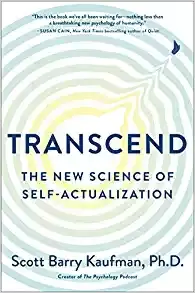
Transcend: The New Science of Self-Actualization
Author: Scott Barry Kaufman
ISBN-10: 0143131206
ISBN-13: 978-0143131205
APA Style Citation
Kaufman, S.B. (2020). Transcend: The new science of self-actualization. New York, NY: Tarcher Perigee.
Buy This Book
https://www.amazon.com/Transcend-Self-Actualization-Scott-Barry-Kaufman/dp/014313120
Author: Scott Barry Kaufman
ISBN-10: 0143131206
ISBN-13: 978-0143131205
APA Style Citation
Kaufman, S.B. (2020). Transcend: The new science of self-actualization. New York, NY: Tarcher Perigee.
Buy This Book
https://www.amazon.com/Transcend-Self-Actualization-Scott-Barry-Kaufman/dp/014313120

| transcend_activity.pdf |
Book Description
Many individuals studying psychology are familiar with Maslow’s Hierarchy of Needs. But who was this man and how many levels truly exist in his hierarchy? Transcend: The New Science of Self-actualization, written by Scott Kaufman, offers a short biography seamlessly blended with an exploration of Maslow’s theories that laid the foundation of humanistic psychology and modern research.
Maslow was the eldest son of Russian Jewish immigrants. He was bullied as a kid and went on to dedicate his life to social change. At age 19, Maslow had a life-changing experience. While attending a college class (that he eventually dropped claiming it was too hard) he learned of folkways and was bitten by the anthropology bug. Shortly after, he transferred to the University of Wisconsin Madison. In 1930, Maslow was just three years younger than his 24- year-old professor Harry Harlow, and they would go on to become dear friends. After reading Freud’s Interpretation of Dreams, Maslow was drawn to psychoanalysis. He approached Harlow to empirically test the ideas of Freud and Adler. It was then that Maslow began researching sex and dominance in monkeys. His work impressed Thorndike, a behaviorial psychologist who’s work on learning theory led to operant conditioning, who invited him to come to Columbia University to work as his postdoctoral fellow. That same year Adler also moved to New York City and hosted weekly get togethers. After asking about his connection to Freud, Adler became visibly angry and Maslow was embarrassed. At a later meeting, Adler questioned Maslow’s loyalty and Maslow never attended another meeting. Later that year Adler had a heart attack and died. Maslow had a great deal of regret about his final interaction with Adler. In 1938, Maslow spent the summer among the Northern Blackfoot Indians in Alberta, Canada. This experience influenced his perception of human nature. He believed all humans were basically good, but society changes this natural personality. From 1935-1945, Maslow learned from some of the most influential psychologists and anthropologists of his generation and many become his friends: Alfred Adler, Erich Fromm, Karen Horney, Bela Mittlemann, Emil Oberholzer, Abran Kdariner, David Levy, Max Wertheimer, Kurt Koffka, Kurt Goldstein, Ruth Benedict, and Margaret Mead to name a few.
Another life-changing experience came shortly after the United States entered WWII. Maslow felt we didn’t understand the Fascists or Communists and devoted his life to discovering a psychology for the peace table. He used his varied experiences to create his theory of human motivation. In 1943, he used the phrase “self-actualization” referring to the desire for self-fulfillment. He believed everyone should be self-actualizing, and it was the society that impacted them. For him, the self-actualizing man was not an ordinary man with something added, but the ordinary man with nothing taken away. He studied personal acquaintances and friends, college students, and public and historical figures. He acknowledged the limitations of this methodology but hoped to inspire further study. It has been almost 70 years since he published his list of self-actualization characteristics, but ten can still be reliably and validly measured. From 1945-49, he kept a Good Human Being (GHB) Notebook to organize his findings. Along the journey, he wanted to inspire students not just provide mastery of content. He was also blunt and honest to a fault. In 1954, he turned his attention to “peak experiences”. He read widely from Eastern religious thought and Carl Jung. After collecting mystical experiences from college students, he created the concept of a “peak experience”. He shared this with his colleagues and was rejected by a top journal. Later he explored industrial psychology and was influenced by McGregor’s concepts of Theory X and Theory Y. He went on to create Theory Z and soon realized self-actualization is not the top of the hierarchy.
In December, 1967 he had his first heart attack and recognized that he did not have much time left. He decided to commit to his writing and faced his inner conflicts and insecurities. He saved his thoughts in his journal and believed the right person would come along and know what must be done. His last private journal entries showed he was working on a humanistic revolution and a series of exercises to transcend the ego. He was also planning to write a book on humanistic education. He wanted a fifth force in psychology, known as transhumanism that would transcend human interests. On June 8, 1970, Maslow died from a second heart attack at the young age of 62. He had much more to explore for his humanistic theory.
Maslow called for a “Being-Psychology,” a field of psychology that incorporates a full understanding that includes both sick and healthy. It explores the ends rather than the means and was sometimes known as “positive psychology.” He created a “third force” in response to the limitations of behaviorism and Freudian psychoanalysis. It became known as humanistic psychology and started with the launch of the Journal of Humanistic Psychology in 1961. It focuses on a healthy personality and gained popularity. The 13 sources of well-being have been studied extensively and supported over the years. However, several misconceptions of his theory have also been firmly implanted in public perception.
Rather than focusing on a pyramid, Maslow proposed all needs can be grouped into two main classes, which must be integrated for wholeness. Deficiency needs (D-needs) are motivated by lack of satisfaction- lack of food, safety, affection, belonging, and self-esteem. The D-realm colors our perceptions and distorts reality. The Being-realm (B-needs) is about accepting and loving of oneself and others.
The author, Kaufman, proposes perhaps a more appropriate analogy for understanding the true essence of Maslow’s theory. Rather than a hierarchy, he suggests a sailboat. It is a sailboat that protects one from dangerous seas. Each plank offers security, but it is not enough for movement. A sail is necessary to move the boat through the water. Each level of the sail helps an individual capture more wind and explore their environment. Rather than climbing a pyramid, one opens their sail and drops their defenses. As you catch the wind you can enter peak experiences. And as one makes their way through the ocean, they help other sailboats near them.
Boat: Security Needs
1. Safety
Maslow emphasized the need for the most fundamental needs to be met to realize one’s full potential. Modern science supports having a safe base. The research is clear that psychological processes are entangled with our physiology. Kaufman feels fine combining the physiological and safety needs that Maslow proposed. He further explores research on hunger and the need for attachment security. Bowlby and Ainsworth’s research are addressed along with adult categories of attachment styles. The future implications of trauma on the brain and learned helplessness are also explored along with their physiological connections. Maslow believed healthy growth involved not only fulfillment of the basic needs, but also the ability to endure deprivation and grow as a result. One of the most important paths to growth is through education. Sternberg emphasizes viewing intelligence in context. Skills for success in school may differ from skills necessary for survival. An emerging field in education, known as possibility development, focuses on helping adolescents imagine future possible selves and strategies to overcome obstacles, which can have a persistent positive impact.
2. Connection
Maslow quickly acquired great affection for monkeys under Harlow. Harlow’s research identified connection is essential to normal development. Maslow said belonging and affection were fundamental and not reducible to safety or sex. The need for connection consists of two sub needs: need to belong and the need for intimacy. The Robbers Cave Study explores how external threats and a lack of resources can motivate belonging. Additional research shows the strength of groups, even when membership is meaningless. However, people differ greatly in their need for belonging as a result of individual genes interacting with personal experiences. The need for intimacy is more about connecting, caring, and protecting loved ones. At the heart of intimacy is a high-quality connection. Further topics explored include the brain’s opioid system increasing connection, the deadly consequences of social isolation, the impact of money and satisfaction, social media’s link to loneliness, and finally the Blue Zones of connections.
3. Self-Esteem
The same year Adler died, Maslow published the first of his studies on “dominance-feeling” among humans, a term he soon changed to “self-esteem.” Adler’s influence is visible in Maslow’s paper, clearly distinguishing between feelings of dominance and dominance behavior. Maslow also matched Adler’s thoughts about overcompensation and turning challenges into growth and strength. Healthy self-esteem is one of the strongest correlates to life satisfaction. Modern research identifies two aspects of healthy self-esteem: self-worth and mastery. Self-worth is the evaluation of your overall sense of self. Maslow distinguished the need for self-esteem and the need for esteem from others. Modern research says they are linked. Mastery is the evaluation of your overall sense of agency. We need to know “who we are” as well as “what we can do.” Further topics explored include self-esteem vs. narcissism, the two faces of narcissism (grandiose and vulnerable), and healthy pride.
Sail- Growth Needs
1. Exploration
To move forward and grow, exploration helps stop the anxieties and fears. Research has linked the dopamine pathway to the reward value of information. Topics explored include social exploration and adventure-seeking. Research regarding post-traumatic growth is also explored in more detail. For both Maslow and Rogers, the height of self-actualization was creativity. One key to creativity is openness and modern research has looked at openness and the “default mode network” also known as the “imagination network.” Connections to intellectual curiosity and academic achievement are also being explored. A map of the creative brain has been developed to predict the quality of creative thought.
2. Love
Maslow recognized beyond a certain point of love fulfillment, we become more capable of turning our love to others. He distinguished needing love or “D-love (deficiency love)” from unneeding love or “B-love (love for the being of another person).” The difference between the dark triad and light triad are also explored. Research has confirmed Maslow’s idea that those with a strong loving orientation are less likely to need love. B-loving people have self-transcendent values. They are high in universal concern, universal tolerance, trustworthiness, dependability for close loved ones, benevolence, and caring for friends and family. They also have healthy compassion and genuine motives. B-loving individuals score high in affective empathy. Other topics explored that are associated with B-loving are healthy coping mechanisms, healthy self-love, a quiet ego, healthy authenticity, and whole love.
3. Purpose
Maslow was exposed to industrial psychology and realized the potential of the workplace for testing self-actualization. He felt self-actualized people pursued their calling, not happiness. Having purpose is a crucial human need. Modern research supports that seeing work as a calling is related to greater life satisfaction and fewer missed days of work. However, having a purpose is not enough for growth. It is important to pick the right personal goals. The most growth fostering purpose is built on a strong foundation of a secure environment, belonging, connection, healthy self-esteem, and driven by exploration and love.
Healthy Transcendence
Maslow found that peak experiences (any experience that comes close to perfection) had many triggers and were common in a variety of people. However, those with greater psychological health had a greater frequency of peak experiences. Maslow thought peak experiences were profound and transformative for the person experiencing them. What distinguishes self-actualizing people, are more frequent and intense peak experiences.
In 1967, Maslow began wondering if there were different types of self-actualizing people and if there was a different motivation besides temporary peak experiences. There appeared to be a higher motivation for continual striving for transcendent experiences and values. Maslow put his ideas together in a 1969 paper called Theory Z. He proposed that “merely healthy” people fulfilled Theory Y, but transcenders went beyond basic needs and fulfillment of one’s unique self. He identified the characteristics of transcenders. A Theory Z worldview is full of awe, beauty, wonder, savoring, exploration, discovery, and openness. It is similar to modern research on wisdom. Theory Z was an inspiring vision of what humans could be. Maslow was also working on humanistic education and psychopolitics. As his health declined he did not fear death. Instead, he had found new depths of meaning, which he related to a plateau experience. A plateau experience was more enduring and cognitive, in contrast to a peak experience that was ecstatic and momentary. A key trigger of the plateau experience was a confrontation with mortality. In 1970, Maslow mentioned the intention to develop exercises to help bring to the B-realm.
The man that built humanistic psychology had so much more to offer. Thanks to his journals we have a little bit more of an understanding about where he was wanted to take psychology with his beliefs of a “Being Psychology.”
Other Related Resources
Author Webpage
https://scottbarrykaufman.com/
Self-Actualization Tests
https://scottbarrykaufman.com/selfactualizationtests/
Scientific American- Summary of Research on Characteristics of Self-Actualization Scale
https://blogs.scientificamerican.com/beautiful-minds/what-does-it-mean-to-be-self-actualized-in-the-21st-century/
Research on Characteristics of Self-Actualization Scale
https://scottbarrykaufman.com/wp-content/uploads/2018/11/Kaufman-self-actualization-2018.pdf
The Psychology Podcast
https://www.youtube.com/watch?v=1hjyLvI7ywc
SLOWW website (Detailed Book Summary)
https://www.sloww.co/transcend-book-scott-barry-kaufman/
Scientific American Stories by Scott Barry Kaufman
https://www.scientificamerican.com/author/scott-barry-kaufman/
Psychological Concepts and Figures
Alfred Adler
Mary Ainsworth
John Bowlby
Brené Brown
David Buss
Mihaly Csikszentmihalyi
Angela Duckworth
Erik Erikson
Sigmund Freud
Howard Gardner
Harry Harlow
Karen Horney
William James
Henry Murray
Carl Rogers
Martin Seligman
Robert Sternberg
Edward Thorndike
John Watson
Altruism
Attachment
Being psychology
B-needs vs. D-needs
Brain parts
Cortisol
emotion-focused coping strategies
Eros
Evolutionary psychology
Flow
fMRI
Grit
Hormones
Humanistic psychology
In-group biases
Instincits
Instrumental social alue
Intelligence
Intrinsic
Learned helplessness
Narcissism
Natural selection
Neuroticism
Openness to experience
Overconfidence
Oxytocin
Peak experience
Personality
Plateau experience
Pleasure system- opioid system
Post-traumatic growth
Post-traumatic stress disorder (PTSD)
problem-focused coping strategies
Projection
Proximity
Relational social value
Robbers Cave study
Self-actualization
Self-efficacy
Signature strengths
Stress
Sublimation
Terror management theory (TMT)
Theory of mind
Theory X vs. Y vs. Z
Third force
Transcendence
Transcranial magnetic stimulation (TMS)
Transformational leadership
Unconditional positive regard
Many individuals studying psychology are familiar with Maslow’s Hierarchy of Needs. But who was this man and how many levels truly exist in his hierarchy? Transcend: The New Science of Self-actualization, written by Scott Kaufman, offers a short biography seamlessly blended with an exploration of Maslow’s theories that laid the foundation of humanistic psychology and modern research.
Maslow was the eldest son of Russian Jewish immigrants. He was bullied as a kid and went on to dedicate his life to social change. At age 19, Maslow had a life-changing experience. While attending a college class (that he eventually dropped claiming it was too hard) he learned of folkways and was bitten by the anthropology bug. Shortly after, he transferred to the University of Wisconsin Madison. In 1930, Maslow was just three years younger than his 24- year-old professor Harry Harlow, and they would go on to become dear friends. After reading Freud’s Interpretation of Dreams, Maslow was drawn to psychoanalysis. He approached Harlow to empirically test the ideas of Freud and Adler. It was then that Maslow began researching sex and dominance in monkeys. His work impressed Thorndike, a behaviorial psychologist who’s work on learning theory led to operant conditioning, who invited him to come to Columbia University to work as his postdoctoral fellow. That same year Adler also moved to New York City and hosted weekly get togethers. After asking about his connection to Freud, Adler became visibly angry and Maslow was embarrassed. At a later meeting, Adler questioned Maslow’s loyalty and Maslow never attended another meeting. Later that year Adler had a heart attack and died. Maslow had a great deal of regret about his final interaction with Adler. In 1938, Maslow spent the summer among the Northern Blackfoot Indians in Alberta, Canada. This experience influenced his perception of human nature. He believed all humans were basically good, but society changes this natural personality. From 1935-1945, Maslow learned from some of the most influential psychologists and anthropologists of his generation and many become his friends: Alfred Adler, Erich Fromm, Karen Horney, Bela Mittlemann, Emil Oberholzer, Abran Kdariner, David Levy, Max Wertheimer, Kurt Koffka, Kurt Goldstein, Ruth Benedict, and Margaret Mead to name a few.
Another life-changing experience came shortly after the United States entered WWII. Maslow felt we didn’t understand the Fascists or Communists and devoted his life to discovering a psychology for the peace table. He used his varied experiences to create his theory of human motivation. In 1943, he used the phrase “self-actualization” referring to the desire for self-fulfillment. He believed everyone should be self-actualizing, and it was the society that impacted them. For him, the self-actualizing man was not an ordinary man with something added, but the ordinary man with nothing taken away. He studied personal acquaintances and friends, college students, and public and historical figures. He acknowledged the limitations of this methodology but hoped to inspire further study. It has been almost 70 years since he published his list of self-actualization characteristics, but ten can still be reliably and validly measured. From 1945-49, he kept a Good Human Being (GHB) Notebook to organize his findings. Along the journey, he wanted to inspire students not just provide mastery of content. He was also blunt and honest to a fault. In 1954, he turned his attention to “peak experiences”. He read widely from Eastern religious thought and Carl Jung. After collecting mystical experiences from college students, he created the concept of a “peak experience”. He shared this with his colleagues and was rejected by a top journal. Later he explored industrial psychology and was influenced by McGregor’s concepts of Theory X and Theory Y. He went on to create Theory Z and soon realized self-actualization is not the top of the hierarchy.
In December, 1967 he had his first heart attack and recognized that he did not have much time left. He decided to commit to his writing and faced his inner conflicts and insecurities. He saved his thoughts in his journal and believed the right person would come along and know what must be done. His last private journal entries showed he was working on a humanistic revolution and a series of exercises to transcend the ego. He was also planning to write a book on humanistic education. He wanted a fifth force in psychology, known as transhumanism that would transcend human interests. On June 8, 1970, Maslow died from a second heart attack at the young age of 62. He had much more to explore for his humanistic theory.
Maslow called for a “Being-Psychology,” a field of psychology that incorporates a full understanding that includes both sick and healthy. It explores the ends rather than the means and was sometimes known as “positive psychology.” He created a “third force” in response to the limitations of behaviorism and Freudian psychoanalysis. It became known as humanistic psychology and started with the launch of the Journal of Humanistic Psychology in 1961. It focuses on a healthy personality and gained popularity. The 13 sources of well-being have been studied extensively and supported over the years. However, several misconceptions of his theory have also been firmly implanted in public perception.
- The theory is NOT similar to a video game with a lockstep progression. Maslow was a developmental psychologist and recognized maturation as ongoing. Individuals are often only partially satisfied at any level and can return to a lower level.
- The needs are NOT isolated from one another. Maslow discussed how the needs are arranged and rest on one another, but returning to lower needs is always a possibility. John Rowan, an English humanistic psychotherapist, used the analogy of Russian nesting dolls: each larger doll includes all of the smaller dolls but also transcends them. While working on higher needs, the lower needs don’t disappear but rather work together for growth.
- The theory is NOT a pyramid. Maslow never created a pyramid to represent his hierarchy of needs; it was created by a management consultant in the 1960s. The graphic gained popularity and was reproduced in textbooks, but the theory is much more powerful than the simplistic, 5-step, one-way pyramid offered with the graphic.
- The theory DOES allow for cross-cultural variation and individual differences. Maslow recognized that basic needs can change across a lifetime, but there are also significant differences in the order to which people satisfy their needs. For example, if a group is lacking security (i.e., war-torn society) they will be focused on their survival needs. However, they can simultaneously work on community, respect, and talent development. Individuals do not need to wait for their security needs to be met before working on self-fulfillment. Even within a society, individuals are influenced by their personality and environmental experiences. Needs can change as we mature and develop.
Rather than focusing on a pyramid, Maslow proposed all needs can be grouped into two main classes, which must be integrated for wholeness. Deficiency needs (D-needs) are motivated by lack of satisfaction- lack of food, safety, affection, belonging, and self-esteem. The D-realm colors our perceptions and distorts reality. The Being-realm (B-needs) is about accepting and loving of oneself and others.
The author, Kaufman, proposes perhaps a more appropriate analogy for understanding the true essence of Maslow’s theory. Rather than a hierarchy, he suggests a sailboat. It is a sailboat that protects one from dangerous seas. Each plank offers security, but it is not enough for movement. A sail is necessary to move the boat through the water. Each level of the sail helps an individual capture more wind and explore their environment. Rather than climbing a pyramid, one opens their sail and drops their defenses. As you catch the wind you can enter peak experiences. And as one makes their way through the ocean, they help other sailboats near them.
- The boat consists of the basic needs of safety, connection, and self-esteem. These security needs work together, but under bad conditions can lead to instability.
- The sail represents growth, which is the heart of self-actualization.
Boat: Security Needs
1. Safety
Maslow emphasized the need for the most fundamental needs to be met to realize one’s full potential. Modern science supports having a safe base. The research is clear that psychological processes are entangled with our physiology. Kaufman feels fine combining the physiological and safety needs that Maslow proposed. He further explores research on hunger and the need for attachment security. Bowlby and Ainsworth’s research are addressed along with adult categories of attachment styles. The future implications of trauma on the brain and learned helplessness are also explored along with their physiological connections. Maslow believed healthy growth involved not only fulfillment of the basic needs, but also the ability to endure deprivation and grow as a result. One of the most important paths to growth is through education. Sternberg emphasizes viewing intelligence in context. Skills for success in school may differ from skills necessary for survival. An emerging field in education, known as possibility development, focuses on helping adolescents imagine future possible selves and strategies to overcome obstacles, which can have a persistent positive impact.
2. Connection
Maslow quickly acquired great affection for monkeys under Harlow. Harlow’s research identified connection is essential to normal development. Maslow said belonging and affection were fundamental and not reducible to safety or sex. The need for connection consists of two sub needs: need to belong and the need for intimacy. The Robbers Cave Study explores how external threats and a lack of resources can motivate belonging. Additional research shows the strength of groups, even when membership is meaningless. However, people differ greatly in their need for belonging as a result of individual genes interacting with personal experiences. The need for intimacy is more about connecting, caring, and protecting loved ones. At the heart of intimacy is a high-quality connection. Further topics explored include the brain’s opioid system increasing connection, the deadly consequences of social isolation, the impact of money and satisfaction, social media’s link to loneliness, and finally the Blue Zones of connections.
3. Self-Esteem
The same year Adler died, Maslow published the first of his studies on “dominance-feeling” among humans, a term he soon changed to “self-esteem.” Adler’s influence is visible in Maslow’s paper, clearly distinguishing between feelings of dominance and dominance behavior. Maslow also matched Adler’s thoughts about overcompensation and turning challenges into growth and strength. Healthy self-esteem is one of the strongest correlates to life satisfaction. Modern research identifies two aspects of healthy self-esteem: self-worth and mastery. Self-worth is the evaluation of your overall sense of self. Maslow distinguished the need for self-esteem and the need for esteem from others. Modern research says they are linked. Mastery is the evaluation of your overall sense of agency. We need to know “who we are” as well as “what we can do.” Further topics explored include self-esteem vs. narcissism, the two faces of narcissism (grandiose and vulnerable), and healthy pride.
Sail- Growth Needs
1. Exploration
To move forward and grow, exploration helps stop the anxieties and fears. Research has linked the dopamine pathway to the reward value of information. Topics explored include social exploration and adventure-seeking. Research regarding post-traumatic growth is also explored in more detail. For both Maslow and Rogers, the height of self-actualization was creativity. One key to creativity is openness and modern research has looked at openness and the “default mode network” also known as the “imagination network.” Connections to intellectual curiosity and academic achievement are also being explored. A map of the creative brain has been developed to predict the quality of creative thought.
2. Love
Maslow recognized beyond a certain point of love fulfillment, we become more capable of turning our love to others. He distinguished needing love or “D-love (deficiency love)” from unneeding love or “B-love (love for the being of another person).” The difference between the dark triad and light triad are also explored. Research has confirmed Maslow’s idea that those with a strong loving orientation are less likely to need love. B-loving people have self-transcendent values. They are high in universal concern, universal tolerance, trustworthiness, dependability for close loved ones, benevolence, and caring for friends and family. They also have healthy compassion and genuine motives. B-loving individuals score high in affective empathy. Other topics explored that are associated with B-loving are healthy coping mechanisms, healthy self-love, a quiet ego, healthy authenticity, and whole love.
3. Purpose
Maslow was exposed to industrial psychology and realized the potential of the workplace for testing self-actualization. He felt self-actualized people pursued their calling, not happiness. Having purpose is a crucial human need. Modern research supports that seeing work as a calling is related to greater life satisfaction and fewer missed days of work. However, having a purpose is not enough for growth. It is important to pick the right personal goals. The most growth fostering purpose is built on a strong foundation of a secure environment, belonging, connection, healthy self-esteem, and driven by exploration and love.
Healthy Transcendence
Maslow found that peak experiences (any experience that comes close to perfection) had many triggers and were common in a variety of people. However, those with greater psychological health had a greater frequency of peak experiences. Maslow thought peak experiences were profound and transformative for the person experiencing them. What distinguishes self-actualizing people, are more frequent and intense peak experiences.
In 1967, Maslow began wondering if there were different types of self-actualizing people and if there was a different motivation besides temporary peak experiences. There appeared to be a higher motivation for continual striving for transcendent experiences and values. Maslow put his ideas together in a 1969 paper called Theory Z. He proposed that “merely healthy” people fulfilled Theory Y, but transcenders went beyond basic needs and fulfillment of one’s unique self. He identified the characteristics of transcenders. A Theory Z worldview is full of awe, beauty, wonder, savoring, exploration, discovery, and openness. It is similar to modern research on wisdom. Theory Z was an inspiring vision of what humans could be. Maslow was also working on humanistic education and psychopolitics. As his health declined he did not fear death. Instead, he had found new depths of meaning, which he related to a plateau experience. A plateau experience was more enduring and cognitive, in contrast to a peak experience that was ecstatic and momentary. A key trigger of the plateau experience was a confrontation with mortality. In 1970, Maslow mentioned the intention to develop exercises to help bring to the B-realm.
The man that built humanistic psychology had so much more to offer. Thanks to his journals we have a little bit more of an understanding about where he was wanted to take psychology with his beliefs of a “Being Psychology.”
Other Related Resources
Author Webpage
https://scottbarrykaufman.com/
Self-Actualization Tests
https://scottbarrykaufman.com/selfactualizationtests/
Scientific American- Summary of Research on Characteristics of Self-Actualization Scale
https://blogs.scientificamerican.com/beautiful-minds/what-does-it-mean-to-be-self-actualized-in-the-21st-century/
Research on Characteristics of Self-Actualization Scale
https://scottbarrykaufman.com/wp-content/uploads/2018/11/Kaufman-self-actualization-2018.pdf
The Psychology Podcast
https://www.youtube.com/watch?v=1hjyLvI7ywc
SLOWW website (Detailed Book Summary)
https://www.sloww.co/transcend-book-scott-barry-kaufman/
Scientific American Stories by Scott Barry Kaufman
https://www.scientificamerican.com/author/scott-barry-kaufman/
Psychological Concepts and Figures
Alfred Adler
Mary Ainsworth
John Bowlby
Brené Brown
David Buss
Mihaly Csikszentmihalyi
Angela Duckworth
Erik Erikson
Sigmund Freud
Howard Gardner
Harry Harlow
Karen Horney
William James
Henry Murray
Carl Rogers
Martin Seligman
Robert Sternberg
Edward Thorndike
John Watson
Altruism
Attachment
Being psychology
B-needs vs. D-needs
Brain parts
Cortisol
emotion-focused coping strategies
Eros
Evolutionary psychology
Flow
fMRI
Grit
Hormones
Humanistic psychology
In-group biases
Instincits
Instrumental social alue
Intelligence
Intrinsic
Learned helplessness
Narcissism
Natural selection
Neuroticism
Openness to experience
Overconfidence
Oxytocin
Peak experience
Personality
Plateau experience
Pleasure system- opioid system
Post-traumatic growth
Post-traumatic stress disorder (PTSD)
problem-focused coping strategies
Projection
Proximity
Relational social value
Robbers Cave study
Self-actualization
Self-efficacy
Signature strengths
Stress
Sublimation
Terror management theory (TMT)
Theory of mind
Theory X vs. Y vs. Z
Third force
Transcendence
Transcranial magnetic stimulation (TMS)
Transformational leadership
Unconditional positive regard
 RSS Feed