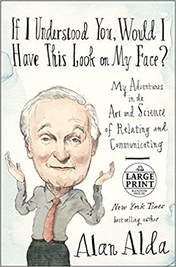
If I Understood You, Would I Have This Look on My Face? My Adventures in the Art and Science of Relating and Communicating
Author: Alan Alda
ISBN-10: 1524781924
ISBN-13: 978-1524781927
APA Style Citation
Alda, A. (2017). If I understood you, would I have this look on my face? My adventures in the art and science of relating and communicating. New York, NY: Random House LLC.
Buy This Book
https://www.amazon.com/Understood-Would-Have-This-Look/dp/1524781924
Author: Alan Alda
ISBN-10: 1524781924
ISBN-13: 978-1524781927
APA Style Citation
Alda, A. (2017). If I understood you, would I have this look on my face? My adventures in the art and science of relating and communicating. New York, NY: Random House LLC.
Buy This Book
https://www.amazon.com/Understood-Would-Have-This-Look/dp/1524781924

| if_i_understood_you_activity.pdf |
Book Description
What is the key to communication? Alan Alda, author of the book If I Understood You, Would I Have This Look on My Face? My Adventures in the Art and Science of Relating and Communicating, believes it is empathy and recognizing what the other person is thinking. He is an actor, writer, and director. Some may know him from his role on the TV show M*A*S*H and various movie appearances. Others know him within the scientific community as host of the PBS show Scientific American Frontiers and founder of the Alan Alda Center for Communicating Science at Stony Brook University. Recently, he has also been thrust into the spotlight by sharing his diagnosis of Parkinson’s disease. His varied history within the fields of science and media provides him an interesting perspective when answering the question of how to enhance communication. He started with wanting to teach scientists how to communicate better, but now wants to share what he learned with you so you can become a better communicator.
As he ventured into the world of interviewing scientists, he recognized the need to listen with his eyes, ears, and feelings. He believes his training in improvisation helped him do just that and can help you too. Through games and exercises, your communication can be transformed. These theater games include sharing something in space, using mirroring exercises, guessing the relationship, and playing imaginary games, such as volleyball or tug-of-war. He also explored the fundamental rule of improv known as “Yes, and…” in the context of communication. If one can start with where the listener is in their knowledge and build, they will have more successful communication. According to Alda, the person delivering the message is responsible for good communication, not the person receiving it. You need to listen to what the audience needs and is feeling. This advice works in all areas of life, including business and personal relationships.
Not all empathy is created equal. Empathy is never good if it traps you in quicksand and encompasses your life. It can also be bad if it is being used to keep others submissive, what Alda refers to as dark empathy. This topic is further addressed in a blog entry for Against Empathy under the category Motivation/Emotion. Alda uses examples of bullies, torture sessions, and dishonorable sales techniques to point out how empathy can be used in a negative way. But then he quickly emphasizes that empathy is not the basis of good behavior, but rather a tool for communication. A little acting training that involves empathy, can lead to a positive doctor-patient relationship and improve communication in those on the autism spectrum. It can also enhance writing and teaching.
On Scientific American Frontiers, Alda was always willing to volunteer and throw himself into the research. So when he was curious about the power of empathy on communication, he began a personal journey. He started to practice reading the faces of strangers, listening to people, and mentally attaching a word to what he thought was the emotion they were experiencing. He believed that naming emotions would help increase empathy. He was able to test this hypothesis with the help of a colleague and a cellphone application that allowed one to record every time you read someone’s emotion and labeled it. After one week with daily practice of paying attention to emotions and faces, his empathy did improve.
Along the journey to enhance communication, Alda explores what both helps and hurts communication. He shares how emotions make experiences memorable. In particular, laughter not only aids in memory but helps people connect. Stories provide the perfect vehicle to build a personal connection. A little dramatic action in the story is sure to catch the listener. People also become better communicators when they recognize what they have in common with each other. On the flip side, there are some aspects to avoid. Jargon and the curse of knowledge prevent people from communicating. One of the most challenging roadblocks to communication is when you can’t imagine what it is like to not have that knowledge. It prevents you from being able to truly listen to the other person.
Daily life offers you a continuous chance at improvisation. While there are no specific tips necessary to increase empathy, Alda encourages you to make personal connections and experience improvisation if you can. To get better at communication, it takes practice and being able to read another person. It is an art, not a formula. So keep practicing!
Other Related Resources
Author Website
http://alanalda.com/
Clear + Vivid Podcast
http://www.aldacommunicationtraining.com/podcasts/
Alan Alda Center for Communicating Science
https://www.aldacenter.org/
Alan Alda Twitter
https://twitter.com/search?q=alan+alda&ref_src=twsrc%5Egoogle%7Ctwcamp%5Eserp%7Ctwgr%5Esearch
Life’s Work: Interview with Alan Alda
https://hbr.org/2017/07/alan-alda
NPR: Learning Life’s Lessons from Alan Alda
https://www.npr.org/templates/story/story.php?storyId=4856461
Alan Alda has Parkinson’s disease
https://www.cnn.com/2018/07/31/entertainment/alan-alda-parkinsons/index.html
https://www.npr.org/2018/07/31/634346984/i-m-not-angry-alan-alda-says-he-s-living-with-parkinson-s
Mirror Neurons
https://www.scientificamerican.com/article/the-social-brain/
TED Talk- Helen Riess and Doctor-Patient Empathy
https://www.youtube.com/watch?v=baHrcC8B4WM
Psychological Figures and Concepts
Albert Bandura
Carl Rogers
Daniel Goleman
Edward Thorndike
Michael Gazzaniga
Sigmund Freud
Active listening
Affective resonance
Altruism
Amygdala
Attention
Autism spectrum
Body language
Cognitive empathy
Communication
Corpus callosum
Dreams
EEG
Emotional intelligence
Empathy
Epilepsy
Facial expressions
Fear
fMRI
Humor
Learned helplessness
Lie detectors
Meditation
Memory
Meta-analysis
Mirror neurons
MRI
Neuroscientists
Oxytocin
Self-regulation
Similarity
Social awareness
Split brain
Stress-hormone response
Theory of mind
What is the key to communication? Alan Alda, author of the book If I Understood You, Would I Have This Look on My Face? My Adventures in the Art and Science of Relating and Communicating, believes it is empathy and recognizing what the other person is thinking. He is an actor, writer, and director. Some may know him from his role on the TV show M*A*S*H and various movie appearances. Others know him within the scientific community as host of the PBS show Scientific American Frontiers and founder of the Alan Alda Center for Communicating Science at Stony Brook University. Recently, he has also been thrust into the spotlight by sharing his diagnosis of Parkinson’s disease. His varied history within the fields of science and media provides him an interesting perspective when answering the question of how to enhance communication. He started with wanting to teach scientists how to communicate better, but now wants to share what he learned with you so you can become a better communicator.
As he ventured into the world of interviewing scientists, he recognized the need to listen with his eyes, ears, and feelings. He believes his training in improvisation helped him do just that and can help you too. Through games and exercises, your communication can be transformed. These theater games include sharing something in space, using mirroring exercises, guessing the relationship, and playing imaginary games, such as volleyball or tug-of-war. He also explored the fundamental rule of improv known as “Yes, and…” in the context of communication. If one can start with where the listener is in their knowledge and build, they will have more successful communication. According to Alda, the person delivering the message is responsible for good communication, not the person receiving it. You need to listen to what the audience needs and is feeling. This advice works in all areas of life, including business and personal relationships.
Not all empathy is created equal. Empathy is never good if it traps you in quicksand and encompasses your life. It can also be bad if it is being used to keep others submissive, what Alda refers to as dark empathy. This topic is further addressed in a blog entry for Against Empathy under the category Motivation/Emotion. Alda uses examples of bullies, torture sessions, and dishonorable sales techniques to point out how empathy can be used in a negative way. But then he quickly emphasizes that empathy is not the basis of good behavior, but rather a tool for communication. A little acting training that involves empathy, can lead to a positive doctor-patient relationship and improve communication in those on the autism spectrum. It can also enhance writing and teaching.
On Scientific American Frontiers, Alda was always willing to volunteer and throw himself into the research. So when he was curious about the power of empathy on communication, he began a personal journey. He started to practice reading the faces of strangers, listening to people, and mentally attaching a word to what he thought was the emotion they were experiencing. He believed that naming emotions would help increase empathy. He was able to test this hypothesis with the help of a colleague and a cellphone application that allowed one to record every time you read someone’s emotion and labeled it. After one week with daily practice of paying attention to emotions and faces, his empathy did improve.
Along the journey to enhance communication, Alda explores what both helps and hurts communication. He shares how emotions make experiences memorable. In particular, laughter not only aids in memory but helps people connect. Stories provide the perfect vehicle to build a personal connection. A little dramatic action in the story is sure to catch the listener. People also become better communicators when they recognize what they have in common with each other. On the flip side, there are some aspects to avoid. Jargon and the curse of knowledge prevent people from communicating. One of the most challenging roadblocks to communication is when you can’t imagine what it is like to not have that knowledge. It prevents you from being able to truly listen to the other person.
Daily life offers you a continuous chance at improvisation. While there are no specific tips necessary to increase empathy, Alda encourages you to make personal connections and experience improvisation if you can. To get better at communication, it takes practice and being able to read another person. It is an art, not a formula. So keep practicing!
Other Related Resources
Author Website
http://alanalda.com/
Clear + Vivid Podcast
http://www.aldacommunicationtraining.com/podcasts/
Alan Alda Center for Communicating Science
https://www.aldacenter.org/
Alan Alda Twitter
https://twitter.com/search?q=alan+alda&ref_src=twsrc%5Egoogle%7Ctwcamp%5Eserp%7Ctwgr%5Esearch
Life’s Work: Interview with Alan Alda
https://hbr.org/2017/07/alan-alda
NPR: Learning Life’s Lessons from Alan Alda
https://www.npr.org/templates/story/story.php?storyId=4856461
Alan Alda has Parkinson’s disease
https://www.cnn.com/2018/07/31/entertainment/alan-alda-parkinsons/index.html
https://www.npr.org/2018/07/31/634346984/i-m-not-angry-alan-alda-says-he-s-living-with-parkinson-s
Mirror Neurons
https://www.scientificamerican.com/article/the-social-brain/
TED Talk- Helen Riess and Doctor-Patient Empathy
https://www.youtube.com/watch?v=baHrcC8B4WM
Psychological Figures and Concepts
Albert Bandura
Carl Rogers
Daniel Goleman
Edward Thorndike
Michael Gazzaniga
Sigmund Freud
Active listening
Affective resonance
Altruism
Amygdala
Attention
Autism spectrum
Body language
Cognitive empathy
Communication
Corpus callosum
Dreams
EEG
Emotional intelligence
Empathy
Epilepsy
Facial expressions
Fear
fMRI
Humor
Learned helplessness
Lie detectors
Meditation
Memory
Meta-analysis
Mirror neurons
MRI
Neuroscientists
Oxytocin
Self-regulation
Similarity
Social awareness
Split brain
Stress-hormone response
Theory of mind
 RSS Feed