Jessica Flitter
West Bend East High School, West Bend, WI
[email protected]
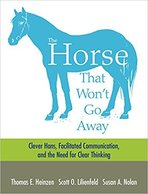
The Horse That Won’t Go Away: Clever Hans, Facilitated Communication and the Need for Clear Thinking
Author(s): Heinzen, T.E, Lilienfeld, S.O. and Nolan, S.A.
ISBN-13: 978-1-4641-4574-2
APA Style Citation
Heinzen, T. E., Lilienfeld, S. O., & Nolan, S. A. (2015). The horse that won't go away: Clever Hans, facilitated communication and the need for clear thinking. New York: Worth, a Macmillan Education imprint.
Buy This Book
https://www.amazon.com/Horse-That-Wont-Go-Away/dp/1464145741
West Bend East High School, West Bend, WI
[email protected]
The Horse That Won’t Go Away: Clever Hans, Facilitated Communication and the Need for Clear Thinking
Author(s): Heinzen, T.E, Lilienfeld, S.O. and Nolan, S.A.
ISBN-13: 978-1-4641-4574-2
APA Style Citation
Heinzen, T. E., Lilienfeld, S. O., & Nolan, S. A. (2015). The horse that won't go away: Clever Hans, facilitated communication and the need for clear thinking. New York: Worth, a Macmillan Education imprint.
Buy This Book
https://www.amazon.com/Horse-That-Wont-Go-Away/dp/1464145741

| clever_hans.docx.pdf |
Book Description
Psychology is a science! The authors of The Horse That Won’t Go Away emphasize that clear, critical thinking is the “hallmark of psychological science." Sometimes we make mental mistakes that can lead to bad decisions, poor investments, and failed social programs, but clear thinking and the scientific approach helps prevent us from fooling ourselves or others. “Making psychological science available to the public- and helping people apply it to their daily lives” is why the authors wrote this book.
The first part of the book tells the story of Clever Hans, the infamous horse that could count. Wilhelm von Osten, a retired math teacher, taught his horse how to tap the ground as he answered various mathematical questions. This amazing feat took place in Berlin, Germany and gained public attention in the early 1900s. From there, the story of Clever Hans was fostered by the media, vivid public demonstrations, validation by experts, and incredible explanations. The authors take you through a detailed description of von Osten’s mission, his endorsement by experts, the media’s misrepresentation of the findings of the Hans Commission, and von Osten’s desire to contribute to the field of science. It was thanks to Oskar Pfungst that we finally found out how Clever Hans was able to complete such amazing feats. With critical thinking and organized experiment, Pfungst was able to rule out alternative explanations. After the explanation was made public, von Osten himself expressed cognitive dissonance and believed even stronger in his horse's intelligence. At the age of 70, von Osten died "apparently of a broken heart" and was sadly "frustrated in the great goal of his life." He failed to contribute to science, but his failure opened our eyes to the power of confirmation bias. Unfortunately, we did not learn from the story of Clever Hans. The United States had their own rock star horses, Beautiful Jim Key on display at the 1904 World’s Fair and Lady Wonder who demonstrated psychic abilities for three questions per dollar.
These might just be examples involving horses, but the authors propose a more current example that follows the same pattern. It is known as Clever Hands- the facilitated communication story. Julian and Thal Wendrow, from Michigan, wanted to communicate with their autistic daughter, Aislinn, who was nonverbal. A keyboard was placed in front of her, and she sat next to a facilitator who held and guided her hand over the letters. Soon Aislinn was composing poems, taking classes, and speaking of her dreams. The miracle therapy seemed to work. Then, one morning Aislinn communicated with a facilitator at school about sexual abuse that was occurring at home. Her father was arrested and held in jail. The accusations were later found untrue, and he was released, but his and his family’s life was ruined. The method used by his daughter, facilitated communication, started in Australia and was meant to be used with children with obvious physical disabilities. Then, in the 1990s Douglas Biklen, a professor of special education and sociologist, helped promote its use in the United States for autism, which he viewed as a motor disorder. Biklen was both articulate and persuasive, and the method was quickly adopted in schools. In addition, it was endorsed by the media and famous individuals just like the Clever Hans story. Just as critical thinking disproved the horse’s supposed intelligence, the method of facilitated communication came apart once researchers demanded the claims be tested. Testimonials and anecdotes would no longer suffice. Experimental tests were introduced, for example, an autistic child was told to spell a word such as “keys” with the facilitator out of the room. The facilitator did not know the word the child was trying to spell, and when the facilitator returned and assisted the child, they were only able to produce nonsense words. The facilitator has been unconsciously assisting the child in the same way von Osten had been unconsciously cueing his horse. Almost a century later the exact same fatal flaw was occurring. You would think the story ends here, but instead, facilitated communication has reappeared. In 2004 and 2010 documentaries about autism began to gain the public’s attention once again. Douglas Bilken made a comeback by giving speeches at prestigious institutions and winning awards. Facilitated communication rebranded itself by changing its name to supported typing or rapid prompting. The Facilitated Communication Institute became known as the Institute for Communication and Inclusion. Even though the method is unsupported by science, it continues to make its way into homes of families who place much hope into an unsound practice.
History is not supposed to repeat itself, and we are supposed to learn from it. However, if you look closely the Clever Hans effect is still present in everyday life. That is, humans still perceive what we want to believe. The authors investigate modern day examples of the effect, such as Potato the math-genius dog, elephants capable of painting self-portraits and landscapes, drug sniffing dogs, the Scared Straight program that terrifies youth in the hope of reducing future criminal behavior, the D.A.R.E. program meant to reduce future drug use, and the Your Baby Can Read video program, to name a few. While the animal tricks sound like fun, the authors point out the other examples play on the human desire to do good for others but can lead to real social harm, such as anxiety, false accusations, and bogus social programs wasting tax payers’ money. The way to expose these claims for what they are is through critical thinking and the scientific approach. They implore readers to share the story of Clever Hans with each generation. Von Osten did not make a lasting contribution to science like he wanted, but instead, he taught us the power and necessity of using the scientific approach. Mental errors without critical thinking can lead to self-deception. The authors end on the note, “That is why Clever Hans is the horse that won’t go away- and why we don’t want him to.”
Other Related Resources
Video Clips Involving Critical Thinking
Book Reviews
A book review of The Horse That Won’t Go Away: Clever Hans, Facilitated Communication and the Need for Clear Thinking compiled by the American Psychological Association for the Psychology Teacher Network.
http://www.apa.org/ed/precollege/ptn/2016/05/clever-hans.aspx
A book review of The Horse That Won’t Go Away: Clever Hans, Facilitated Communication and the Need for Clear Thinking compiled for Psych Central, an independent mental health social network maintained by mental health professionals.
https://psychcentral.com/lib/the-horse-that-wont-go-away-clever-hans-facilitated-communication-the-need-for-clear-thinking/
Facilitated Communication
A series of articles on the controversial method of facilitated communication from the American Psychological Association, the Atlantic, Scientific American, and the Autism Speaks.
http://www.apa.org/research/action/facilitated.aspx
https://www.theatlantic.com/education/archive/2016/07/a-controversial-method-for-autism-communication/491810/
https://www.autismspeaks.org/blog/2012/01/09/all-children-deserve-access-communication
https://www.scientificamerican.com/article/if-facilitated-communication-is-a-canard-why-teach-it/
Apple Video Released on World Autism Awareness Day
https://www.digitaltrends.com/cool-tech/apple-releases-films-to-raise-autism-awareness/
Psychological Figures and Concepts
Sigmund Freud
Clever Hans
Applied behavior analysis (ABA)
Autism
Automatic writing
Availability heuristic
Cognitive dissonance
Confirmation bias
Control group vs. experimental group
Critical thinking
Down syndrome, Turner syndrome, Fetal alcohol syndrome, PKU
ESP
Facilitated communication
False positives and false negatives
Hindsight bias
Illusory correlation
Intellectual disability
Intuition
Methods of elimination
Naïve realism
Phrenology
Prefrontal lobotomy
Regression to the mean
Savants
Shaping
Skepticism
Telepathy
Psychology is a science! The authors of The Horse That Won’t Go Away emphasize that clear, critical thinking is the “hallmark of psychological science." Sometimes we make mental mistakes that can lead to bad decisions, poor investments, and failed social programs, but clear thinking and the scientific approach helps prevent us from fooling ourselves or others. “Making psychological science available to the public- and helping people apply it to their daily lives” is why the authors wrote this book.
The first part of the book tells the story of Clever Hans, the infamous horse that could count. Wilhelm von Osten, a retired math teacher, taught his horse how to tap the ground as he answered various mathematical questions. This amazing feat took place in Berlin, Germany and gained public attention in the early 1900s. From there, the story of Clever Hans was fostered by the media, vivid public demonstrations, validation by experts, and incredible explanations. The authors take you through a detailed description of von Osten’s mission, his endorsement by experts, the media’s misrepresentation of the findings of the Hans Commission, and von Osten’s desire to contribute to the field of science. It was thanks to Oskar Pfungst that we finally found out how Clever Hans was able to complete such amazing feats. With critical thinking and organized experiment, Pfungst was able to rule out alternative explanations. After the explanation was made public, von Osten himself expressed cognitive dissonance and believed even stronger in his horse's intelligence. At the age of 70, von Osten died "apparently of a broken heart" and was sadly "frustrated in the great goal of his life." He failed to contribute to science, but his failure opened our eyes to the power of confirmation bias. Unfortunately, we did not learn from the story of Clever Hans. The United States had their own rock star horses, Beautiful Jim Key on display at the 1904 World’s Fair and Lady Wonder who demonstrated psychic abilities for three questions per dollar.
These might just be examples involving horses, but the authors propose a more current example that follows the same pattern. It is known as Clever Hands- the facilitated communication story. Julian and Thal Wendrow, from Michigan, wanted to communicate with their autistic daughter, Aislinn, who was nonverbal. A keyboard was placed in front of her, and she sat next to a facilitator who held and guided her hand over the letters. Soon Aislinn was composing poems, taking classes, and speaking of her dreams. The miracle therapy seemed to work. Then, one morning Aislinn communicated with a facilitator at school about sexual abuse that was occurring at home. Her father was arrested and held in jail. The accusations were later found untrue, and he was released, but his and his family’s life was ruined. The method used by his daughter, facilitated communication, started in Australia and was meant to be used with children with obvious physical disabilities. Then, in the 1990s Douglas Biklen, a professor of special education and sociologist, helped promote its use in the United States for autism, which he viewed as a motor disorder. Biklen was both articulate and persuasive, and the method was quickly adopted in schools. In addition, it was endorsed by the media and famous individuals just like the Clever Hans story. Just as critical thinking disproved the horse’s supposed intelligence, the method of facilitated communication came apart once researchers demanded the claims be tested. Testimonials and anecdotes would no longer suffice. Experimental tests were introduced, for example, an autistic child was told to spell a word such as “keys” with the facilitator out of the room. The facilitator did not know the word the child was trying to spell, and when the facilitator returned and assisted the child, they were only able to produce nonsense words. The facilitator has been unconsciously assisting the child in the same way von Osten had been unconsciously cueing his horse. Almost a century later the exact same fatal flaw was occurring. You would think the story ends here, but instead, facilitated communication has reappeared. In 2004 and 2010 documentaries about autism began to gain the public’s attention once again. Douglas Bilken made a comeback by giving speeches at prestigious institutions and winning awards. Facilitated communication rebranded itself by changing its name to supported typing or rapid prompting. The Facilitated Communication Institute became known as the Institute for Communication and Inclusion. Even though the method is unsupported by science, it continues to make its way into homes of families who place much hope into an unsound practice.
History is not supposed to repeat itself, and we are supposed to learn from it. However, if you look closely the Clever Hans effect is still present in everyday life. That is, humans still perceive what we want to believe. The authors investigate modern day examples of the effect, such as Potato the math-genius dog, elephants capable of painting self-portraits and landscapes, drug sniffing dogs, the Scared Straight program that terrifies youth in the hope of reducing future criminal behavior, the D.A.R.E. program meant to reduce future drug use, and the Your Baby Can Read video program, to name a few. While the animal tricks sound like fun, the authors point out the other examples play on the human desire to do good for others but can lead to real social harm, such as anxiety, false accusations, and bogus social programs wasting tax payers’ money. The way to expose these claims for what they are is through critical thinking and the scientific approach. They implore readers to share the story of Clever Hans with each generation. Von Osten did not make a lasting contribution to science like he wanted, but instead, he taught us the power and necessity of using the scientific approach. Mental errors without critical thinking can lead to self-deception. The authors end on the note, “That is why Clever Hans is the horse that won’t go away- and why we don’t want him to.”
Other Related Resources
Video Clips Involving Critical Thinking
- Potato the math-genius dog https://www.youtube.com/watch?v=JUeGKNg39mE
- Maggie the mathematical dog https://www.youtube.com/watch?v=EAo0MJbsC_g
Book Reviews
A book review of The Horse That Won’t Go Away: Clever Hans, Facilitated Communication and the Need for Clear Thinking compiled by the American Psychological Association for the Psychology Teacher Network.
http://www.apa.org/ed/precollege/ptn/2016/05/clever-hans.aspx
A book review of The Horse That Won’t Go Away: Clever Hans, Facilitated Communication and the Need for Clear Thinking compiled for Psych Central, an independent mental health social network maintained by mental health professionals.
https://psychcentral.com/lib/the-horse-that-wont-go-away-clever-hans-facilitated-communication-the-need-for-clear-thinking/
Facilitated Communication
A series of articles on the controversial method of facilitated communication from the American Psychological Association, the Atlantic, Scientific American, and the Autism Speaks.
http://www.apa.org/research/action/facilitated.aspx
https://www.theatlantic.com/education/archive/2016/07/a-controversial-method-for-autism-communication/491810/
https://www.autismspeaks.org/blog/2012/01/09/all-children-deserve-access-communication
https://www.scientificamerican.com/article/if-facilitated-communication-is-a-canard-why-teach-it/
Apple Video Released on World Autism Awareness Day
https://www.digitaltrends.com/cool-tech/apple-releases-films-to-raise-autism-awareness/
Psychological Figures and Concepts
Sigmund Freud
Clever Hans
Applied behavior analysis (ABA)
Autism
Automatic writing
Availability heuristic
Cognitive dissonance
Confirmation bias
Control group vs. experimental group
Critical thinking
Down syndrome, Turner syndrome, Fetal alcohol syndrome, PKU
ESP
Facilitated communication
False positives and false negatives
Hindsight bias
Illusory correlation
Intellectual disability
Intuition
Methods of elimination
Naïve realism
Phrenology
Prefrontal lobotomy
Regression to the mean
Savants
Shaping
Skepticism
Telepathy
 RSS Feed