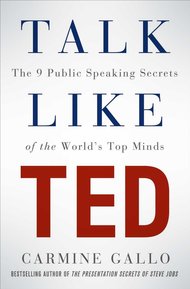
Talk Like TED: The 9 Public-Speaking Secrets of the World’s Top Minds
Author: Carmine Gallo
ISBN: 978-1-250-04112-8
APA Style Citation
Gallo, Carmine (2014). Talk Like TED: The 9 Public-Speaking Secrets of the World’s Top Minds. New York: St. Martin’s Press.
Author: Carmine Gallo
ISBN: 978-1-250-04112-8
APA Style Citation
Gallo, Carmine (2014). Talk Like TED: The 9 Public-Speaking Secrets of the World’s Top Minds. New York: St. Martin’s Press.

| ted_open_your_class.pdf |
Book Description
The TED Conference, which stands for Technology, Entertainment, and Design, has been around since 1984 but did not become well known until they began posting videos of their trademark 19-minute presentations online for free. Author Carmine Gallo is a communications expert and the author of the bestselling book, The Presentation Secrets of Steve Jobs. Gallo examined over 500 TED presentations and added insights from research on persuasion and communication to generate a list of the critical aspects of highly engaging presentations. Talk Like TED offers nine key public-speaking tips utilized in some of the most well-known presentations. The tips for giving great talks are organized into three broad categories: Emotional (they touch the heart), Novel (they teach something new), and Memorable (they present ideas in a unique manner). As teachers, we frequently deliver content to students in a presentation form and this book can provide a variety of tools to use to increase student engagement and learning. Each chapter describes a method used in the most successful TED talks including specific examples and insight from the speakers. One of the best aspects of this book was stopping periodically to watch the amazing TED talks discussed in the book!
EMOTIONAL
The first third of the book is devoted to the three tips in the category related to emotional factors that “touch the heart.” In chapter one, “Unleash the Master Within” the author discusses the importance of choosing topics to discuss about which you have personal passion and interest. According to the author, “the first step to inspiring others is to make sure you are inspired yourself.” An excellent example of a TED talk that exemplifies passion was given by University of Waterloo Economics professor Larry Smith titled, “Why You Will Fail to Have a Great Career.” Smith discusses that although college students are told to pursue their passion most will not because “You’re afraid to pursue your passion. You’re afraid to look ridiculous. You’re afraid to try. You’re afraid you may fail.”
https://www.ted.com/talks/larry_smith_why_you_will_fail_to_have_a_great_career
One of the most watched TED talks of all time (about 20 million views) was given by neuroanatomist Jill Bolte Taylor. The talk illustrates how having a strong emotional connection with the material leads to increased audience engagement. Bolte Taylor’s talk is compelling because it involves a personal connection and exceptional story telling. TEDster Dr. Jill Bolte Taylor offers advice for teachers and other presenters, and that is to tell a story and demonstrate your passion for the topic. According to Bolte Taylor, “When I was at Harvard, I was the one winning the awards. I wasn't winning the awards because my science was better than anyone else’s. I was winning because I could tell a story that was interesting and fascinating and it was mine, down to the detail.”
http://www.ted.com/talks/jill_bolte_taylor_s_powerful_stroke_of_insight
Chapter two discusses how to “Master the Art of Storytelling” by illustrating how effective speakers utilize narratives to make an emotional connection with the audience. For example, TED speaker Brene Brown famously begins her topic by defending qualitative research she conducts with the statement that “Stories are data with a soul.” Effective storytelling engages each listener individually and allows them to become emotionally attached and to the ideas being presented. Some of the most effective TED storytellers are discussed in this chapter including Brian Stevenson’s talk, “We Need to Talk About an Injustice” which led to the longest standing ovation in TED history (see earlier Books for Psychology Class post on his book Just Mercy). The 1,000 attendees at Stevenson’s talk collectively donated $1 million dollars to his nonprofit, the Equal Justice Institute. Stevenson raised $55,000 for every minute he spoke that day. This TED talk was given without the aid of a PowerPoint, visuals, or props of any kind – a testament to the power of story.
https://www.ted.com/talks/bryan_stevenson_we_need_to_talk_about_an_injustice
Another tip for an effectively persuasive presentation according to the author is to utilize Aristotle’s three components of effective persuasion ethos, logos, and pathos in the most effective ratio. Ethos refers to the credibility and credentials of the speaker, logos is the use of logic and data to make effective arguments, and pathos is the ability to appeal to the emotions of the audience. When the author of the book analyzed the content of Brian Stevenson’s TED talk, he found it was 10 percent ethos, 25 percent logos, and 65 percent pathos or emotional appeal. Despite being 65 percent of pathos Stevenson’s talk has been rated as one of the most persuasive of all time. One of the ways the book recommends inserting pathos or emotional appeal is by including extreme moments. Dan Ariely, a psychologist and behavioral economist at Duke introduces his talk on how research shows that people are predictably irrational with a dramatic personal story of his recovery from an injury that left him burned over 70 percent of his body. Ariely’s talk is an excellent addition to the research unit for illustrating the need to test beliefs that are held intuitively through careful research methods.
https://www.ted.com/talks/dan_ariely_on_our_buggy_moral_code/transcript?language=en#t-102037
In chapter three the author describes how effective TED presenters can use body language and verbal delivery to engage with the audience in a manner that feels authentic and conversational instead of an impersonal lecture to a large group. The four elements of verbal delivery addressed in this section are rate, volume, pitch, and the effective use of pauses for emphasis. One of the examples of the effective nonverbal communications is a 2012 TED talk by a former Army general and U.S. secretary of state Colin Powell on the importance of providing children with structure early in life. His speech is broken down to illustrate how particular gestures corresponded with the words he used during his speech.
Another amazing TED talk that powerfully uses gestures to strengthen an argument was given by Ernesto Sirolli titled, “Want to help someone? Shut up and listen!” is also broken down to highlight the expert use of gestures. Sirolli’s talk discusses how his failure to listen led to failure for his NGO project designed to help increase food production in rural Zambia. The project involved teaching people living in southern Zambia to grow Italian tomatoes and other vegetables. Because the local population was uninterested, the NGO paid them to grow the vegetables. Sirolli and his team were surprised that agriculture was not being used in this fertile region with excellent weather and soil. According to Sirolli, instead of asking the people living there why they did not grow crops they said, "Thank God we're here." Just in the nick of time to save the Zambian people from starvation." The result was that everything grew extremely well and we were telling the Zambians, "Look how easy agriculture is." When the tomatoes were nice and ripe and red, overnight, some 200 hippos came out from the river, and they ate everything. It was then that Sirolli asked the Zambians, “My God, the hippos!" and the Zambians said, "Yes, that's why we have no agriculture here." When Sirolli asked “Why didn't you tell us?" the Zambians replied, "You never asked."
https://www.ted.com/talks/ernesto_sirolli_want_to_help_someone_shut_up_and_listen
NOVEL
The second section of the book explains three aspects that contribute to an effective presentation because it is new and unique. Kevin Allocca who studies YouTube trends stated this perfectly when he pointed out that in an era when two days’ worth of video is uploaded every two minutes it is only the truly unique and original ideas that capture the attention of the online audience.
The topic of chapter four, “Teach Me Something New” describes how the best TED talks find a way to introduce new ideas or perspectives. The author suggests that the titles of some of the most frequently viewed TED talks promise to teach something new such as “Schools Kill Creativity” (Sir Ken Robinson), “How Great Leaders Inspire Action” (Simon Sinek), “The Surprising Science of Happiness” (Dan Gilbert), “The Power of Introverts” (Susan Cain), “8 Secrets of Success” (Richard St. John), and “How to Live Before You Die” (Steve Jobs). Martha Burns, a professor at Northwestern teaches how to use neuroscience to be a better educator and highlights the biology behind the “buzz” we experience when learning something in her powerful TEDx talk. One of the best examples of teaching something novel is Hans Rosling talk that makes statistics and correlations exciting and meaningful. Rosling, an expert on global health, animates correlational data regarding health and wealth in a powerful demonstration. You can view his entire talk at ted.com or view the abbreviated version titled: 200 countries, 200 years, 4minutes. https://www.youtube.com/watch?v=jbkSRLYSojo
Novel presentations according to chapter five “Deliver Jaw-Dropping Moments” in which presenters capture the attention and imagination of their audiences by using dramatic demonstrations or surprises. Some of the most dramatic moments or “hooks” at TED talks have included Bill Gates releasing mosquitos and Dr. Jill Bolte Taylor who opens her talk by holding a human brain that is still attached to the spinal cord. “Wow” moments can also come from a single shocking statistic.
Successful TED talks also hook new viewers by creating memorable headlines, which turn into sound bites that are often spread across social media. TED even has a Twitter handle devoted to the catchy, memorable quotes that are likely to generate public attention (@TEDQuote).
Chapter six highlights how the ability to “Lighten Up” by using appropriate and genuine humor can increase audience engagement. The book provides numerous tips for adding humor to presentations including quotes, short video clips, and anecdotes.
MEMORABLE
The final third of the book is dedicated to various ways to make your ideas and your presentation memorable. Chapter seven, “Stick to the 18-Minute Rule” explains why all TED talks are limited to 18 minutes. This key rule was established because it allows enough time for a thoughtful analysis, yet short it is enough to maintain audience engagement. Research shows that information is remembered better if it is organized into related chunks, this has led TED to recommend that presentations be centered around three main areas or points that support one large overarching idea. This concept can be applied to classroom presentations as well by limiting direct instruction to shorter chunks broken up with time for reflection and formative practice. The 18-minute rule forces researchers to create a focused message that maintains attention levels, and that does not create what researchers call “cognitive backlog” or the problem in which too much information prevents the successful transfer of ideas. There are also numerous other TED rules of three such as the Three A’s of Awesome: Attitude, Awareness, and Authenticity which were shared by award-winning blogger and author of the Book of Awesome, Neil Pasricha in a TEDx talk.
https://www.ted.com/talks/neil_pasricha_the_3_a_s_of_awesome
Kevin Allocca, a YouTube trends manager studies why some videos go viral, and others do not. According to Allocca 48 hours of video are uploaded to YouTube every minute, yet only a few will have millions of views. In Allocca’s TED talk he explains the three factors that contribute to the success of a video: tastemakers, communities of participation, and unexpectedness. Of course, there is also the three-minute TED talk titled “TED in 3 Minutes” which has been given by individuals such as Arianna Huffington and New York Times tech columnist David Pogue. The original three-minute talk was given by Terry Moore who showed the audience a better way to tie their shoes, which has been viewed more than 1.5 million times. The rule of three suggests
Chapter eight describes how effective speakers can “Paint a Mental Picture with Multisensory Experiences” and engage as many of the senses of audience members as possible. For example, the best TED talks use memorable images not excessive text on slides. One of the major tips is for creating better more effective power point presentations by avoiding too much text and instead relying more on memorable images and other visuals. One of the worst ways to present is PowerPoint karaoke in which the speaker reads text aloud off of the screen. The chapter includes several examples of successful TED talks that show the words being used by the presenter alongside a description of the images being displayed to audience members. A powerful example of how words are delivered alongside dramatic images is Lisa Kristine’s TED talk about the hardships of indigenous peoples and the reality of the 27 million individuals living in modern day slavery. https://www.ted.com/talks/lisa_kristine_glimpses_of_modern_day_slavery
The final tip for making your presentation memorable, “Stay in Your Lane” is outlined in chapter nine. Staying in your lane means that you presentations need to be authentic and honest and speak from the heart. One of the tips offered for “staying in your lane” is to practice by giving your presentation to a friend or family member first because when you have a close relationship with someone you are more likely to show who you are.
Talk Like TED is an excellent guide full of practical ideas for making your presentations, activities, and demos more engaging and effective. The book is also an opportunity to learn about some amazing TED talks you may not have heard of before. TED talks can be shown in class, assigned as homework to facilitate class discussions or offered as opportunities for students who want to expand their understanding of a particular area of psychology. Another interesting way to use TED talks is to execute the demos or activities presented by a particular TED talk in class and then after hooking students on the content let your students know how to access the entire TED talk. Because many TED presenters are also authors, TED talks can be used to stimulate interest for students to read books related to their favorite TED talks or pursue research projects in areas related to what they watched.
Other Related Resources
Author’s Website
Carmine Gallo’s website offers articles, videos, and links to other books.
http://gallocommunications.com/books/talk-like-ted-2/
The Top 20 TED Talks of All Time
http://www.ted.com/playlists/171/the_most_popular_talks_of_all?gclid=CjwKEAjwtNbABRCsqO7J0_uJxWYSJAAiVo5LuME8Z7o2-Ki6OahJAA2Liq3mJcpOAdNcrtYR4zRz0RoCKgPw_wcB
How to Sound Smart in Your TED Talk
Comedian Will Stephen’s take on how to give a TED talk and impress your audience.
https://www.youtube.com/watch?v=8S0FDjFBj8o
Psychological Figures and Concepts
Dan Ariely
Aristotle
Jill Bolte-Taylor
Susan Cain
James Flynn
Daniel Gilbert
Malcolm Gladwell
George Miller
Daniel Pink
Hans Rosling
10,000 Hour Rule
Altruism
Amygdala
Analogies
Dopamine
Dual-Coding Theory
Flashbulb Memory
Flynn Effect
Genius
Hippocampus
Imagery
Introversion
Magic Number 7 Plus or Minus 2
Multitasking
Neuroplasticity
Nonverbal Communication
Persuasion
Positive Emotion
Self-Esteem
Statistics
The TED Conference, which stands for Technology, Entertainment, and Design, has been around since 1984 but did not become well known until they began posting videos of their trademark 19-minute presentations online for free. Author Carmine Gallo is a communications expert and the author of the bestselling book, The Presentation Secrets of Steve Jobs. Gallo examined over 500 TED presentations and added insights from research on persuasion and communication to generate a list of the critical aspects of highly engaging presentations. Talk Like TED offers nine key public-speaking tips utilized in some of the most well-known presentations. The tips for giving great talks are organized into three broad categories: Emotional (they touch the heart), Novel (they teach something new), and Memorable (they present ideas in a unique manner). As teachers, we frequently deliver content to students in a presentation form and this book can provide a variety of tools to use to increase student engagement and learning. Each chapter describes a method used in the most successful TED talks including specific examples and insight from the speakers. One of the best aspects of this book was stopping periodically to watch the amazing TED talks discussed in the book!
EMOTIONAL
The first third of the book is devoted to the three tips in the category related to emotional factors that “touch the heart.” In chapter one, “Unleash the Master Within” the author discusses the importance of choosing topics to discuss about which you have personal passion and interest. According to the author, “the first step to inspiring others is to make sure you are inspired yourself.” An excellent example of a TED talk that exemplifies passion was given by University of Waterloo Economics professor Larry Smith titled, “Why You Will Fail to Have a Great Career.” Smith discusses that although college students are told to pursue their passion most will not because “You’re afraid to pursue your passion. You’re afraid to look ridiculous. You’re afraid to try. You’re afraid you may fail.”
https://www.ted.com/talks/larry_smith_why_you_will_fail_to_have_a_great_career
One of the most watched TED talks of all time (about 20 million views) was given by neuroanatomist Jill Bolte Taylor. The talk illustrates how having a strong emotional connection with the material leads to increased audience engagement. Bolte Taylor’s talk is compelling because it involves a personal connection and exceptional story telling. TEDster Dr. Jill Bolte Taylor offers advice for teachers and other presenters, and that is to tell a story and demonstrate your passion for the topic. According to Bolte Taylor, “When I was at Harvard, I was the one winning the awards. I wasn't winning the awards because my science was better than anyone else’s. I was winning because I could tell a story that was interesting and fascinating and it was mine, down to the detail.”
http://www.ted.com/talks/jill_bolte_taylor_s_powerful_stroke_of_insight
Chapter two discusses how to “Master the Art of Storytelling” by illustrating how effective speakers utilize narratives to make an emotional connection with the audience. For example, TED speaker Brene Brown famously begins her topic by defending qualitative research she conducts with the statement that “Stories are data with a soul.” Effective storytelling engages each listener individually and allows them to become emotionally attached and to the ideas being presented. Some of the most effective TED storytellers are discussed in this chapter including Brian Stevenson’s talk, “We Need to Talk About an Injustice” which led to the longest standing ovation in TED history (see earlier Books for Psychology Class post on his book Just Mercy). The 1,000 attendees at Stevenson’s talk collectively donated $1 million dollars to his nonprofit, the Equal Justice Institute. Stevenson raised $55,000 for every minute he spoke that day. This TED talk was given without the aid of a PowerPoint, visuals, or props of any kind – a testament to the power of story.
https://www.ted.com/talks/bryan_stevenson_we_need_to_talk_about_an_injustice
Another tip for an effectively persuasive presentation according to the author is to utilize Aristotle’s three components of effective persuasion ethos, logos, and pathos in the most effective ratio. Ethos refers to the credibility and credentials of the speaker, logos is the use of logic and data to make effective arguments, and pathos is the ability to appeal to the emotions of the audience. When the author of the book analyzed the content of Brian Stevenson’s TED talk, he found it was 10 percent ethos, 25 percent logos, and 65 percent pathos or emotional appeal. Despite being 65 percent of pathos Stevenson’s talk has been rated as one of the most persuasive of all time. One of the ways the book recommends inserting pathos or emotional appeal is by including extreme moments. Dan Ariely, a psychologist and behavioral economist at Duke introduces his talk on how research shows that people are predictably irrational with a dramatic personal story of his recovery from an injury that left him burned over 70 percent of his body. Ariely’s talk is an excellent addition to the research unit for illustrating the need to test beliefs that are held intuitively through careful research methods.
https://www.ted.com/talks/dan_ariely_on_our_buggy_moral_code/transcript?language=en#t-102037
In chapter three the author describes how effective TED presenters can use body language and verbal delivery to engage with the audience in a manner that feels authentic and conversational instead of an impersonal lecture to a large group. The four elements of verbal delivery addressed in this section are rate, volume, pitch, and the effective use of pauses for emphasis. One of the examples of the effective nonverbal communications is a 2012 TED talk by a former Army general and U.S. secretary of state Colin Powell on the importance of providing children with structure early in life. His speech is broken down to illustrate how particular gestures corresponded with the words he used during his speech.
Another amazing TED talk that powerfully uses gestures to strengthen an argument was given by Ernesto Sirolli titled, “Want to help someone? Shut up and listen!” is also broken down to highlight the expert use of gestures. Sirolli’s talk discusses how his failure to listen led to failure for his NGO project designed to help increase food production in rural Zambia. The project involved teaching people living in southern Zambia to grow Italian tomatoes and other vegetables. Because the local population was uninterested, the NGO paid them to grow the vegetables. Sirolli and his team were surprised that agriculture was not being used in this fertile region with excellent weather and soil. According to Sirolli, instead of asking the people living there why they did not grow crops they said, "Thank God we're here." Just in the nick of time to save the Zambian people from starvation." The result was that everything grew extremely well and we were telling the Zambians, "Look how easy agriculture is." When the tomatoes were nice and ripe and red, overnight, some 200 hippos came out from the river, and they ate everything. It was then that Sirolli asked the Zambians, “My God, the hippos!" and the Zambians said, "Yes, that's why we have no agriculture here." When Sirolli asked “Why didn't you tell us?" the Zambians replied, "You never asked."
https://www.ted.com/talks/ernesto_sirolli_want_to_help_someone_shut_up_and_listen
NOVEL
The second section of the book explains three aspects that contribute to an effective presentation because it is new and unique. Kevin Allocca who studies YouTube trends stated this perfectly when he pointed out that in an era when two days’ worth of video is uploaded every two minutes it is only the truly unique and original ideas that capture the attention of the online audience.
The topic of chapter four, “Teach Me Something New” describes how the best TED talks find a way to introduce new ideas or perspectives. The author suggests that the titles of some of the most frequently viewed TED talks promise to teach something new such as “Schools Kill Creativity” (Sir Ken Robinson), “How Great Leaders Inspire Action” (Simon Sinek), “The Surprising Science of Happiness” (Dan Gilbert), “The Power of Introverts” (Susan Cain), “8 Secrets of Success” (Richard St. John), and “How to Live Before You Die” (Steve Jobs). Martha Burns, a professor at Northwestern teaches how to use neuroscience to be a better educator and highlights the biology behind the “buzz” we experience when learning something in her powerful TEDx talk. One of the best examples of teaching something novel is Hans Rosling talk that makes statistics and correlations exciting and meaningful. Rosling, an expert on global health, animates correlational data regarding health and wealth in a powerful demonstration. You can view his entire talk at ted.com or view the abbreviated version titled: 200 countries, 200 years, 4minutes. https://www.youtube.com/watch?v=jbkSRLYSojo
Novel presentations according to chapter five “Deliver Jaw-Dropping Moments” in which presenters capture the attention and imagination of their audiences by using dramatic demonstrations or surprises. Some of the most dramatic moments or “hooks” at TED talks have included Bill Gates releasing mosquitos and Dr. Jill Bolte Taylor who opens her talk by holding a human brain that is still attached to the spinal cord. “Wow” moments can also come from a single shocking statistic.
- “This country is very different today than it was 40 years ago. In 1972 there were 300,000 people in jails and prisons. Today there are 2.3 million. The United States now has the highest rate of incarceration in the world.”
- “Why are we ignoring the oceans? If you compare NASA’s annual budget to explore the heavens, that one-year budget would fund NOAA’s budget to explore the world's oceans for 1,600 years.”
- “One in a hundred regular people is a psychopath. So there are 1,500 people in this room. Fifteen of you are psychopaths.”
Successful TED talks also hook new viewers by creating memorable headlines, which turn into sound bites that are often spread across social media. TED even has a Twitter handle devoted to the catchy, memorable quotes that are likely to generate public attention (@TEDQuote).
- “There’s zero correlation between being the best talker and having the best ideas.”
- “Don’t fake it till you make it. Fake it till you become it.”
- “Numbers are the musical notes with which the symphony of the universe is written.”
Chapter six highlights how the ability to “Lighten Up” by using appropriate and genuine humor can increase audience engagement. The book provides numerous tips for adding humor to presentations including quotes, short video clips, and anecdotes.
MEMORABLE
The final third of the book is dedicated to various ways to make your ideas and your presentation memorable. Chapter seven, “Stick to the 18-Minute Rule” explains why all TED talks are limited to 18 minutes. This key rule was established because it allows enough time for a thoughtful analysis, yet short it is enough to maintain audience engagement. Research shows that information is remembered better if it is organized into related chunks, this has led TED to recommend that presentations be centered around three main areas or points that support one large overarching idea. This concept can be applied to classroom presentations as well by limiting direct instruction to shorter chunks broken up with time for reflection and formative practice. The 18-minute rule forces researchers to create a focused message that maintains attention levels, and that does not create what researchers call “cognitive backlog” or the problem in which too much information prevents the successful transfer of ideas. There are also numerous other TED rules of three such as the Three A’s of Awesome: Attitude, Awareness, and Authenticity which were shared by award-winning blogger and author of the Book of Awesome, Neil Pasricha in a TEDx talk.
https://www.ted.com/talks/neil_pasricha_the_3_a_s_of_awesome
Kevin Allocca, a YouTube trends manager studies why some videos go viral, and others do not. According to Allocca 48 hours of video are uploaded to YouTube every minute, yet only a few will have millions of views. In Allocca’s TED talk he explains the three factors that contribute to the success of a video: tastemakers, communities of participation, and unexpectedness. Of course, there is also the three-minute TED talk titled “TED in 3 Minutes” which has been given by individuals such as Arianna Huffington and New York Times tech columnist David Pogue. The original three-minute talk was given by Terry Moore who showed the audience a better way to tie their shoes, which has been viewed more than 1.5 million times. The rule of three suggests
- Creating a Twitter-friendly headline
- Support the headline with three key messages
- Reinforce the three messages with stories, statistics, and examples
Chapter eight describes how effective speakers can “Paint a Mental Picture with Multisensory Experiences” and engage as many of the senses of audience members as possible. For example, the best TED talks use memorable images not excessive text on slides. One of the major tips is for creating better more effective power point presentations by avoiding too much text and instead relying more on memorable images and other visuals. One of the worst ways to present is PowerPoint karaoke in which the speaker reads text aloud off of the screen. The chapter includes several examples of successful TED talks that show the words being used by the presenter alongside a description of the images being displayed to audience members. A powerful example of how words are delivered alongside dramatic images is Lisa Kristine’s TED talk about the hardships of indigenous peoples and the reality of the 27 million individuals living in modern day slavery. https://www.ted.com/talks/lisa_kristine_glimpses_of_modern_day_slavery
The final tip for making your presentation memorable, “Stay in Your Lane” is outlined in chapter nine. Staying in your lane means that you presentations need to be authentic and honest and speak from the heart. One of the tips offered for “staying in your lane” is to practice by giving your presentation to a friend or family member first because when you have a close relationship with someone you are more likely to show who you are.
Talk Like TED is an excellent guide full of practical ideas for making your presentations, activities, and demos more engaging and effective. The book is also an opportunity to learn about some amazing TED talks you may not have heard of before. TED talks can be shown in class, assigned as homework to facilitate class discussions or offered as opportunities for students who want to expand their understanding of a particular area of psychology. Another interesting way to use TED talks is to execute the demos or activities presented by a particular TED talk in class and then after hooking students on the content let your students know how to access the entire TED talk. Because many TED presenters are also authors, TED talks can be used to stimulate interest for students to read books related to their favorite TED talks or pursue research projects in areas related to what they watched.
Other Related Resources
Author’s Website
Carmine Gallo’s website offers articles, videos, and links to other books.
http://gallocommunications.com/books/talk-like-ted-2/
The Top 20 TED Talks of All Time
http://www.ted.com/playlists/171/the_most_popular_talks_of_all?gclid=CjwKEAjwtNbABRCsqO7J0_uJxWYSJAAiVo5LuME8Z7o2-Ki6OahJAA2Liq3mJcpOAdNcrtYR4zRz0RoCKgPw_wcB
How to Sound Smart in Your TED Talk
Comedian Will Stephen’s take on how to give a TED talk and impress your audience.
https://www.youtube.com/watch?v=8S0FDjFBj8o
Psychological Figures and Concepts
Dan Ariely
Aristotle
Jill Bolte-Taylor
Susan Cain
James Flynn
Daniel Gilbert
Malcolm Gladwell
George Miller
Daniel Pink
Hans Rosling
10,000 Hour Rule
Altruism
Amygdala
Analogies
Dopamine
Dual-Coding Theory
Flashbulb Memory
Flynn Effect
Genius
Hippocampus
Imagery
Introversion
Magic Number 7 Plus or Minus 2
Multitasking
Neuroplasticity
Nonverbal Communication
Persuasion
Positive Emotion
Self-Esteem
Statistics

 RSS Feed