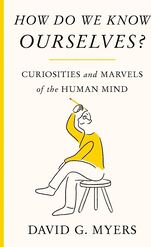
How Do We Know Ourselves: Curiosities and Marvels of the Human Mind
Author: David G. Myers
ISBN: 976-0-374-60195-9
APA Style Citation
Myers, D.G. (2022). How do we know ourselves: Curiosities and marvels of the human mind. Farrar, Strauss and Giroux, New York, N.Y.
Buy This Book
https://www.amazon.com/How-Do-Know-Ourselves-Curiosities/dp/037460195X/ref=sr_1_1?crid=132R4UVO8UGHD&keywords=How+Do+We+Know+Ourselves%3A+Curiosities+and+Marvels+of+the+Human+Mind&qid=1685917569&sprefix=how+do+we+know+ourselves+curiosities+and+marvels+of+the+human+mind%2Caps%2C230&sr=8-1
Author: David G. Myers
ISBN: 976-0-374-60195-9
APA Style Citation
Myers, D.G. (2022). How do we know ourselves: Curiosities and marvels of the human mind. Farrar, Strauss and Giroux, New York, N.Y.
Buy This Book
https://www.amazon.com/How-Do-Know-Ourselves-Curiosities/dp/037460195X/ref=sr_1_1?crid=132R4UVO8UGHD&keywords=How+Do+We+Know+Ourselves%3A+Curiosities+and+Marvels+of+the+Human+Mind&qid=1685917569&sprefix=how+do+we+know+ourselves+curiosities+and+marvels+of+the+human+mind%2Caps%2C230&sr=8-1

| activityhow_do_we_know_ourselves_4.pdf |
David Myers is well known for his contributions to research and raising awareness for those with hearing differences. He is also known for his best-selling textbooks in both the college and high school markets. Myers has used money from the sales of his textbooks to provide ongoing professional development in the area of psychology and has given countless hours to present at conferences, speak with students and faculty, and generally promote the discipline of psychology. How Do We Know Ourselves: Curiosities and Marvels of the Human Mind displays Myer’s expertise in social psychology and describes the many ways in which psychology shapes our day-to-day life.
The book is organized into short chapters that each feature a singular psychological phenomenon such as the self-fulfilling prophecy, overconfidence, well-being, generosity, and many more. The book is a wonderful introduction to the field and would work well to assign in an introductory class. These small digestible chapters are a great way to introduce students to new psychological concepts and begin to see the impact of psychology in their everyday life.
Myer’s endless positivity can be seen throughout the book, although he does not shy away from challenging and timely topics. For example, Myers tackles the issue of increasing social isolation in his chapter titled; Friends or Phones. Myers introduces the word “phubbing” to describe feeling snubbed when talking with their partner because their partner keeps glancing at their cell phone. He describes the “evolutionary mismatch” between close relationships and smartphones and the feeling of isolation people are reporting even when they are around others. People feel disconnected when they are trying to engage with others in a face-to-face setting and people are distracted by their phones or other technology. Myers is careful to point out the many benefits that smartphones have brought, including the ability to video with distant family and friends anytime. In order to enjoy these benefits, while not experiencing or making someone else feel “phubbed,” he recommends some simple modifications for interacting with one another, here are a few:
–At social events, leave phones in another room.
–If someone else is distracted by their phone, stop talking until they are finished.
–At a dinner, pile up phones in the center of the table and the first person to reach for their phone pays for dinner.
Another timely and controversial topic that Myers tackles is that of the “replication crisis” in the field of psychology. While many would describe this as a problem with methodology in the field, Myers points out that this can also be a positive reflection of the ways in which society has changed since many of these “non-replicable” studies have been conducted. Myers provides a three-point rebuttal to those who are willing to dismiss psychological science because some studies, such as the facial-feedback hypothesis or Marshmallow test, have not found the same results as earlier trials. First, he responds that this is how science works. When we find out new information we adjust and teach accordingly, we need not accept that a study from 40 or 50 years ago will necessarily yield the same results today. Humans and societies are ever-changing, and some results may be reflective of these changing norms. Second, some phenomena are genuine, but situation specific. He uses the example of the facial-feedback hypothesis and reports that people who are being videotaped do not display the same characteristics as those who are not. Third, he claims that what endures are many research studies in the field that have been replicated and that is what we teach. He poses that we can encourage critical thinking, while also being careful not to dismiss the field outright because a few popular studies have not replicated the same way as earlier studies have reported. In some cases, this was fraud or misrepresentation but in others, society has changed for the better.
Myers’ positive outlook provides new light to psychological phenomena yet again. This is a book that can introduce people to the field of psychology or enrich those already entrenched in its research. As always, Myers’ approachable writing style is engaging and enriching.
Other Related Resources
WGN News: Interview with David Myers
https://www.youtube.com/watch?v=rDyZx4vCQa0
Society for the Teaching of Psychology: This is how I teach
https://teachpsych.org/page-1703896/4962005
Psych Sessions Podcast: Interview with David Myers
https://www.youtube.com/watch?v=17WFtvZVbr0
Three Life Lessons from the Sage of Psychology: Psychology Today
https://www.psychologytoday.com/us/blog/sex-murder-and-the-meaning-life/202211/three-life-lessons-great-sage-psychology
Seize the Moment Podcast with David Myers
https://www.youtube.com/watch?v=aOaXdTZ5hd0
Next Big Idea Club Podcast
https://nextbigideaclub.com/magazine/know-curiosities-marvels-human-mind-bookbite/38437/
Psychological Figures and Concepts
Roy Baumeister
Robert Cialdini
Hans Eysenck
Sigmund Freud
John Gottman
Jonathan Haidt
Daniel Kahneman
Stanley Milgram
David Rosenhan
Oliver Sacks
Muzafar Sherif
Norman Triplett
Jean Twenge
Robert Zajonc
Automatic processing
Availability heuristic
Behavioral genetics
Confirmation bias
Blindsight
Dual-processing
Dunning-Krueger effect
Equity
fMRI
Group polarization
Groupthink
Heritability
Hindsight bias
Implicit bias
Loss aversion
Mere exposure effect
Minority influence
Narcissism
Overconfidence
Partial reinforcement schedule
Representativeness heuristic
Self-disclosure
Self-fulfilling prophecy
Self-serving bias
Similarity
Social comparison
Social facilitation
Social identity
Social inhibition
Spotlight effect
The book is organized into short chapters that each feature a singular psychological phenomenon such as the self-fulfilling prophecy, overconfidence, well-being, generosity, and many more. The book is a wonderful introduction to the field and would work well to assign in an introductory class. These small digestible chapters are a great way to introduce students to new psychological concepts and begin to see the impact of psychology in their everyday life.
Myer’s endless positivity can be seen throughout the book, although he does not shy away from challenging and timely topics. For example, Myers tackles the issue of increasing social isolation in his chapter titled; Friends or Phones. Myers introduces the word “phubbing” to describe feeling snubbed when talking with their partner because their partner keeps glancing at their cell phone. He describes the “evolutionary mismatch” between close relationships and smartphones and the feeling of isolation people are reporting even when they are around others. People feel disconnected when they are trying to engage with others in a face-to-face setting and people are distracted by their phones or other technology. Myers is careful to point out the many benefits that smartphones have brought, including the ability to video with distant family and friends anytime. In order to enjoy these benefits, while not experiencing or making someone else feel “phubbed,” he recommends some simple modifications for interacting with one another, here are a few:
–At social events, leave phones in another room.
–If someone else is distracted by their phone, stop talking until they are finished.
–At a dinner, pile up phones in the center of the table and the first person to reach for their phone pays for dinner.
Another timely and controversial topic that Myers tackles is that of the “replication crisis” in the field of psychology. While many would describe this as a problem with methodology in the field, Myers points out that this can also be a positive reflection of the ways in which society has changed since many of these “non-replicable” studies have been conducted. Myers provides a three-point rebuttal to those who are willing to dismiss psychological science because some studies, such as the facial-feedback hypothesis or Marshmallow test, have not found the same results as earlier trials. First, he responds that this is how science works. When we find out new information we adjust and teach accordingly, we need not accept that a study from 40 or 50 years ago will necessarily yield the same results today. Humans and societies are ever-changing, and some results may be reflective of these changing norms. Second, some phenomena are genuine, but situation specific. He uses the example of the facial-feedback hypothesis and reports that people who are being videotaped do not display the same characteristics as those who are not. Third, he claims that what endures are many research studies in the field that have been replicated and that is what we teach. He poses that we can encourage critical thinking, while also being careful not to dismiss the field outright because a few popular studies have not replicated the same way as earlier studies have reported. In some cases, this was fraud or misrepresentation but in others, society has changed for the better.
Myers’ positive outlook provides new light to psychological phenomena yet again. This is a book that can introduce people to the field of psychology or enrich those already entrenched in its research. As always, Myers’ approachable writing style is engaging and enriching.
Other Related Resources
WGN News: Interview with David Myers
https://www.youtube.com/watch?v=rDyZx4vCQa0
Society for the Teaching of Psychology: This is how I teach
https://teachpsych.org/page-1703896/4962005
Psych Sessions Podcast: Interview with David Myers
https://www.youtube.com/watch?v=17WFtvZVbr0
Three Life Lessons from the Sage of Psychology: Psychology Today
https://www.psychologytoday.com/us/blog/sex-murder-and-the-meaning-life/202211/three-life-lessons-great-sage-psychology
Seize the Moment Podcast with David Myers
https://www.youtube.com/watch?v=aOaXdTZ5hd0
Next Big Idea Club Podcast
https://nextbigideaclub.com/magazine/know-curiosities-marvels-human-mind-bookbite/38437/
Psychological Figures and Concepts
Roy Baumeister
Robert Cialdini
Hans Eysenck
Sigmund Freud
John Gottman
Jonathan Haidt
Daniel Kahneman
Stanley Milgram
David Rosenhan
Oliver Sacks
Muzafar Sherif
Norman Triplett
Jean Twenge
Robert Zajonc
Automatic processing
Availability heuristic
Behavioral genetics
Confirmation bias
Blindsight
Dual-processing
Dunning-Krueger effect
Equity
fMRI
Group polarization
Groupthink
Heritability
Hindsight bias
Implicit bias
Loss aversion
Mere exposure effect
Minority influence
Narcissism
Overconfidence
Partial reinforcement schedule
Representativeness heuristic
Self-disclosure
Self-fulfilling prophecy
Self-serving bias
Similarity
Social comparison
Social facilitation
Social identity
Social inhibition
Spotlight effect
 RSS Feed