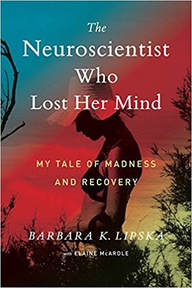
The Neuroscientist Who Lost Her Mind: My Tale of Madness and Recovery
Authors: Barbara K. Lipska and Elaine McArdle
ISBN-10: 1328787303
ISBN-13: 978-1328787309
APA Style Citation
Lipska, B. K. & McArdle, E. (2018). The Neuroscientist Who Lost Her Mind: My Tale of Madness and Recovery. New York, NY: Houghton Mifflin Harcourt Publishing Company.
Buy This Book
https://www.amazon.com/Neuroscientist-Who-Lost-Her-Mind/dp/1328787303
Authors: Barbara K. Lipska and Elaine McArdle
ISBN-10: 1328787303
ISBN-13: 978-1328787309
APA Style Citation
Lipska, B. K. & McArdle, E. (2018). The Neuroscientist Who Lost Her Mind: My Tale of Madness and Recovery. New York, NY: Houghton Mifflin Harcourt Publishing Company.
Buy This Book
https://www.amazon.com/Neuroscientist-Who-Lost-Her-Mind/dp/1328787303

| neuroscientist_activity.pdf |
| neuroscientist_activity_key.pdf |
Book Description
Dr. Barbara Lipska dedicated her life to neuroscience and ended up raging a personal battle with her own brain. As a neuroscientist her specialty was schizophrenia, but soon she experienced the very symptoms she studied. The Neuroscientist Who Lost Her Mind: My Tale of Madness and Recovery follows her personal story of overcoming melanoma that metastasized to the brain. She reminds us that mental illness is a brain disease and provides a blend of brain awareness and personal anecdotes to educate the reader. According to Dr. Thomas R. Insel, former National Institute of Mental Health (NIMH) director, when speaking of Lipska, “You have done something so important for people with serious mental illness who do not have an observable lesion. Not only have you reminded us all that mental illnesses are brain illnesses, you have reminded us to be hopeful. People recover.” It is her expertise, desire to help reduce stigma, and optimism that leaves a lasting mark on the reader.
Throughout the book, Dr. Lipska divulges personal stories to build together the timeline of her amazing strength and battle with various cancers. She began her journey in communist Poland in the 1980s where she worked on clinical trials for drugs to treat schizophrenia. Her first marriage quickly fell apart after she learned her husband had melanoma that ended up metastasizing to the brain, the very disorder she later faced. She found comfort in another man, Mirek and went on to marry him and raise her two children from her first marriage. In 1989, she was offered employment at the National Institute of Health in Maryland. Her research quickly took off and, in 1993, she published findings for the Lipska model. Then, in 2009, she was diagnosed with breast cancer and had a mastectomy on her left breast. Again in 2011, she received the unimaginable news and learned that she had the deadliest form of skin cancer, melanoma. She went on to beat cancer for a second time. In 2013, she was named Director of the Human Brain Collection Core at the NIMH. Life seemed to be taking a turn for the better, and she started to train for a half Ironman.
In January 2015, her story changed once again for the worse. She was working on her computer when her right hand vanished from her lower right visual field. She did not want to admit that something was wrong, but she was well-versed in the symptoms of cancer. An MRI confirmed she had three tumors and that one was bleeding and appeared to be melanoma. She was going to battle this cancer with the “kitchen sink”, including surgery, radiation, and immunotherapy. She was given steroids to prevent swelling and needed brain surgery to remove the bleeding tumor from her occipital lobe. Fortunately, the raisin-sized tumor was in a non-life-threatening location. Next, she decided to use stereotactic radiosurgery (SRS) to focus high doses of radiation onto individual tumors. Within one month of the brain surgery she was skiing, and within two months, training for a triathlon again. The family vacationed in Hawaii and spirits were high. After she returned, she received the news that she had been accepted into an immunotherapy clinical trial. Immunotherapy uses the body’s own defenses to fight the disease and has been touted as one of the most encouraging cancer treatments in decades. Over 12 weeks, Dr. Lipska received four injections, consisting of a combination of two monoclonal antibody drugs that boosted the immune system. The drugs teach the dysfunctional T cells to recognize, attack, and kill off the cancerous cells. She was not supposed to have any active tumors to complete the trial because the consequences were unknown. However, she learned from a second opinion that she had three new tumors. Dr. Lipska decided to keep the news a secret and she proceeded with the trial. After the second injection, her body took a turn for the worse. She had an autoimmune reaction and suffered lymphedema from her previous mastectomy. When her lymph nodes were removed, her lymphatic system was blocked and her lymph fluid could not properly drain. This fluid buildup led to swelling in Dr. Lipska’s arm. It was at this time that her personality started to change. She became aggressive, acting like a 2-year-old having a tantrum, but did not have insight into her own behavior. She lashed out at her family, a physical therapist, and termite inspection man. She was angry, paranoid, impatient, and lacked empathy. Her frontal lobe was changing, but everyone wrote it off as stress. In June 2015, a variety of odd behaviors started to occur. She went for a run in her neighborhood with hair dye dripping everywhere and missing her prosthetic breast. She lost her car and, after finding it, damaged it as she frantically tried to escape the parking structure. After her final injection, she got sick on pizza and believed she had been poisoned by plastic hidden in the pizza. Upon her family’s advice she returned to the doctor for her first MRI since joining the immunotherapy trial. She learned that she had new tumors and the immunotherapy did not work. There was a total of 18 tumors, the largest in her frontal and parietal lobe. She also had significant swelling and inflammation of brain tissue. Once again, she was given high amounts of steroids. This time her therapy included CyberKnife Robotic Radiosurgery, which used a robotic arm to shoot high-dose radiation into the tumors.
Dr. Lipska continued to battle her symptoms for the next two months. She was argumentative and lost her ability to plan. She became obsessed with food and gained ten pounds. She was told to get her affairs in order, and her family began a rotation of visits. As her symptoms continued to advance, she forgot her husband’s birthday and how to do simple math, but her writing and creativity remained strong. Dr. Lipska continued to work out, but did not understand the physical strain on her body. One specific incident included a seven-mile hike where she found chanterelle mushrooms that she wanted her husband to gather for breakfast. After her 2.5 hour walk, she was exhausted and became overwhelmed. Her brain entered survival mode, and she blew up at her husband and family. Soon after this incident, her family noticed her short-term memory was disappearing. In addition, she would lose her balance and not be able to judge distance. One afternoon after demanding to walk home, she got lost and had her first incident of incontinence. When attending the grand opening of a local supermarket, she experienced a sensory overload from the music that sent her into panic mode. She was living a strange irony of the symptoms she once studied.
Her mind finally started to return. She described it like crawling out of a black hole. Dr. Lipska wanted to keep fighting, but the two new drugs that showed promise for her genetic variation were not approved by the FDA and were not covered by insurance. The drug company gave her the drugs for “compassionate use” and she began both types. Her body exploded in a rash, but eventually she had promising results. In July 2015, she had a scan that showed the tumors shrank considerably or disappeared. There was no way to know exactly which treatment worked, but she was grateful (even though the scientist in her was annoyed). She continued to have brain scans every six weeks. Small tumors have appeared and were treated with CyberKnife.
Dr. Lipska has tried to put all the pieces together and figure out how to move forward. Her family doesn’t talk much about those two summer months. She was scared about how her mind failed and has since regularly tested herself to see if her symptoms are returning. She publicly shared her story through The New York Times for the first time and received a positive response. But her story took another twist in August 2016. At the site of her biggest tumor she experienced brain tissue necrosis. This is a delayed and sometimes fatal effect of radiation, where the surrounding tissue of the brain tumor does not heal after the radiation. Dr. Lipska noticed a blind spot at the top of her visual field in her left eye. She was diagnosed with irreversible optic neuropathy- total blindness in her left eye due to the radiation she received. Lipska refused to give up, retrained her body to deal with the blindness, and even trained for a family triathlon. Two weeks before the race she experienced a leg twitch. She was having seizures due to necrotic tissue in her right motor cortex. Despite her complications she continued to compete in the triathlon, taking the swimming leg of the race. When she passed the timing piece to her husband, he said, “Life is a team sport! And remember, my love, we’ll conquer this beast!”
The prognosis for Dr. Lipska is good, but she is cautious. She is worried it could all happen again with old age. But she knows it is through the support of her family that she got through her journey to madness and back.
Other Related Resources
Barbara K. Lipska Webpage
https://www.barbaralipska.com/bio/
The New York Times Article written by Dr. Lipska
https://www.nytimes.com/2016/03/13/opinion/sunday/the-neuroscientist-who-lost-her-mind.html
Possible questions include:
NPR Interview with Dr. Lipska
https://www.npr.org/sections/health-shots/2018/03/31/598236622/the-neuroscientist-who-lost-her-mind-returns-from-madness
Megyn Kelly TODAY interview with Dr. Lipska
https://www.today.com/video/meet-the-neuroscientist-who-lost-her-mind-then-got-it-back-again-1209150019548
2018 Gaithersburg Book Festival in Maryland book talk with Dr. Lipska
https://www.c-span.org/video/?445042-12/the-neuroscientist-lost-mind
WGBH News interview with Dr. Lipska
https://www.youtube.com/watch?v=abWumGocVoU
WBUR- Radio Boston interview with Dr. Lipska
http://www.wbur.org/radioboston/2018/04/23/neuroscientist-new-book
Psychology Today posts from authors
https://www.psychologytoday.com/us/experts/barbara-k-lipska-phd-elaine-mcardle
The Guardian Article
https://www.theguardian.com/lifeandstyle/2018/mar/30/i-was-a-caricature-of-my-worst-traits-how-brain-cancer-can-affect-the-mind
Wall Street Journal article written by James (son-in-law) about the family triathlon
https://www.wsj.com/articles/a-triathlon-is-easy-next-to-soviets-and-polio-1495492959
Dr. Jill Bolte Taylor- Harvard trained brain scientist who suffers from a stroke and then writes about it
http://mystrokeofinsight.com/
http://drjilltaylor.com/book.html
https://www.amazon.com/My-Stroke-Insight-Scientists-Personal/dp/0452295548
https://www.ted.com/talks/jill_bolte_taylor_s_powerful_stroke_of_insight
https://www.npr.org/templates/story/story.php?storyId=104154403
Psychological Figures and Concepts
Phineas Gage
Adrenal glands
Anosognosia- lack of insight
Antipsychotic drugs in the 1950s
Blood-brain-barrier (BBB)
Brain
Brain bank
Cerebellum
Confidentiality
Consciousness
Creativity
CT scan
Dementia
DSM-5
Dyspraxia
Empathy
Frontal cortex
Frontal lobotomy
Frontotemporal dementia (FTD)
Gray vs. white matter
Hippocampus
Id vs. superego
Immunotherapy
Language
Lipska model- neonatal hippocampal lesion model of schizophrenia
Lobes- frontal, parietal, temporal, occipital
Localization
Mental illness statistics
MRI
Nature vs. nurture
Neuroscientist
Paranoia
PET scan
Pituitary glands
Prefrontal cortex
Psychosis
Schizophrenagenic mother myth
Schizophrenia
Sensory overload
Short vs. long-term memory
Spatial memory
Stigma of mental illness
Thyroid glands
Visual field
Dr. Barbara Lipska dedicated her life to neuroscience and ended up raging a personal battle with her own brain. As a neuroscientist her specialty was schizophrenia, but soon she experienced the very symptoms she studied. The Neuroscientist Who Lost Her Mind: My Tale of Madness and Recovery follows her personal story of overcoming melanoma that metastasized to the brain. She reminds us that mental illness is a brain disease and provides a blend of brain awareness and personal anecdotes to educate the reader. According to Dr. Thomas R. Insel, former National Institute of Mental Health (NIMH) director, when speaking of Lipska, “You have done something so important for people with serious mental illness who do not have an observable lesion. Not only have you reminded us all that mental illnesses are brain illnesses, you have reminded us to be hopeful. People recover.” It is her expertise, desire to help reduce stigma, and optimism that leaves a lasting mark on the reader.
Throughout the book, Dr. Lipska divulges personal stories to build together the timeline of her amazing strength and battle with various cancers. She began her journey in communist Poland in the 1980s where she worked on clinical trials for drugs to treat schizophrenia. Her first marriage quickly fell apart after she learned her husband had melanoma that ended up metastasizing to the brain, the very disorder she later faced. She found comfort in another man, Mirek and went on to marry him and raise her two children from her first marriage. In 1989, she was offered employment at the National Institute of Health in Maryland. Her research quickly took off and, in 1993, she published findings for the Lipska model. Then, in 2009, she was diagnosed with breast cancer and had a mastectomy on her left breast. Again in 2011, she received the unimaginable news and learned that she had the deadliest form of skin cancer, melanoma. She went on to beat cancer for a second time. In 2013, she was named Director of the Human Brain Collection Core at the NIMH. Life seemed to be taking a turn for the better, and she started to train for a half Ironman.
In January 2015, her story changed once again for the worse. She was working on her computer when her right hand vanished from her lower right visual field. She did not want to admit that something was wrong, but she was well-versed in the symptoms of cancer. An MRI confirmed she had three tumors and that one was bleeding and appeared to be melanoma. She was going to battle this cancer with the “kitchen sink”, including surgery, radiation, and immunotherapy. She was given steroids to prevent swelling and needed brain surgery to remove the bleeding tumor from her occipital lobe. Fortunately, the raisin-sized tumor was in a non-life-threatening location. Next, she decided to use stereotactic radiosurgery (SRS) to focus high doses of radiation onto individual tumors. Within one month of the brain surgery she was skiing, and within two months, training for a triathlon again. The family vacationed in Hawaii and spirits were high. After she returned, she received the news that she had been accepted into an immunotherapy clinical trial. Immunotherapy uses the body’s own defenses to fight the disease and has been touted as one of the most encouraging cancer treatments in decades. Over 12 weeks, Dr. Lipska received four injections, consisting of a combination of two monoclonal antibody drugs that boosted the immune system. The drugs teach the dysfunctional T cells to recognize, attack, and kill off the cancerous cells. She was not supposed to have any active tumors to complete the trial because the consequences were unknown. However, she learned from a second opinion that she had three new tumors. Dr. Lipska decided to keep the news a secret and she proceeded with the trial. After the second injection, her body took a turn for the worse. She had an autoimmune reaction and suffered lymphedema from her previous mastectomy. When her lymph nodes were removed, her lymphatic system was blocked and her lymph fluid could not properly drain. This fluid buildup led to swelling in Dr. Lipska’s arm. It was at this time that her personality started to change. She became aggressive, acting like a 2-year-old having a tantrum, but did not have insight into her own behavior. She lashed out at her family, a physical therapist, and termite inspection man. She was angry, paranoid, impatient, and lacked empathy. Her frontal lobe was changing, but everyone wrote it off as stress. In June 2015, a variety of odd behaviors started to occur. She went for a run in her neighborhood with hair dye dripping everywhere and missing her prosthetic breast. She lost her car and, after finding it, damaged it as she frantically tried to escape the parking structure. After her final injection, she got sick on pizza and believed she had been poisoned by plastic hidden in the pizza. Upon her family’s advice she returned to the doctor for her first MRI since joining the immunotherapy trial. She learned that she had new tumors and the immunotherapy did not work. There was a total of 18 tumors, the largest in her frontal and parietal lobe. She also had significant swelling and inflammation of brain tissue. Once again, she was given high amounts of steroids. This time her therapy included CyberKnife Robotic Radiosurgery, which used a robotic arm to shoot high-dose radiation into the tumors.
Dr. Lipska continued to battle her symptoms for the next two months. She was argumentative and lost her ability to plan. She became obsessed with food and gained ten pounds. She was told to get her affairs in order, and her family began a rotation of visits. As her symptoms continued to advance, she forgot her husband’s birthday and how to do simple math, but her writing and creativity remained strong. Dr. Lipska continued to work out, but did not understand the physical strain on her body. One specific incident included a seven-mile hike where she found chanterelle mushrooms that she wanted her husband to gather for breakfast. After her 2.5 hour walk, she was exhausted and became overwhelmed. Her brain entered survival mode, and she blew up at her husband and family. Soon after this incident, her family noticed her short-term memory was disappearing. In addition, she would lose her balance and not be able to judge distance. One afternoon after demanding to walk home, she got lost and had her first incident of incontinence. When attending the grand opening of a local supermarket, she experienced a sensory overload from the music that sent her into panic mode. She was living a strange irony of the symptoms she once studied.
Her mind finally started to return. She described it like crawling out of a black hole. Dr. Lipska wanted to keep fighting, but the two new drugs that showed promise for her genetic variation were not approved by the FDA and were not covered by insurance. The drug company gave her the drugs for “compassionate use” and she began both types. Her body exploded in a rash, but eventually she had promising results. In July 2015, she had a scan that showed the tumors shrank considerably or disappeared. There was no way to know exactly which treatment worked, but she was grateful (even though the scientist in her was annoyed). She continued to have brain scans every six weeks. Small tumors have appeared and were treated with CyberKnife.
Dr. Lipska has tried to put all the pieces together and figure out how to move forward. Her family doesn’t talk much about those two summer months. She was scared about how her mind failed and has since regularly tested herself to see if her symptoms are returning. She publicly shared her story through The New York Times for the first time and received a positive response. But her story took another twist in August 2016. At the site of her biggest tumor she experienced brain tissue necrosis. This is a delayed and sometimes fatal effect of radiation, where the surrounding tissue of the brain tumor does not heal after the radiation. Dr. Lipska noticed a blind spot at the top of her visual field in her left eye. She was diagnosed with irreversible optic neuropathy- total blindness in her left eye due to the radiation she received. Lipska refused to give up, retrained her body to deal with the blindness, and even trained for a family triathlon. Two weeks before the race she experienced a leg twitch. She was having seizures due to necrotic tissue in her right motor cortex. Despite her complications she continued to compete in the triathlon, taking the swimming leg of the race. When she passed the timing piece to her husband, he said, “Life is a team sport! And remember, my love, we’ll conquer this beast!”
The prognosis for Dr. Lipska is good, but she is cautious. She is worried it could all happen again with old age. But she knows it is through the support of her family that she got through her journey to madness and back.
Other Related Resources
Barbara K. Lipska Webpage
https://www.barbaralipska.com/bio/
The New York Times Article written by Dr. Lipska
https://www.nytimes.com/2016/03/13/opinion/sunday/the-neuroscientist-who-lost-her-mind.html
Possible questions include:
- What symptoms did Dr. Lipska experience that mimic mental illness?
- What role did her family play in her story with melanoma?
- How does this story fight the stigma of mental illness?
- How is this story a testament to optimism?
NPR Interview with Dr. Lipska
https://www.npr.org/sections/health-shots/2018/03/31/598236622/the-neuroscientist-who-lost-her-mind-returns-from-madness
Megyn Kelly TODAY interview with Dr. Lipska
https://www.today.com/video/meet-the-neuroscientist-who-lost-her-mind-then-got-it-back-again-1209150019548
2018 Gaithersburg Book Festival in Maryland book talk with Dr. Lipska
https://www.c-span.org/video/?445042-12/the-neuroscientist-lost-mind
WGBH News interview with Dr. Lipska
https://www.youtube.com/watch?v=abWumGocVoU
WBUR- Radio Boston interview with Dr. Lipska
http://www.wbur.org/radioboston/2018/04/23/neuroscientist-new-book
Psychology Today posts from authors
https://www.psychologytoday.com/us/experts/barbara-k-lipska-phd-elaine-mcardle
The Guardian Article
https://www.theguardian.com/lifeandstyle/2018/mar/30/i-was-a-caricature-of-my-worst-traits-how-brain-cancer-can-affect-the-mind
Wall Street Journal article written by James (son-in-law) about the family triathlon
https://www.wsj.com/articles/a-triathlon-is-easy-next-to-soviets-and-polio-1495492959
Dr. Jill Bolte Taylor- Harvard trained brain scientist who suffers from a stroke and then writes about it
http://mystrokeofinsight.com/
http://drjilltaylor.com/book.html
https://www.amazon.com/My-Stroke-Insight-Scientists-Personal/dp/0452295548
https://www.ted.com/talks/jill_bolte_taylor_s_powerful_stroke_of_insight
https://www.npr.org/templates/story/story.php?storyId=104154403
Psychological Figures and Concepts
Phineas Gage
Adrenal glands
Anosognosia- lack of insight
Antipsychotic drugs in the 1950s
Blood-brain-barrier (BBB)
Brain
Brain bank
Cerebellum
Confidentiality
Consciousness
Creativity
CT scan
Dementia
DSM-5
Dyspraxia
Empathy
Frontal cortex
Frontal lobotomy
Frontotemporal dementia (FTD)
Gray vs. white matter
Hippocampus
Id vs. superego
Immunotherapy
Language
Lipska model- neonatal hippocampal lesion model of schizophrenia
Lobes- frontal, parietal, temporal, occipital
Localization
Mental illness statistics
MRI
Nature vs. nurture
Neuroscientist
Paranoia
PET scan
Pituitary glands
Prefrontal cortex
Psychosis
Schizophrenagenic mother myth
Schizophrenia
Sensory overload
Short vs. long-term memory
Spatial memory
Stigma of mental illness
Thyroid glands
Visual field
 RSS Feed