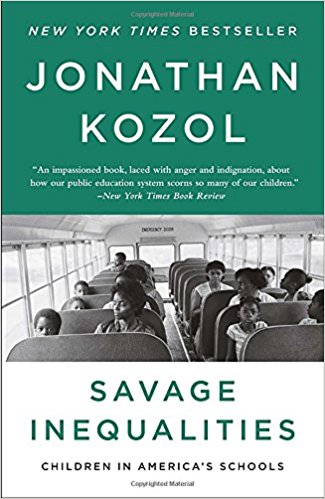
Savage Inequalities: Children in America’s Schools
Author: Jonathan Kozol
ISBN: 978-0-7704-3568-4
APA Style Citation
Kozol, J (1991). Savage Inequalities: Children in America`s Schools. Random House: New York, New York.
Buy This Book
Savage Inequalities: Children in America`s Schools
https://www.amazon.com/Savage-Inequalities-Children-Americas-Schools/dp/0770435688
Author: Jonathan Kozol
ISBN: 978-0-7704-3568-4
APA Style Citation
Kozol, J (1991). Savage Inequalities: Children in America`s Schools. Random House: New York, New York.
Buy This Book
Savage Inequalities: Children in America`s Schools
https://www.amazon.com/Savage-Inequalities-Children-Americas-Schools/dp/0770435688

| activity_savage_inequalities_3.pdf |
Book Description
Jonathon Kozol lays bare the many inequities in the American Public-School System. Kozol attempts to convey to the reader the dramatic dichotomies which exist even in public schools that are only miles apart. The belief that all American`s have the opportunity to a strong educational foundation is easily dispelled by Kozol`s behind the scenes look at schools in wealthy versus poor neighborhoods. An individual`s opportunity to receive a top-quality education is in large part determined by the net worth of their parents and the neighborhood in which the child was born. This can either create a life full of opportunities for the upper-class or doom the underprivileged child to a cycle of poverty. Kozol examines the differences in the physical space of a school building, teacher ability and retention, annual spending per child, academic programs offered to students including gifted and special education programs, extra-curricular programs, and class sizes.
Kozol visits schools across the country and speaks with students, teachers, and administrators in each of the buildings he visits. He examines only public schools which are supported by a combination of local property taxes and state funding. To provide a broad range of geographic locations, Kozol visits schools in Illinois, Washington D.C. New York, New Jersey, and Texas. Kozol cites the 1954 Brown versus Board of Education Supreme Court decision which many cite as the landmark decision that made equal education available to all American school children regardless of their race or class and argues that we are in much the same situation today as when the decision was made.
To use one comparison of schools that Kozol addresses in depth are East St. Louis, North Lawndale, and New Trier High Schools, all in the state of Illinois. East St. Louis in 1991 (when the book was written) was 98% black, and 75% of the population relied on some form of welfare. Chemical Plants pumped fumes into the town from companies like Pfizer and Monsanto. These plants have left the ground riddled with lead and mercury, but mechanization of those plants led to the layoff of many workers. East St. Louis Senior High School flooded twice that year and left sewage in the basement. In the same week, 280 teachers and 34 custodians and workers were laid off because of funding shortages. Class size is 35 and often taught by `permanent` substitutes because the city cannot afford to pay teacher`s salaries. The school often lacks enough chalk or toilet paper in the building, and in the bathrooms sometimes only one stall is functional and may or may not have a door. The science labs do not function because there is no water and the lab equipment is fifty years old. When a teacher is ill, no substitute is assigned, and the students supervise themselves. Thousands of dollars are wasted each month heating a building with drafty windows and old systems, and then the school is accused of mismanaging their funds by the state. The superintendent of the East St. Louis school district sums this up by saying, “Gifted children are everywhere in East St. Louis, but their gifts are lost to poverty and turmoil and the damage done by knowing that they are written off by their society.”
In North Lawndale, Chicago a neighborhood where Martin Luther King Jr. lived for a time while fighting against housing discrimination in Chicago, the situation is no better. Overcrowded classrooms, dilapidated buildings, and exhausted staff do their best to educate students in a building without adequate space or facilities. This, adds to the challenge of trying to educate students who frequently move in an out of a classroom and who are facing poverty, crime or addiction in their home environments makes any learning a challenge. While parents of these children certainly want a good education for their children, the basic necessities of life (finding housing, employment) often push that priority way down the list. Kozol describes his visit here with the primary students who are excited to learn and hear stories read to them. Unfortunately, by middle school, the children seem to understand that life has dealt them an unfair deal and the chances of changing their circumstances are slim. over half of the students at North Lawndale will not complete high school, but nearly 30% will not even complete middle school. As they move through middle school, their attitudes have changed, and they seem resigned to a similar life, they do not believe that education will help change that.
Magnet schools have been sold to the public as a chance for outstanding students living in the city to have access to a world-class education. Many of these schools have lived up to that reputation, but the cost to the overall system may not warrant these efforts. By selecting the top students for these magnet schools, the remaining students are acutely aware of their “lower” status and not having the two or three students in school may have a deleterious impact on the neighborhood public schools. The media often reports about the success at these Magnets schools, but often the result is even further degradation for those “left behind”.
There is an alternate reality in the Illinois Public school system. The one that Kozol describes is that of New Trier High School located in Wilmette, a wealthy northern suburb of Chicago not more than 20 miles from North Lawndale. Here, students are given counseling in a 25 to 1 ratio by a counselor who will stay with the student during all four years of high school. In comparison, counselors in East St. Louis schools are staffed at 250 to 1. The New Trier school library has over 60,000 volumes while most Chicago public schools less than 25% of that number. Teachers at New Trier earn an average salary of 150% of what those in the city are making and have smaller class sizes, unlimited copies (and today access to technology and personal devices provided by the school) and generally a great deal of parental support. This makes it easier to understand why staffing in the Chicago public system has become such a challenge and that often those who remain may only stay because they have no better option. The students are New Trier have access to over thirty different sports programs and any number of extracurricular clubs in which sponsors are paid extra. The students at North Lawndale had a choir. New Trier students have access to Advanced Placement classes and college counselors, and with these types of supports, it is no surprise that over 90% of the graduating class will go on to a four-year college or university, versus a dropout rate of nearly 50%.
Kozol finds similar discrepancies in schools across the country and wonders if all children are not entitled to a free and equitable education. State and local property taxes account for most of a school`s budget, but those in wealthy neighborhoods experience the benefits of an increased budget because of the high value of homes in the area. Those in poorer areas often paying a higher rate of tax on their property but it cannot begin to make up for the gap in value. Supplemental state funding can make up for some of this gap, but it does not come close to closing it. Many states have capped the amount of money they will send to a district or have tied financial support to state testing. This causes those in underfunded schools to constantly prepare students for statewide assessments instead of focusing on curriculum or individual student needs. Schools like New Trier can shirk the mandates of the state because they can for the most part fund themselves. Many schools in the state will spend roughly half the amount that New Trier spends per pupil, per year. In old buildings, without parents with the means to fundraise and stock libraries or sports programs, the socioeconomically disadvantaged are in a situation in which the cycle of poverty is likely to repeat itself. Kozol argues that race is still a major factor in the type of education that children receive. He used an example in New Jersey when a school was destroyed in Camden, students were bussed to another vacant school in a neighboring wealthy Caucasian suburb, but the citizens of the community specifically indicated where and when the buses could take these poor, primarily African-American children to their “new” school.
Savage Inequalities was written in 1991 to which some might respond that times have changed and many of his findings are no longer valid, to this one may be shocked and horrified at how little has changed in the nearly thirty years since Kozol`s publication. It is time to consider how to provide every student in America with the best education possible and to give every child the opportunity to live up to their full potential. Kozol proposes an equitable distribution of funds to all schools, to which wealthy parents respond that something is being taken away from their children, Kozol believes however that the availability of a top-notch education can be mutually beneficial to all. Sadly, over sixty years after the Brown decision, socioeconomics had determined that racial diversity in schools creates a system of de facto segregation in which a whole generation of American`s are losing out on the opportunity to make a better life. Jonathan Kozol has written a more recent version of the same topic entitled The Shame of the Nation.
Other Related Resources
Jonathan Kozol`s website
http://www.jonathankozol.com/books/savage-inequalities/
Jonathan Kozol describing his mission regarding equaling the playing field for public education in the United States (Multiple Videos)
https://www.youtube.com/watch?v=f6wCsAXmjdI
This American Life, National Public Radio: 3 Miles: This podcast depicts the vast differences in two schools just miles apart (see activity)
https://www.thisamericanlife.org/550/three-miles
The Atlantic: The Inequity in Public Schools
https://www.theatlantic.com/education/archive/2015/06/inequality-public-schools/395876/
The Atlantic: Good School, Rich School, Bad School, Poor School
https://www.theatlantic.com/business/archive/2016/08/property-taxes-and-unequal-schools/497333/
National Public Radio: Why America`s Schools have a Money Problem
https://www.npr.org/2016/04/18/474256366/why-americas-schools-have-a-money-problem
Ed Central: Overview on how American Schools are funded
http://www.edcentral.org/edcyclopedia/school-finance/
Websites for the schools described in the review
East St. Louis District (No separate school website for the high school)
https://www.estl189.com/domain/68
North Lawndale College Prep
https://www.nlcphs.org
New Trier High School
http://www.newtrier.k12.il.us
Psychological Figures and Concepts
Addiction
Discrimination
Prejudice
Self-Fulfilling Prophecy
Stereotyping
Stereotype Threat
Jonathon Kozol lays bare the many inequities in the American Public-School System. Kozol attempts to convey to the reader the dramatic dichotomies which exist even in public schools that are only miles apart. The belief that all American`s have the opportunity to a strong educational foundation is easily dispelled by Kozol`s behind the scenes look at schools in wealthy versus poor neighborhoods. An individual`s opportunity to receive a top-quality education is in large part determined by the net worth of their parents and the neighborhood in which the child was born. This can either create a life full of opportunities for the upper-class or doom the underprivileged child to a cycle of poverty. Kozol examines the differences in the physical space of a school building, teacher ability and retention, annual spending per child, academic programs offered to students including gifted and special education programs, extra-curricular programs, and class sizes.
Kozol visits schools across the country and speaks with students, teachers, and administrators in each of the buildings he visits. He examines only public schools which are supported by a combination of local property taxes and state funding. To provide a broad range of geographic locations, Kozol visits schools in Illinois, Washington D.C. New York, New Jersey, and Texas. Kozol cites the 1954 Brown versus Board of Education Supreme Court decision which many cite as the landmark decision that made equal education available to all American school children regardless of their race or class and argues that we are in much the same situation today as when the decision was made.
To use one comparison of schools that Kozol addresses in depth are East St. Louis, North Lawndale, and New Trier High Schools, all in the state of Illinois. East St. Louis in 1991 (when the book was written) was 98% black, and 75% of the population relied on some form of welfare. Chemical Plants pumped fumes into the town from companies like Pfizer and Monsanto. These plants have left the ground riddled with lead and mercury, but mechanization of those plants led to the layoff of many workers. East St. Louis Senior High School flooded twice that year and left sewage in the basement. In the same week, 280 teachers and 34 custodians and workers were laid off because of funding shortages. Class size is 35 and often taught by `permanent` substitutes because the city cannot afford to pay teacher`s salaries. The school often lacks enough chalk or toilet paper in the building, and in the bathrooms sometimes only one stall is functional and may or may not have a door. The science labs do not function because there is no water and the lab equipment is fifty years old. When a teacher is ill, no substitute is assigned, and the students supervise themselves. Thousands of dollars are wasted each month heating a building with drafty windows and old systems, and then the school is accused of mismanaging their funds by the state. The superintendent of the East St. Louis school district sums this up by saying, “Gifted children are everywhere in East St. Louis, but their gifts are lost to poverty and turmoil and the damage done by knowing that they are written off by their society.”
In North Lawndale, Chicago a neighborhood where Martin Luther King Jr. lived for a time while fighting against housing discrimination in Chicago, the situation is no better. Overcrowded classrooms, dilapidated buildings, and exhausted staff do their best to educate students in a building without adequate space or facilities. This, adds to the challenge of trying to educate students who frequently move in an out of a classroom and who are facing poverty, crime or addiction in their home environments makes any learning a challenge. While parents of these children certainly want a good education for their children, the basic necessities of life (finding housing, employment) often push that priority way down the list. Kozol describes his visit here with the primary students who are excited to learn and hear stories read to them. Unfortunately, by middle school, the children seem to understand that life has dealt them an unfair deal and the chances of changing their circumstances are slim. over half of the students at North Lawndale will not complete high school, but nearly 30% will not even complete middle school. As they move through middle school, their attitudes have changed, and they seem resigned to a similar life, they do not believe that education will help change that.
Magnet schools have been sold to the public as a chance for outstanding students living in the city to have access to a world-class education. Many of these schools have lived up to that reputation, but the cost to the overall system may not warrant these efforts. By selecting the top students for these magnet schools, the remaining students are acutely aware of their “lower” status and not having the two or three students in school may have a deleterious impact on the neighborhood public schools. The media often reports about the success at these Magnets schools, but often the result is even further degradation for those “left behind”.
There is an alternate reality in the Illinois Public school system. The one that Kozol describes is that of New Trier High School located in Wilmette, a wealthy northern suburb of Chicago not more than 20 miles from North Lawndale. Here, students are given counseling in a 25 to 1 ratio by a counselor who will stay with the student during all four years of high school. In comparison, counselors in East St. Louis schools are staffed at 250 to 1. The New Trier school library has over 60,000 volumes while most Chicago public schools less than 25% of that number. Teachers at New Trier earn an average salary of 150% of what those in the city are making and have smaller class sizes, unlimited copies (and today access to technology and personal devices provided by the school) and generally a great deal of parental support. This makes it easier to understand why staffing in the Chicago public system has become such a challenge and that often those who remain may only stay because they have no better option. The students are New Trier have access to over thirty different sports programs and any number of extracurricular clubs in which sponsors are paid extra. The students at North Lawndale had a choir. New Trier students have access to Advanced Placement classes and college counselors, and with these types of supports, it is no surprise that over 90% of the graduating class will go on to a four-year college or university, versus a dropout rate of nearly 50%.
Kozol finds similar discrepancies in schools across the country and wonders if all children are not entitled to a free and equitable education. State and local property taxes account for most of a school`s budget, but those in wealthy neighborhoods experience the benefits of an increased budget because of the high value of homes in the area. Those in poorer areas often paying a higher rate of tax on their property but it cannot begin to make up for the gap in value. Supplemental state funding can make up for some of this gap, but it does not come close to closing it. Many states have capped the amount of money they will send to a district or have tied financial support to state testing. This causes those in underfunded schools to constantly prepare students for statewide assessments instead of focusing on curriculum or individual student needs. Schools like New Trier can shirk the mandates of the state because they can for the most part fund themselves. Many schools in the state will spend roughly half the amount that New Trier spends per pupil, per year. In old buildings, without parents with the means to fundraise and stock libraries or sports programs, the socioeconomically disadvantaged are in a situation in which the cycle of poverty is likely to repeat itself. Kozol argues that race is still a major factor in the type of education that children receive. He used an example in New Jersey when a school was destroyed in Camden, students were bussed to another vacant school in a neighboring wealthy Caucasian suburb, but the citizens of the community specifically indicated where and when the buses could take these poor, primarily African-American children to their “new” school.
Savage Inequalities was written in 1991 to which some might respond that times have changed and many of his findings are no longer valid, to this one may be shocked and horrified at how little has changed in the nearly thirty years since Kozol`s publication. It is time to consider how to provide every student in America with the best education possible and to give every child the opportunity to live up to their full potential. Kozol proposes an equitable distribution of funds to all schools, to which wealthy parents respond that something is being taken away from their children, Kozol believes however that the availability of a top-notch education can be mutually beneficial to all. Sadly, over sixty years after the Brown decision, socioeconomics had determined that racial diversity in schools creates a system of de facto segregation in which a whole generation of American`s are losing out on the opportunity to make a better life. Jonathan Kozol has written a more recent version of the same topic entitled The Shame of the Nation.
Other Related Resources
Jonathan Kozol`s website
http://www.jonathankozol.com/books/savage-inequalities/
Jonathan Kozol describing his mission regarding equaling the playing field for public education in the United States (Multiple Videos)
https://www.youtube.com/watch?v=f6wCsAXmjdI
This American Life, National Public Radio: 3 Miles: This podcast depicts the vast differences in two schools just miles apart (see activity)
https://www.thisamericanlife.org/550/three-miles
The Atlantic: The Inequity in Public Schools
https://www.theatlantic.com/education/archive/2015/06/inequality-public-schools/395876/
The Atlantic: Good School, Rich School, Bad School, Poor School
https://www.theatlantic.com/business/archive/2016/08/property-taxes-and-unequal-schools/497333/
National Public Radio: Why America`s Schools have a Money Problem
https://www.npr.org/2016/04/18/474256366/why-americas-schools-have-a-money-problem
Ed Central: Overview on how American Schools are funded
http://www.edcentral.org/edcyclopedia/school-finance/
Websites for the schools described in the review
East St. Louis District (No separate school website for the high school)
https://www.estl189.com/domain/68
North Lawndale College Prep
https://www.nlcphs.org
New Trier High School
http://www.newtrier.k12.il.us
Psychological Figures and Concepts
Addiction
Discrimination
Prejudice
Self-Fulfilling Prophecy
Stereotyping
Stereotype Threat

 RSS Feed