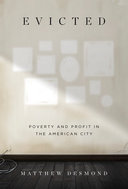
Evicted: Poverty and Profit in the American City
Author: Matthew Desmond
ISBN: 978-0-553-44745-3
APA Style Citation
Desmond, M. (2016). Evicted: Poverty and Profit in the American City. Penguin Random House LLC, New York, New York.
Buy This Book
https://www.amazon.com/Evicted-Poverty-Profit-American-City/dp/0553447459
Author: Matthew Desmond
ISBN: 978-0-553-44745-3
APA Style Citation
Desmond, M. (2016). Evicted: Poverty and Profit in the American City. Penguin Random House LLC, New York, New York.
Buy This Book
https://www.amazon.com/Evicted-Poverty-Profit-American-City/dp/0553447459

| activity_evicted.docx |
Book Description
Matthew Desmond's Evicted follows eight families in Milwaukee during 2013 who experienced eviction for a variety of different reasons. Desmond lived for a year in Milwaukee, first in a trailer park on the Southside of Milwaukee and then in the inner city in shared apartment. The families he followed are both black and white, some come from middle-class backgrounds, and others have experienced a cycle of poverty for their entire lives. While Desmond specifically examines the impact of the eviction process in Milwaukee, he notes that the statistics (roughly 1 in 8 renters experienced a forced eviction between 2009 and 2011) are similar in other mid-sized American cities. Desmond contends that rents in disadvantaged neighborhoods are not significantly lower than those in middle-class neighborhoods, but the income between those who live in these neighborhoods is significant disparate. This means those living in the worst neighborhoods spend a larger percentage of their income on rent, often leaving little for food and monthly expenses and nothing for emergencies. Many of those depicted in Desmond's book do not qualify for public housing because of a prior eviction on their housing record. Oddly, this often prohibits those who most need housing from qualifying for governmental assistance. Also, the public housing available in most American cities cannot begin to meet the needs of the number of individuals applying.
Desmond contends that the eviction process is a major factor contributing to the creation of high crime rates in inner-city neighborhoods. As people move in and out so quickly, there is little opportunity for a community network to develop in which neighbors work together to keep the neighborhood, block or building safe. One might be inclined to conclude that if rents are not very different in middle-class neighborhoods, those living in dangerous areas should simply move. In Evicted, Desmond follows a family with four children and in another case, two girls who had befriended one another in a shelter (one with two children) to afford a nicer apartment with their combined income. In the first case, the family saw nearly 60 apartments before moving into an apartment for which they were approved only by concealing the fact that they had three more children than reported. The two girls looked at over 80 apartments before being accepted for an apartment in the inner-city ghetto for which they were extremely grateful. They had wanted to move into a nicer neighborhood, but as soon as the landlord saw them, those units became mysteriously “unavailable.” Because individuals who have an eviction on their housing record have few options in terms of who will accept them as tenants, they also hold little sway when asking landlords to repair damages to the properties in which they live. Desmond also follows a Milwaukee landlord and her husband who own multiple properties in the inner city. When a tenant complains that a sink or toilet is not working, Sherrena (the landlady) blames the tenant for negligence and threatens to kick them out of the apartment rather than fix the problem. When one of her buildings burns down because of a hot plate, which starts a fire (the stove was not working), rather than concern herself with the death of the child caught in the fire, she worries about deflecting any responsibility and concealing the fact that the necessary fire alarms had never been installed.
Whether it is in dilapidated buildings in the primarily African American inner city of Milwaukee or the primarily Caucasian Southside trailer park, the problems Desmond witnesses first hand are similar. Landlords looking to make a profit are under little obligation to improve the living conditions of individuals with nowhere to go. Repairs are unattended, and even Desmond`s trailer was without heat for months despite multiple requests to have it repaired, and with full knowledge that he was there because he was writing a book on poor living conditions. While poverty cuts across racial boundaries, Milwaukee remains a deeply segregated city, which creates a tremendous glut of housing in certain areas. When an African-American mother attempts to find an apartment in a “mixed” neighborhood, she is turned down for apartment after apartment, and those that might have been available are suddenly rented when she comes for a viewing. This forces her back into the overcrowded, inner city in which housing options are limited and often dilapidated. Despite the Fair Housing Act of 1968, Desmond (who often drove individuals to see these apartments) records numerous acts of outright discrimination from landlords and property owners which often prevents individuals from moving to more desirable areas of the city.
One individual Desmond tracks over the year is a woman named Larraine. She fell out of an attic window as a child and receives a monthly check from the government because of her learning impairments (as a result of the fall), which prohibit her from working. Her monthly check is $714 and the rent on her trailer home (which she does not own) is $550 per month. This leaves Larraine just $164 dollars per month for food, heat, transportation and any other expenses. When one is attempting to live on $40 per week, any small setback can begin the slippery slope into eviction. When Larraine’s landlord was taken to court for the conditions in which he was keeping the trailer park, Lorraine did not pay her rent, seeing it as pointless if the trailer park was going to be shut down. When the trailer park remained open, her landlord used the missed rent and an opportunity to begin the eviction process. She did not have the money to cover the rent, as she had used to pay a defaulted utility bill and she wanted to have her heat turned back on. Lorraine moved into her brother’s trailer in the same park since he could not decline as he hospitalized at the time. Her belongings were taken to a storage facility for which she had to pay 50 dollars per month. Lorraine had two estranged daughters, and she borrowed money from her brother occasionally but it was not enough to keep her afloat. Eventually, her brother moved from the trailer and she was evicted, and Lorraine could not make payments on her possessions and wound up in a shelter and everything she owned was sold.
In the inner city, eight members of the Hinkston family had lived in a cramped 2-bedroom apartment with a clogged kitchen sink and bathtub and a leaking ceiling. The rear door was off the hinges, the ceiling sagged, and multiple dining room windows were cracked. When they reported these problems to Sherrena (the landlord), she either blamed them for the damage or promised to fix the items, which never happened. Mattresses were set up in nearly every room, but the children still had to share because there was simply no space. One of the family members had a job at Quiznos, others primarily took care of the children and all pooled their money to create a somewhat stable family environment but expressed feeling a lack of hope that their situation could improve. Eventually, numerous family members moved to Tennessee to try and make a fresh start.
Those who might be quick to blame the disadvantaged for lack of financial planning or a lack of motivation or drive should try to understand what it is like for a child caught up in eviction who must move from school to school or miss school while helping a parent search for a new apartment. These children have no material possessions, no books or access to computers; they do not sleep well because they may share a mattress with their siblings in the dining room as in the Hinktson family. While these parents often reported to Desmond that they wanted a better life for their children, the eviction process made it nearly impossible for them to provide a stable life for their children.
Scott was a former middle-class nurse who became addicted to painkillers and who was fired and had his nursing certificate revoked because he was caught stealing medicine from his patients. As he spiraled further into addiction, he lost everything and wound up in a shelter with little hope of earning back his nursing license. Lamar is a veteran, who was a paraplegic from his time in the military trying to raise his three boys on his veteran’s disability check. He was forced to evacuate after a fire in his building, and his family was forced to live in a shelter for a time because he could not find someone to agree to rent to him with such a low monthly income.
Desmond contends that if affordable housing was available to all, the stability of many cities ghettos could be transformed into safer neighborhoods where neighbors knew one and looked out for one another. If public housing was still available for those with an eviction on their housing record, there might be an opportunity for these families to create a stable environment for their children. If landlords repaired and maintained buildings as required by law instead of taking advantage of those with little agency the individuals living in these spaces might take more pride in creating a home for their families. If housing costs did not eat up over 80% of individual’s monthly income, a single set back would not be lead to eviction and might allow for savings and a plan for the future. If the minimum wage allowed people to earn a reasonable living, individuals would be incentivized to work because it might mean an opportunity to improve their condition and their contribution to society. Desmond believes that the issue of eviction has for too long been ignored as a major culprit in what plagues many American cities. His close up examination of real people experiencing eviction challenges many preconceived notions that may be comforting to those looking from a distance but are far from the reality or the day-to-day struggles of those facing eviction.
Other Related Resources
Chicago Tribune: Saving lives, saving money: Hospitals set up homeless patients with permanent housing
http://www.chicagotribune.com/business/ct-biz-hospitals-house-homeless-0114-story.html#nt=oft08a-9gp2
The Guardian: What if the problem with eviction is that it is profitable to other people?
https://www.theguardian.com/books/2016/apr/07/evicted-poverty-and-profit-in-the-american-city-matthew-desmond-review
The New Yorker: Forced out, for many Americans, eviction never ends.
https://www.newyorker.com/magazine/2016/02/08/forced-out
How eviction works: What renters need to know
https://www.nolo.com/legal-encyclopedia/evictions-renters-tenants-rights-29824.html
University of Wisconsin-Madison: Institute or Research on Poverty: Unaffordable America: Poverty, Housing, and Eviction.
https://www.irp.wisc.edu/publications/fastfocus/pdfs/FF22-2015.pdf
Forbes: Why Americans are facing more evictions
https://www.forbes.com/sites/troymcmullen/2016/12/12/why-more-americans-are-facing-eviction/#a1d8ec91617b
Next City: The U.S. Metros hit hardest by rising eviction rates
https://www.forbes.com/sites/troymcmullen/2016/12/12/why-more-americans-are-facing-eviction/#a1d8ec91617b
Psychological Figures and Concepts
Addiction
Discrimination
Poverty
Prejudice
Stereotype Threat
Stereotyping
Matthew Desmond's Evicted follows eight families in Milwaukee during 2013 who experienced eviction for a variety of different reasons. Desmond lived for a year in Milwaukee, first in a trailer park on the Southside of Milwaukee and then in the inner city in shared apartment. The families he followed are both black and white, some come from middle-class backgrounds, and others have experienced a cycle of poverty for their entire lives. While Desmond specifically examines the impact of the eviction process in Milwaukee, he notes that the statistics (roughly 1 in 8 renters experienced a forced eviction between 2009 and 2011) are similar in other mid-sized American cities. Desmond contends that rents in disadvantaged neighborhoods are not significantly lower than those in middle-class neighborhoods, but the income between those who live in these neighborhoods is significant disparate. This means those living in the worst neighborhoods spend a larger percentage of their income on rent, often leaving little for food and monthly expenses and nothing for emergencies. Many of those depicted in Desmond's book do not qualify for public housing because of a prior eviction on their housing record. Oddly, this often prohibits those who most need housing from qualifying for governmental assistance. Also, the public housing available in most American cities cannot begin to meet the needs of the number of individuals applying.
Desmond contends that the eviction process is a major factor contributing to the creation of high crime rates in inner-city neighborhoods. As people move in and out so quickly, there is little opportunity for a community network to develop in which neighbors work together to keep the neighborhood, block or building safe. One might be inclined to conclude that if rents are not very different in middle-class neighborhoods, those living in dangerous areas should simply move. In Evicted, Desmond follows a family with four children and in another case, two girls who had befriended one another in a shelter (one with two children) to afford a nicer apartment with their combined income. In the first case, the family saw nearly 60 apartments before moving into an apartment for which they were approved only by concealing the fact that they had three more children than reported. The two girls looked at over 80 apartments before being accepted for an apartment in the inner-city ghetto for which they were extremely grateful. They had wanted to move into a nicer neighborhood, but as soon as the landlord saw them, those units became mysteriously “unavailable.” Because individuals who have an eviction on their housing record have few options in terms of who will accept them as tenants, they also hold little sway when asking landlords to repair damages to the properties in which they live. Desmond also follows a Milwaukee landlord and her husband who own multiple properties in the inner city. When a tenant complains that a sink or toilet is not working, Sherrena (the landlady) blames the tenant for negligence and threatens to kick them out of the apartment rather than fix the problem. When one of her buildings burns down because of a hot plate, which starts a fire (the stove was not working), rather than concern herself with the death of the child caught in the fire, she worries about deflecting any responsibility and concealing the fact that the necessary fire alarms had never been installed.
Whether it is in dilapidated buildings in the primarily African American inner city of Milwaukee or the primarily Caucasian Southside trailer park, the problems Desmond witnesses first hand are similar. Landlords looking to make a profit are under little obligation to improve the living conditions of individuals with nowhere to go. Repairs are unattended, and even Desmond`s trailer was without heat for months despite multiple requests to have it repaired, and with full knowledge that he was there because he was writing a book on poor living conditions. While poverty cuts across racial boundaries, Milwaukee remains a deeply segregated city, which creates a tremendous glut of housing in certain areas. When an African-American mother attempts to find an apartment in a “mixed” neighborhood, she is turned down for apartment after apartment, and those that might have been available are suddenly rented when she comes for a viewing. This forces her back into the overcrowded, inner city in which housing options are limited and often dilapidated. Despite the Fair Housing Act of 1968, Desmond (who often drove individuals to see these apartments) records numerous acts of outright discrimination from landlords and property owners which often prevents individuals from moving to more desirable areas of the city.
One individual Desmond tracks over the year is a woman named Larraine. She fell out of an attic window as a child and receives a monthly check from the government because of her learning impairments (as a result of the fall), which prohibit her from working. Her monthly check is $714 and the rent on her trailer home (which she does not own) is $550 per month. This leaves Larraine just $164 dollars per month for food, heat, transportation and any other expenses. When one is attempting to live on $40 per week, any small setback can begin the slippery slope into eviction. When Larraine’s landlord was taken to court for the conditions in which he was keeping the trailer park, Lorraine did not pay her rent, seeing it as pointless if the trailer park was going to be shut down. When the trailer park remained open, her landlord used the missed rent and an opportunity to begin the eviction process. She did not have the money to cover the rent, as she had used to pay a defaulted utility bill and she wanted to have her heat turned back on. Lorraine moved into her brother’s trailer in the same park since he could not decline as he hospitalized at the time. Her belongings were taken to a storage facility for which she had to pay 50 dollars per month. Lorraine had two estranged daughters, and she borrowed money from her brother occasionally but it was not enough to keep her afloat. Eventually, her brother moved from the trailer and she was evicted, and Lorraine could not make payments on her possessions and wound up in a shelter and everything she owned was sold.
In the inner city, eight members of the Hinkston family had lived in a cramped 2-bedroom apartment with a clogged kitchen sink and bathtub and a leaking ceiling. The rear door was off the hinges, the ceiling sagged, and multiple dining room windows were cracked. When they reported these problems to Sherrena (the landlord), she either blamed them for the damage or promised to fix the items, which never happened. Mattresses were set up in nearly every room, but the children still had to share because there was simply no space. One of the family members had a job at Quiznos, others primarily took care of the children and all pooled their money to create a somewhat stable family environment but expressed feeling a lack of hope that their situation could improve. Eventually, numerous family members moved to Tennessee to try and make a fresh start.
Those who might be quick to blame the disadvantaged for lack of financial planning or a lack of motivation or drive should try to understand what it is like for a child caught up in eviction who must move from school to school or miss school while helping a parent search for a new apartment. These children have no material possessions, no books or access to computers; they do not sleep well because they may share a mattress with their siblings in the dining room as in the Hinktson family. While these parents often reported to Desmond that they wanted a better life for their children, the eviction process made it nearly impossible for them to provide a stable life for their children.
Scott was a former middle-class nurse who became addicted to painkillers and who was fired and had his nursing certificate revoked because he was caught stealing medicine from his patients. As he spiraled further into addiction, he lost everything and wound up in a shelter with little hope of earning back his nursing license. Lamar is a veteran, who was a paraplegic from his time in the military trying to raise his three boys on his veteran’s disability check. He was forced to evacuate after a fire in his building, and his family was forced to live in a shelter for a time because he could not find someone to agree to rent to him with such a low monthly income.
Desmond contends that if affordable housing was available to all, the stability of many cities ghettos could be transformed into safer neighborhoods where neighbors knew one and looked out for one another. If public housing was still available for those with an eviction on their housing record, there might be an opportunity for these families to create a stable environment for their children. If landlords repaired and maintained buildings as required by law instead of taking advantage of those with little agency the individuals living in these spaces might take more pride in creating a home for their families. If housing costs did not eat up over 80% of individual’s monthly income, a single set back would not be lead to eviction and might allow for savings and a plan for the future. If the minimum wage allowed people to earn a reasonable living, individuals would be incentivized to work because it might mean an opportunity to improve their condition and their contribution to society. Desmond believes that the issue of eviction has for too long been ignored as a major culprit in what plagues many American cities. His close up examination of real people experiencing eviction challenges many preconceived notions that may be comforting to those looking from a distance but are far from the reality or the day-to-day struggles of those facing eviction.
Other Related Resources
Chicago Tribune: Saving lives, saving money: Hospitals set up homeless patients with permanent housing
http://www.chicagotribune.com/business/ct-biz-hospitals-house-homeless-0114-story.html#nt=oft08a-9gp2
The Guardian: What if the problem with eviction is that it is profitable to other people?
https://www.theguardian.com/books/2016/apr/07/evicted-poverty-and-profit-in-the-american-city-matthew-desmond-review
The New Yorker: Forced out, for many Americans, eviction never ends.
https://www.newyorker.com/magazine/2016/02/08/forced-out
How eviction works: What renters need to know
https://www.nolo.com/legal-encyclopedia/evictions-renters-tenants-rights-29824.html
University of Wisconsin-Madison: Institute or Research on Poverty: Unaffordable America: Poverty, Housing, and Eviction.
https://www.irp.wisc.edu/publications/fastfocus/pdfs/FF22-2015.pdf
Forbes: Why Americans are facing more evictions
https://www.forbes.com/sites/troymcmullen/2016/12/12/why-more-americans-are-facing-eviction/#a1d8ec91617b
Next City: The U.S. Metros hit hardest by rising eviction rates
https://www.forbes.com/sites/troymcmullen/2016/12/12/why-more-americans-are-facing-eviction/#a1d8ec91617b
Psychological Figures and Concepts
Addiction
Discrimination
Poverty
Prejudice
Stereotype Threat
Stereotyping


 RSS Feed