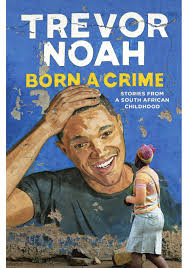
Born a Crime
Author: Trevor Noah
ISBN: 978-0399-588-174
APA Style Citation
Noah, T. (2016). Born a Crime. New York; Penguin Random House LLC.
Buy this Book
https://www.amazon.com/dp/B01DHWACVY/ref=dp-kindle-redirect?_encoding=UTF8&btkr=1
Author: Trevor Noah
ISBN: 978-0399-588-174
APA Style Citation
Noah, T. (2016). Born a Crime. New York; Penguin Random House LLC.
Buy this Book
https://www.amazon.com/dp/B01DHWACVY/ref=dp-kindle-redirect?_encoding=UTF8&btkr=1

| little_things_are_big.docx |
Book Description
You may know Trevor Noah as a stand-up comedian and the host of the Daily Show, but his early life in South Africa was anything but a comedy, involving discrimination, kidnapping, and continual fear for his safety. Noah was born to a South African mother from the Xhosa tribe and a Swiss father. His mother wanted to have a child and told Noah’s father that he was not expected to play a role in the child’s life. While Noah did occasionally see his father growing up, it was not the arrangement between his parents that posed the problem; it was that his birth was illegal in South Africa, thus the title of the book, Noah was himself Born a Crime.
The Immorality Act of 1927 in South Africa made it illegal for Europeans to have intercourse with natives and the repercussions involved imprisonment and removal of the child form the parent(s). While the Europeans involved were often not charged, the natives were prosecuted, which meant that just the sight of Noah, a mixed-race child, was evidence of his mother’s crime. To make matters worse, a stereotype existed that women from the Xhosa tribe were “loose,” and the sight of a light-skinned boy seemed to reinforce this stereotype and restricted where the two could travel together and where they could live due to the fear that someone would report them. Because of these restrictions Noah spent much time alone as a child.
Noah described his attempted kidnapping when he was 9-years old. South Africa did not provide public transportation for blacks at the time, as an alternative, they set up a series of minibusses to accommodate this gap in services. The problem was that the minibus service was inconsistent and was run by both Zulu and Xhosa members who did not like one another. Each Sunday Noah’s mother paraded the family (herself, Noah and his younger brother) to three different church services. Noah refers to these services as “black church,” “white church” and “mixed church.” One day, the old Volkswagen they tried to keep running broke down, but Noah’s mother insisted on attending church services. By the time the services were over, it was late, and they waited for a minibus to bring them home. When a minibus finally arrived, it was driven by two Zulu men who called Noah’s Xhosa mother terrible names and indicated they were going to “teach her a lesson.” They refused to drop the family off, and Noah and his mom were forced to jump from the moving minibus and run for their lives, knowing they would be killed if the men caught them.
When Noah was young, his family moved frequently, but because Noah was often seen as white and the rest of his family was black it was difficult to find available housing. At the time in South Africa, blacks and whites could not live together, and that essentially meant that the family did not belong anywhere. Noah could be picked up at any moment in a black neighborhood because it was clear that he did not belong, but his mother who was much darker would not be permitted to live in a neighborhood reserved for whites. They made it work for a while in a white neighborhood that allowed maids and other household staff to live nearby. Eventually, they moved in with Noah’s grandmother where Noah was forced to play behind a stone fence usually by himself because he could not roam free in the neighborhood. His mother would ask a light-skinned friend to come by so that Trevor could go to the park, Trevor walked with the friend, and his mother walked a few paces behind so that others would assume she was the nanny. As a result, he could not refer to his mother as “mom” in public for fear of the reprisals that would follow.
Attending school was also a challenge for Noah because while he grew up in black family but those blacks outside his family saw him as something different and generally avoided interactions making Noah’s childhood quite lonely. Even his family saw him as different; his grandmother refused to spank Noah when he did something wrong because his skin would bruise easily and she believed that she was causing serious damage. He even got more food and fewer chores because of the implicit racism and deference that his family members had grown accustomed to living for so long under the rules that governed South African Apartheid. Noah did make friends (and money) at school by running at lunch to be first in line at the snack bar. He would take order for others, so others not have to wait in line and eventually became at least friendly with most of the groups at school if not close because of this “business” partnership he had formed. His ability to pick up multiple languages also allowed him to have friendships with people from many different groups. Because he had lived in such a variety of neighborhoods, Noah spoke a bit of many different tribal languages in addition to perfect English and South Afrikaans. In addition to the challenges with race, Noah had to face the challenges of growing up poor. There was rarely enough money for meat, and he had to sleep on the floor of his grandmother’s living room for years alongside his cousins. They shared an outhouse with many other families, and he faced social ostracism at school as a result of his old, ill-fitting clothes. This coupled with this mixed race made finding his place very difficult.
Noah discusses the outright discrimination he faced at the hand of public officials in South Africa, which likely would surprise outsiders. In South Africa, police were willing to say that they pulled Noah over simply because they were police officers and he was black. In one such instance, Noah had “borrowed” a car that his stepfather (a mechanic) was working on without permission, and since he was not willing to call his stepfather to confirm that the car was his, Noah spent time in jail for stealing the car. He was terrified in prison, but that passed relatively quickly once he realized that everyone else was just pretending to be tough and were just as scared as Trevor. He got fed, had a place to sleep, and had no responsibilities in prison. He was more worried about facing his mother and stepfather when he eventually got out than surviving in jail. He called a friend to help with the bail money, which of course was sent by his mother, and she knew everything when he got home.
Noah’s mother worked long hours to support her extended family and was eventually able to purchase a small house of her own. She married an alcoholic auto mechanic who believed that a wife should obey her husband and defer to him on all things. Noah’s mother did not share these beliefs, and while his stepfather spiraled into alcoholism, he stopped working and began abusing Noah and his mother. Noah left home when he was eighteen because he was tired of living in fear of his stepfather. Years later, Noah’s mother went to the police to report the abuse, but the police believed that is a husband’s right to beat his wife and took no action, so the years of abuse continued. Others believed she was lying because Abel, her husband, seemed like a nice guy when he was not drinking, or they were his friends and were not willing to intervene in family affairs. Eventually, Noah’s mother took her youngest son (Noah`s stepbrother) and moved back to her mother’s house even though she was paying the mortgage for the home her estranged husband was living in at the time as well. Noah`s stepfather was insulted by her leaving and felt she has disrespected him and deserved to be punished. He found Noah’s mother at her family`s home shot her in the head. It is only by some miracle that the bullet missed any important brain matter and his mother lived. Noah called his stepfather in a rage, but he expressed no remorse, only saying, “If I knew where you were, I would have shot you too.”
Noah was no angel either; he stole, was responsible for setting a friends house on fire (in accident) and let a friend take the blame for stealing in which they had both been involved. He also made money in high school by illegally burning CDs for other kids at his school which provided some money of his own and money meant freedom. Now living in a post-apartheid South Africa, Noah could buy things that before we off limits such as food from McDonald's. For a time, he ate McDonald's for every meal, and he felt rich. Eventually, he turned his CD business into a DJ business, throwing street parties and hiring dancers to get the party started. Because of this group, he began making money. This same group also began a mini loan business in the overcrowded, poor town of Alexandria making small loans to people and then collecting interest or buying what people were selling on the street and reselling it for a profit.
Eventually, Noah started to perform stand-up comedy in South Africa and then in other countries. Despite his success, the discrimination and hardship of his childhood have shaped the person he is today. The overt racism that existed under the system of Apartheid may be official over, but there are still many challenges for the poor and those who do not fit neatly into the categories created by a society that discriminates against people based on race, tribal affiliation and wealth. This book is also a reflection of the determinental and lasting impact that discrimination, bullying and judgment can have on an individual.
Other Related Resources
Article: Killing of Blacks by Whites are more likely to be ruled “Justifiable”
http://keenetrial.com/blog/2017/09/01/killings-of-blacks-by-whites-are-more-likely-to-be-ruled-justifiable/
Huffington Post: Reducing Institutional Racism
https://www.huffingtonpost.com/entry/air-force-academy-racial-slurs_us_59ce2313e4b05f005d339307?ncid=inblnkushpmg00000009
Association for Psychological Science: Cooperation driven by reciprocity, not conformity
https://www.psychologicalscience.org/news/releases/cooperation-driven-by-reciprocity-not-conformity.html
Huffington Post: If women talked about men the way men talk about women
https://www.huffingtonpost.com/entry/twitter-thread-historical-male-figures-satire_us_59ab74d3e4b0354e440ad8fe?ncid=inblnkushpmg00000009
NPR Pittsburgh: Helping Police to overcome prejudice
https://www.huffingtonpost.com/entry/twitter-thread-historical-male-figures-satire_us_59ab74d3e4b0354e440ad8fe?ncid=inblnkushpmg00000009
Think Progress: The Wage gap between Whites and Blacks is as large as it was 40 years ago
http://wesa.fm/post/meet-man-helping-pittsburgh-police-confront-their-racial-biases#stream/0
Psychological Concepts and Figures
Addiction
Bilingualism
Discrimination
Poverty
Prejudice
Perceptual Set
Resources
Stereotyping
Substance Abuse
You may know Trevor Noah as a stand-up comedian and the host of the Daily Show, but his early life in South Africa was anything but a comedy, involving discrimination, kidnapping, and continual fear for his safety. Noah was born to a South African mother from the Xhosa tribe and a Swiss father. His mother wanted to have a child and told Noah’s father that he was not expected to play a role in the child’s life. While Noah did occasionally see his father growing up, it was not the arrangement between his parents that posed the problem; it was that his birth was illegal in South Africa, thus the title of the book, Noah was himself Born a Crime.
The Immorality Act of 1927 in South Africa made it illegal for Europeans to have intercourse with natives and the repercussions involved imprisonment and removal of the child form the parent(s). While the Europeans involved were often not charged, the natives were prosecuted, which meant that just the sight of Noah, a mixed-race child, was evidence of his mother’s crime. To make matters worse, a stereotype existed that women from the Xhosa tribe were “loose,” and the sight of a light-skinned boy seemed to reinforce this stereotype and restricted where the two could travel together and where they could live due to the fear that someone would report them. Because of these restrictions Noah spent much time alone as a child.
Noah described his attempted kidnapping when he was 9-years old. South Africa did not provide public transportation for blacks at the time, as an alternative, they set up a series of minibusses to accommodate this gap in services. The problem was that the minibus service was inconsistent and was run by both Zulu and Xhosa members who did not like one another. Each Sunday Noah’s mother paraded the family (herself, Noah and his younger brother) to three different church services. Noah refers to these services as “black church,” “white church” and “mixed church.” One day, the old Volkswagen they tried to keep running broke down, but Noah’s mother insisted on attending church services. By the time the services were over, it was late, and they waited for a minibus to bring them home. When a minibus finally arrived, it was driven by two Zulu men who called Noah’s Xhosa mother terrible names and indicated they were going to “teach her a lesson.” They refused to drop the family off, and Noah and his mom were forced to jump from the moving minibus and run for their lives, knowing they would be killed if the men caught them.
When Noah was young, his family moved frequently, but because Noah was often seen as white and the rest of his family was black it was difficult to find available housing. At the time in South Africa, blacks and whites could not live together, and that essentially meant that the family did not belong anywhere. Noah could be picked up at any moment in a black neighborhood because it was clear that he did not belong, but his mother who was much darker would not be permitted to live in a neighborhood reserved for whites. They made it work for a while in a white neighborhood that allowed maids and other household staff to live nearby. Eventually, they moved in with Noah’s grandmother where Noah was forced to play behind a stone fence usually by himself because he could not roam free in the neighborhood. His mother would ask a light-skinned friend to come by so that Trevor could go to the park, Trevor walked with the friend, and his mother walked a few paces behind so that others would assume she was the nanny. As a result, he could not refer to his mother as “mom” in public for fear of the reprisals that would follow.
Attending school was also a challenge for Noah because while he grew up in black family but those blacks outside his family saw him as something different and generally avoided interactions making Noah’s childhood quite lonely. Even his family saw him as different; his grandmother refused to spank Noah when he did something wrong because his skin would bruise easily and she believed that she was causing serious damage. He even got more food and fewer chores because of the implicit racism and deference that his family members had grown accustomed to living for so long under the rules that governed South African Apartheid. Noah did make friends (and money) at school by running at lunch to be first in line at the snack bar. He would take order for others, so others not have to wait in line and eventually became at least friendly with most of the groups at school if not close because of this “business” partnership he had formed. His ability to pick up multiple languages also allowed him to have friendships with people from many different groups. Because he had lived in such a variety of neighborhoods, Noah spoke a bit of many different tribal languages in addition to perfect English and South Afrikaans. In addition to the challenges with race, Noah had to face the challenges of growing up poor. There was rarely enough money for meat, and he had to sleep on the floor of his grandmother’s living room for years alongside his cousins. They shared an outhouse with many other families, and he faced social ostracism at school as a result of his old, ill-fitting clothes. This coupled with this mixed race made finding his place very difficult.
Noah discusses the outright discrimination he faced at the hand of public officials in South Africa, which likely would surprise outsiders. In South Africa, police were willing to say that they pulled Noah over simply because they were police officers and he was black. In one such instance, Noah had “borrowed” a car that his stepfather (a mechanic) was working on without permission, and since he was not willing to call his stepfather to confirm that the car was his, Noah spent time in jail for stealing the car. He was terrified in prison, but that passed relatively quickly once he realized that everyone else was just pretending to be tough and were just as scared as Trevor. He got fed, had a place to sleep, and had no responsibilities in prison. He was more worried about facing his mother and stepfather when he eventually got out than surviving in jail. He called a friend to help with the bail money, which of course was sent by his mother, and she knew everything when he got home.
Noah’s mother worked long hours to support her extended family and was eventually able to purchase a small house of her own. She married an alcoholic auto mechanic who believed that a wife should obey her husband and defer to him on all things. Noah’s mother did not share these beliefs, and while his stepfather spiraled into alcoholism, he stopped working and began abusing Noah and his mother. Noah left home when he was eighteen because he was tired of living in fear of his stepfather. Years later, Noah’s mother went to the police to report the abuse, but the police believed that is a husband’s right to beat his wife and took no action, so the years of abuse continued. Others believed she was lying because Abel, her husband, seemed like a nice guy when he was not drinking, or they were his friends and were not willing to intervene in family affairs. Eventually, Noah’s mother took her youngest son (Noah`s stepbrother) and moved back to her mother’s house even though she was paying the mortgage for the home her estranged husband was living in at the time as well. Noah`s stepfather was insulted by her leaving and felt she has disrespected him and deserved to be punished. He found Noah’s mother at her family`s home shot her in the head. It is only by some miracle that the bullet missed any important brain matter and his mother lived. Noah called his stepfather in a rage, but he expressed no remorse, only saying, “If I knew where you were, I would have shot you too.”
Noah was no angel either; he stole, was responsible for setting a friends house on fire (in accident) and let a friend take the blame for stealing in which they had both been involved. He also made money in high school by illegally burning CDs for other kids at his school which provided some money of his own and money meant freedom. Now living in a post-apartheid South Africa, Noah could buy things that before we off limits such as food from McDonald's. For a time, he ate McDonald's for every meal, and he felt rich. Eventually, he turned his CD business into a DJ business, throwing street parties and hiring dancers to get the party started. Because of this group, he began making money. This same group also began a mini loan business in the overcrowded, poor town of Alexandria making small loans to people and then collecting interest or buying what people were selling on the street and reselling it for a profit.
Eventually, Noah started to perform stand-up comedy in South Africa and then in other countries. Despite his success, the discrimination and hardship of his childhood have shaped the person he is today. The overt racism that existed under the system of Apartheid may be official over, but there are still many challenges for the poor and those who do not fit neatly into the categories created by a society that discriminates against people based on race, tribal affiliation and wealth. This book is also a reflection of the determinental and lasting impact that discrimination, bullying and judgment can have on an individual.
Other Related Resources
Article: Killing of Blacks by Whites are more likely to be ruled “Justifiable”
http://keenetrial.com/blog/2017/09/01/killings-of-blacks-by-whites-are-more-likely-to-be-ruled-justifiable/
Huffington Post: Reducing Institutional Racism
https://www.huffingtonpost.com/entry/air-force-academy-racial-slurs_us_59ce2313e4b05f005d339307?ncid=inblnkushpmg00000009
Association for Psychological Science: Cooperation driven by reciprocity, not conformity
https://www.psychologicalscience.org/news/releases/cooperation-driven-by-reciprocity-not-conformity.html
Huffington Post: If women talked about men the way men talk about women
https://www.huffingtonpost.com/entry/twitter-thread-historical-male-figures-satire_us_59ab74d3e4b0354e440ad8fe?ncid=inblnkushpmg00000009
NPR Pittsburgh: Helping Police to overcome prejudice
https://www.huffingtonpost.com/entry/twitter-thread-historical-male-figures-satire_us_59ab74d3e4b0354e440ad8fe?ncid=inblnkushpmg00000009
Think Progress: The Wage gap between Whites and Blacks is as large as it was 40 years ago
http://wesa.fm/post/meet-man-helping-pittsburgh-police-confront-their-racial-biases#stream/0
Psychological Concepts and Figures
Addiction
Bilingualism
Discrimination
Poverty
Prejudice
Perceptual Set
Resources
Stereotyping
Substance Abuse
 RSS Feed