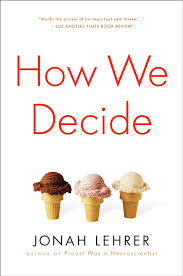
How We Decide
Author: Jonah Lehrer
ISBN: 978-0-618-62011-1
APA Style Citation
Lehrer, J. (2009). How We Decide. New York, New York: Houghton Mifflin.
Author: Jonah Lehrer
ISBN: 978-0-618-62011-1
APA Style Citation
Lehrer, J. (2009). How We Decide. New York, New York: Houghton Mifflin.

| activity_handout_1.pdf |
| activity_handout_2.pdf |
| directions_how_we_decide_5.pdf |
Book Description
Philosophers, psychologists, and others who attempt to determine the cause of human and animal behavior have long debated the influence of both rationality and emotion. Plato believed that with enough conscious evaluation the rational self would prevail, while others have argued that consciousness was not enough. How We Decide attempts to determine the difference between making a good and a bad decision which sometimes is the difference between winning and losing: money, gambling, and even in some cases, life and are significantly impacted by the decision we make. While there is not an either/or answer to the rational/emotional debate, author Jonah Lehrer argues that for too long people have discounted the importance of the emotional components of the brain when investigating decision-making. This, he argues explains why the attempts to create robots or computers with artificial intelligence have been relatively unsuccessful. Although the robots may have cognitively abilities, they do not have the emotional capacity required for effective decision-making.
Lehrer provides insight into how neuroscience can better help us understand how our brain makes decisions and how we can use this information to make better ones. The orbitofrontal cortex (OBF) for example which connects the emotional limbic system to the rational frontal lobe has in important role in decision making. Individuals who have had tumors in this region of the brain removed become paralyzed by their inability to make decisions, even small ones, such as what type of cereal to buy or what day would work best for an appointment.
Dopamine pathways, which are the pleasure centers in the midbrain and run through the nucleus accumbens and hypothalamus, drive behavior that leads to rewards which may impact the decisions one makes, even if those decisions are not in the best interests of the individuals making them. Dopamine reward pathways are activated when rats eat a treat or when a person wins at a slot machine. Dopamine reward pathways also change with experience, Lehrer notes, “Fool me once, shame on you, fool me twice, shame on my dopamine neurons.” Schizophrenics sometimes have an abundance of dopamine neurons which interferes with the accurate prediction of events, they instead hallucinate false patterns and sensory information. These dopamine pathways need to be continually retrained or their predictive accuracy declines. Those who suffer from Parkinson’s disease often lack dopamine and are treated with dopamine agonists. In 13% of cases Parkinson’s patients treated with dopamine agonist drugs become gambling addicts because of the excess of dopamine running through their system. A win in gambling activates the same dopamine reward pathways and triggers the desire to win again and again.
Another area of the brain, the anterior cingulate cortex, influences decisions because it allows us to detect errors in our decisions. Neuroscientists refer to the circuitry emanating from this area of the brain as the “oh shit” circuit. This brain mechanism allows people to control what they know with what they feel. When this area is removed from primates, their behavior becomes erratic. The anterior cingulate cortex also contains spindle neurons which are found only in humans and great apes and are named for their long slender structure. This structure allows the neuron to convey emotions across the entire brain and these cells as a result are related to higher order cognitive functions.
Lehrer recounts many examples of how the seemingly intuitive decisions we make each day are actually based on past experiences and the more experience we have, the better we are able to make accurate split second decisions. Lehrer features Tom Brady’s performance in the 2002 Super Bowl in which the Patriots were predicted to lose to the highly favored St. Louis Rams. Tom Brady and the Patriots decided in the last minute of the game to work their way down the field in a series of passes that might have resulted in a Ram’s interception. Most considered this highly risky, but the young Brady seemed confident that he could lead his team to success. Ultimately, Brady brought the team within field goal range and the Patriots won in the last seconds of the game. Brady did not have time to evaluate each of the possible passes he could make, after the snap and before the opposing team attempted to sack him yet, he was able to make the correct decision on where to throw a pass over and over again. Explicit knowledge that initially takes much cognitive ability eventually becomes intuitive. However, we can often be wrong when relying on our intuition. The idea of a “hot hand” specifically in basketball has been refuted and evidence shows that when one has made previous shots, they actually declined in their likelihood of scoring despite what observers believed. Whether it is slot machines or a random shuffle of one’s i-tunes, what is actually random does not always seem to be. This violates our intuitive belief of what random events “look like”. For example, if a family who has five girls and is having another baby, most people will believe that the next baby will be a boy despite the roughly 50-50 chance of that happening. The genders of the existing children are completely separate and do not factor into the odds of what the new baby’s gender will be.
We are also averse to losing when making decisions. When questions are framed that lead to the same outcome, those that are framed as losing are selected far less frequently than those that are framed as winning (see activity). This can lead to poor decision making in terms of making investments in the stock market. We may be better off in the long run hanging on to a stock that is losing money at the moment, but we often trade when the stock is at its lowest for fear of losing more money than we already have. Bond returns grow more slowly than stocks, but are less variable. Many people would prefer to invest in bonds because they are less likely to lose money (but also less likely to earn very much money) when they would be better off investing in higher risk stocks. Loss aversion also makes credit cards easier to use. If we had to pay cash for an item we wanted, we would feel the loss because we would have to sacrifice cash at the moment of purchase, but with credit cards the bill does not come until later and we feel immediate gratification with the purchase without experiencing the loss. Individuals tend to overvalue immediate gains at the cost of future expenses. When someone thinks about losing something, the amygdala is automatically activated which is part of the physiological reason for why people hate losing.
Sometimes more access to information leads to a less favorable result which can be seen in a variety of practical applications. Those who are involved with tracking the stock market and have access to much information about the history of a given stock actually performed worse because of constant trading than those who made no had no knowledge of the stock market and made no trades in a given period. Medical technology, specifically MRIs for back pain, has made far more information available to doctors. One might believe that this wealth of information has dramatically improved results for those experiencing back pain but that is not the case. Historically, doctors recommended rest and people’s back pain generally subsided. Information from MRI’s has led to many unnecessary surgeries and actually has led to a lower recovery rate.
Some individuals like convicted killer John Wayne Gacy do not respond emotionally to stimuli that would otherwise activate the emotional limbic system. Gacy had an antisocial personality disorder which is often associated with an above average IQ but a damaged emotional brain. Gacy was not disgusted by torturing the young men he killed and was not able to express empathy or sympathy for his victims or their families. For most individuals, the limbic system helps guide decisions and allows us to “feel” when we are doing something wrong. Gacy might have know cognitively that his actions were wrong, but he did not “feel” it as others would. Those with antisocial personality disorder also do not get angry, they have no particular response to highly emotional words such as ‘rape’ or ‘kill’ and do not responded differently to emotional words than they do to neutral words such as ‘sit’ or ‘walk’. Others such as violent domestic batters also have erratic emotional systems. They actually calm down and display lower blood pressure and pulse rates after a violent attack. Likewise, individuals with Autism Spectrum Disorder have an impaired ability to interact emotionally with others. Individuals with autism also demonstrate ineffective decision-making as a result of their irregular emotional responses. Autistic individuals often have challenges with mirror neurons which allow us to mirror the movements and emotions of others. In a study conducted at UCLA, the brains of autistic individuals were examined while they viewed emotional photographs and the scans indicated that there was little activity in the mirror-neuron area. Additionally, autistic individuals look at faces with the part of the brain that normally identifies objects.
How We Decide brings together the cognitive and neurobiological components of an introductory psychology course. While cognitive psychology has longed examined decision-making, the biological underpinnings to these decisions (whether correct or not) help to support psychology’s effort to better understand human behavior. It should be noted that this book may no longer be available in some areas as there has been some questions to the authenticity of the interviews Jonah Lehrer cites in this and other books. You can find below more information about this controversy by examining the related resources section.
Other Related Resources
Jonah Lehrer’s Blog
The author has an interesting and informative blog related to current topics in cognitive psychology. The post from January 25th, 2016 examines cognitive errors by looking at the hit Netflix series, Making a Murderer.
http://www.jonahlehrer.com/?offset=1428246858878
LA times: Making a Case for Letting Emotions in Life’s Decision making processes.
http://articles.latimes.com/2009/feb/24/entertainment/et-book24
Video on How We Decide
An speech given by author Jonah Lehrer describes his work in series of five YouTube videos.
https://www.youtube.com/watch?v=Xllxee8ZnkE
When Instinct Trumps Reason
An interview with author Jonah Lehrer captured in a series of five YouTube videos.
https://www.youtube.com/watch?v=yTeAaKlnz1g
How We Decide Pulled from the Shelves
Short articles describing the controversy regarding the authors use of quotations.
http://www.huffingtonpost.com/2013/03/02/how-we-decide-jonah-lehre_n_2796208.html
http://www.thedailybeast.com/articles/2013/03/01/publisher-pulls-jonah-lehrer-s-how-we-decide-from-stores.html
https://www.psychologytoday.com/blog/pyramids-meaning/201208/jonah-lehrer-charmed-me-then-blatantly-lied-me-about-science
Psychological Figures and Concepts
Rene Descartes
Carol Dweck
Walter Freeman
Sigmund Freud
Harry Harlow
William James
Rosemary Kennedy
George Miller
Walter Mischel
James Olds and Peter Milner
Plato
Herbert Simon
Claude Steele
Agonists
Anchoring Effect
Anchoring Heuristics
Anterior Cingulate Cortex (ACC)
Arousal Theory
Artificial Intelligence
Brainstem
Cognitive Dissonance
Confirmation Bias
Contact Comfort
Corpus Callosum
Diencephalon
Dopamine
Ego
Framing Effect
Frontal Lobe
Gambler’s Fallacy
Groupthink
Hypothalamus
Id
Illusory Correlation
Limbic System
Loss Aversion
Loss Frame
Metacognition
Midbrain
Mirror Neurons
MRI
Natural Selection
Neurons
Nucleus Accumbens
Oedipus Complex
Orbitofrontal Cortex (OFC)
Overconfidence
Parkinson’s Disease
Pleasure Principle
Prefrontal Cortex
Prefrontal Lobotomy
Right Hemisphere
Schizophrenia
Spindle Neurons
Split-Brain Patient
Stereotype Threat
Thalamus
Top-Down Processing
Wonderlic Intelligence Test
Working Memory
Philosophers, psychologists, and others who attempt to determine the cause of human and animal behavior have long debated the influence of both rationality and emotion. Plato believed that with enough conscious evaluation the rational self would prevail, while others have argued that consciousness was not enough. How We Decide attempts to determine the difference between making a good and a bad decision which sometimes is the difference between winning and losing: money, gambling, and even in some cases, life and are significantly impacted by the decision we make. While there is not an either/or answer to the rational/emotional debate, author Jonah Lehrer argues that for too long people have discounted the importance of the emotional components of the brain when investigating decision-making. This, he argues explains why the attempts to create robots or computers with artificial intelligence have been relatively unsuccessful. Although the robots may have cognitively abilities, they do not have the emotional capacity required for effective decision-making.
Lehrer provides insight into how neuroscience can better help us understand how our brain makes decisions and how we can use this information to make better ones. The orbitofrontal cortex (OBF) for example which connects the emotional limbic system to the rational frontal lobe has in important role in decision making. Individuals who have had tumors in this region of the brain removed become paralyzed by their inability to make decisions, even small ones, such as what type of cereal to buy or what day would work best for an appointment.
Dopamine pathways, which are the pleasure centers in the midbrain and run through the nucleus accumbens and hypothalamus, drive behavior that leads to rewards which may impact the decisions one makes, even if those decisions are not in the best interests of the individuals making them. Dopamine reward pathways are activated when rats eat a treat or when a person wins at a slot machine. Dopamine reward pathways also change with experience, Lehrer notes, “Fool me once, shame on you, fool me twice, shame on my dopamine neurons.” Schizophrenics sometimes have an abundance of dopamine neurons which interferes with the accurate prediction of events, they instead hallucinate false patterns and sensory information. These dopamine pathways need to be continually retrained or their predictive accuracy declines. Those who suffer from Parkinson’s disease often lack dopamine and are treated with dopamine agonists. In 13% of cases Parkinson’s patients treated with dopamine agonist drugs become gambling addicts because of the excess of dopamine running through their system. A win in gambling activates the same dopamine reward pathways and triggers the desire to win again and again.
Another area of the brain, the anterior cingulate cortex, influences decisions because it allows us to detect errors in our decisions. Neuroscientists refer to the circuitry emanating from this area of the brain as the “oh shit” circuit. This brain mechanism allows people to control what they know with what they feel. When this area is removed from primates, their behavior becomes erratic. The anterior cingulate cortex also contains spindle neurons which are found only in humans and great apes and are named for their long slender structure. This structure allows the neuron to convey emotions across the entire brain and these cells as a result are related to higher order cognitive functions.
Lehrer recounts many examples of how the seemingly intuitive decisions we make each day are actually based on past experiences and the more experience we have, the better we are able to make accurate split second decisions. Lehrer features Tom Brady’s performance in the 2002 Super Bowl in which the Patriots were predicted to lose to the highly favored St. Louis Rams. Tom Brady and the Patriots decided in the last minute of the game to work their way down the field in a series of passes that might have resulted in a Ram’s interception. Most considered this highly risky, but the young Brady seemed confident that he could lead his team to success. Ultimately, Brady brought the team within field goal range and the Patriots won in the last seconds of the game. Brady did not have time to evaluate each of the possible passes he could make, after the snap and before the opposing team attempted to sack him yet, he was able to make the correct decision on where to throw a pass over and over again. Explicit knowledge that initially takes much cognitive ability eventually becomes intuitive. However, we can often be wrong when relying on our intuition. The idea of a “hot hand” specifically in basketball has been refuted and evidence shows that when one has made previous shots, they actually declined in their likelihood of scoring despite what observers believed. Whether it is slot machines or a random shuffle of one’s i-tunes, what is actually random does not always seem to be. This violates our intuitive belief of what random events “look like”. For example, if a family who has five girls and is having another baby, most people will believe that the next baby will be a boy despite the roughly 50-50 chance of that happening. The genders of the existing children are completely separate and do not factor into the odds of what the new baby’s gender will be.
We are also averse to losing when making decisions. When questions are framed that lead to the same outcome, those that are framed as losing are selected far less frequently than those that are framed as winning (see activity). This can lead to poor decision making in terms of making investments in the stock market. We may be better off in the long run hanging on to a stock that is losing money at the moment, but we often trade when the stock is at its lowest for fear of losing more money than we already have. Bond returns grow more slowly than stocks, but are less variable. Many people would prefer to invest in bonds because they are less likely to lose money (but also less likely to earn very much money) when they would be better off investing in higher risk stocks. Loss aversion also makes credit cards easier to use. If we had to pay cash for an item we wanted, we would feel the loss because we would have to sacrifice cash at the moment of purchase, but with credit cards the bill does not come until later and we feel immediate gratification with the purchase without experiencing the loss. Individuals tend to overvalue immediate gains at the cost of future expenses. When someone thinks about losing something, the amygdala is automatically activated which is part of the physiological reason for why people hate losing.
Sometimes more access to information leads to a less favorable result which can be seen in a variety of practical applications. Those who are involved with tracking the stock market and have access to much information about the history of a given stock actually performed worse because of constant trading than those who made no had no knowledge of the stock market and made no trades in a given period. Medical technology, specifically MRIs for back pain, has made far more information available to doctors. One might believe that this wealth of information has dramatically improved results for those experiencing back pain but that is not the case. Historically, doctors recommended rest and people’s back pain generally subsided. Information from MRI’s has led to many unnecessary surgeries and actually has led to a lower recovery rate.
Some individuals like convicted killer John Wayne Gacy do not respond emotionally to stimuli that would otherwise activate the emotional limbic system. Gacy had an antisocial personality disorder which is often associated with an above average IQ but a damaged emotional brain. Gacy was not disgusted by torturing the young men he killed and was not able to express empathy or sympathy for his victims or their families. For most individuals, the limbic system helps guide decisions and allows us to “feel” when we are doing something wrong. Gacy might have know cognitively that his actions were wrong, but he did not “feel” it as others would. Those with antisocial personality disorder also do not get angry, they have no particular response to highly emotional words such as ‘rape’ or ‘kill’ and do not responded differently to emotional words than they do to neutral words such as ‘sit’ or ‘walk’. Others such as violent domestic batters also have erratic emotional systems. They actually calm down and display lower blood pressure and pulse rates after a violent attack. Likewise, individuals with Autism Spectrum Disorder have an impaired ability to interact emotionally with others. Individuals with autism also demonstrate ineffective decision-making as a result of their irregular emotional responses. Autistic individuals often have challenges with mirror neurons which allow us to mirror the movements and emotions of others. In a study conducted at UCLA, the brains of autistic individuals were examined while they viewed emotional photographs and the scans indicated that there was little activity in the mirror-neuron area. Additionally, autistic individuals look at faces with the part of the brain that normally identifies objects.
How We Decide brings together the cognitive and neurobiological components of an introductory psychology course. While cognitive psychology has longed examined decision-making, the biological underpinnings to these decisions (whether correct or not) help to support psychology’s effort to better understand human behavior. It should be noted that this book may no longer be available in some areas as there has been some questions to the authenticity of the interviews Jonah Lehrer cites in this and other books. You can find below more information about this controversy by examining the related resources section.
Other Related Resources
Jonah Lehrer’s Blog
The author has an interesting and informative blog related to current topics in cognitive psychology. The post from January 25th, 2016 examines cognitive errors by looking at the hit Netflix series, Making a Murderer.
http://www.jonahlehrer.com/?offset=1428246858878
LA times: Making a Case for Letting Emotions in Life’s Decision making processes.
http://articles.latimes.com/2009/feb/24/entertainment/et-book24
Video on How We Decide
An speech given by author Jonah Lehrer describes his work in series of five YouTube videos.
https://www.youtube.com/watch?v=Xllxee8ZnkE
When Instinct Trumps Reason
An interview with author Jonah Lehrer captured in a series of five YouTube videos.
https://www.youtube.com/watch?v=yTeAaKlnz1g
How We Decide Pulled from the Shelves
Short articles describing the controversy regarding the authors use of quotations.
http://www.huffingtonpost.com/2013/03/02/how-we-decide-jonah-lehre_n_2796208.html
http://www.thedailybeast.com/articles/2013/03/01/publisher-pulls-jonah-lehrer-s-how-we-decide-from-stores.html
https://www.psychologytoday.com/blog/pyramids-meaning/201208/jonah-lehrer-charmed-me-then-blatantly-lied-me-about-science
Psychological Figures and Concepts
Rene Descartes
Carol Dweck
Walter Freeman
Sigmund Freud
Harry Harlow
William James
Rosemary Kennedy
George Miller
Walter Mischel
James Olds and Peter Milner
Plato
Herbert Simon
Claude Steele
Agonists
Anchoring Effect
Anchoring Heuristics
Anterior Cingulate Cortex (ACC)
Arousal Theory
Artificial Intelligence
Brainstem
Cognitive Dissonance
Confirmation Bias
Contact Comfort
Corpus Callosum
Diencephalon
Dopamine
Ego
Framing Effect
Frontal Lobe
Gambler’s Fallacy
Groupthink
Hypothalamus
Id
Illusory Correlation
Limbic System
Loss Aversion
Loss Frame
Metacognition
Midbrain
Mirror Neurons
MRI
Natural Selection
Neurons
Nucleus Accumbens
Oedipus Complex
Orbitofrontal Cortex (OFC)
Overconfidence
Parkinson’s Disease
Pleasure Principle
Prefrontal Cortex
Prefrontal Lobotomy
Right Hemisphere
Schizophrenia
Spindle Neurons
Split-Brain Patient
Stereotype Threat
Thalamus
Top-Down Processing
Wonderlic Intelligence Test
Working Memory
 RSS Feed