
| you_may_also_like_activity_.docx |
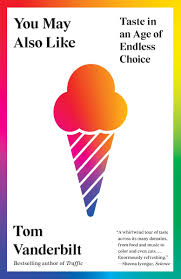
You May Also Like: Taste in an Age of Endless Choice
Author: Tom Vanderbilt
ISBN: 978-0-307-93859-5
APA Style Citation
Vanderbilt, T. (2016). You may also like: Taste in an age of endless choice. New York, NY: Vintage Books.
Buy This Book here:
https://www.amazon.com/You-May-Also-Like-Endless/dp/0307948595
Book Description
Tom Vanderbilt explores why we like what we like. This seems fairly straight forward, we have an experience, we determine how we feel about that experience and then assess that experience. We tend to believe that our preference leads us to a choice, but Vanderbilt sites economists who argue that this can also work in reverse and that our choices can lead to preferences. For example, once we have paid $200 for concert tickets, we are more likely to report liking that concert than if we saw the same concert for free. Effort justification is one component of liking, it occurs when the more effort we put into something is indicative of liking that experience more. Vanderbilt explores many more of the components that make up liking and reveals that we often fool ourselves into believing that we have total control over what we like and that we are not influenced by outside sources.
Preference for colors may be one of the earliest likes we verbalize, however, it may be the association of colors that feed our preferences rather than the color itself. Young girls may describe a preference for pink not because of some natural inclination but rather because the marketing of toys that they enjoy are often pink. Pinkaliciousis a cartoon character intended to appeal to young girls, liking the character may also increase liking of the color. We may demonstrate a preference for our own school colors without realizing that we are demonstrating a preference for colors that have brought some positive outcome or feeling in the past.
Our preferences for taste may in part have a biological basis, we are quicker to articulate what we do not like rather than what we like. Evolutionary psychologists suggest that we have a natural inclination to dislike bitter tastes. Try to recall your first taste of coffee, you likely cut the bitterness with milk or sugar, but over time you may have come to enjoy and even crave this taste, thus bypassing your natural preferences. The taste for sweet conversely is prewired and desirable as highly caloric foods may have served the function of providing calories and energy. Provide a young child with a taste of bitter chocolate or sweet candy and the preference will be easily displayed. Humans naturally are “neophobic” or hesitant to try new foods, this may be because we do not know what new foods contain and are not certain that they are safe. Think of the first time you have tried a new food, chances are you did not immediately fall in love. Vanderbilt argues that the mere exposure effect has a dramatic influence on what we like or do not like. We tend not to like what is new or different, this applies to tastes, or music or fashion rather, the more we are exposed to something, the more we tend to like it. Once we try that new food, song, or style over and over again, it becomes familiar which often leads to liking. However, this liking is not completely objective, we now have an expectation of what a certain food will taste like or what a certain genre of music should sound like and we compare it to past experiences.
This top-down processing allows us to place our experiences into context by comparing them to similar experiences in the past. If you loved classic 1960s rock music and then heard the punk music of the 1970s you may have initially been horrified, but after listening over and over again you may find you prefer this to classic rock. Just seeing a new food or knowing your favorite band has a new album creates an expectation before the sensory experiences even begins. While we attribute our preference to bottom-up processing, our preferences are driven by our expectations as much as by our sensory receptors. We also like choice, just by having items on a menu or a playlist to select from makes us enjoy our choice more that if this is out of our control. If you go to The Cheesecake Factoryand are presented with a menu that spans seven pages, you may still choose the same item or few items each time you dine, but the illusion of choice increases your liking for what you have selected.
Marketers make a living from studying people`s preferences and may know what we like, or dislike better than we do. We are not always honest in reporting what we like because we want to portray ourselves in a positive light. Organizations like Netflix know this, so you might report that you love watching historical documentaries, but the recommendation Netflix is making for you is a silly romantic comedy. What people say they like and what they actually watch are not the same. Todd Yellin, Netflix vice president for product innovation says, “You might giveHotel Rwandafive stars and two stars to Captain America, but you are much more likely to watch Captain America.” We also don`t necessarily show consistency over what we like, as people rate the same movie differently after multiple viewings. Context, mood, setting, and who you watch a movie with have a tremendous impact on your preference for that film, food, person, artwork, etc.
Experts no longer have the same sway as before in terms of creating our sense of liking. With social media sites anyone can become an expert and the opinions of lay people and experts vary greatly. Those who rate hotels or restaurants, tend to come from a bimodal population, they either had a great experience or a horrible experience and can easily share this online. When we see positive reviews, we are more likely to follow suit or adjust our opinion in a positive direction. When the first comments are negative, the next comments seem to also follow suit. However, this can backfire; books that have received literary awards actually are rated lower after they receive the rewards. Presumably this occurs because sales increase after the award causing people who would not normally purchase the book to buy a book that might not suit their particular preferences. It may also set up an unrealistic expectation that the book will be life changing and it may not live up to the hype. Too many reviews online are like too many choices, even if a book or a hotel has 4,000 reviews you cannot reasonably take in and assess all of that information, so you will read a few reviews and make a decision from there.
Everyone wants to feel that we are unique in our likes or dislikes, so we reject the idea that we are conforming to a norm, we feel silly when we wear the same shorts as someone else to work or wear the same prom dress, which we think perfectly suits our personality. Solomon Asch clearly demonstrated our tendency to conform to others in his historic line study, but just as the participants in his study stated that they believed they provided the correct responses, we also believe that we set our own trends and do not give into the pressure of conformity. We conform to the preferences of our friends and fashion and we tend to like those who share our preferences.
Each of these factors contribute to the vast lists of likes and dislikes we experience each day. Knowing these factors can allow us to realize that preferences are more subjective and less personal than we might like to believe. Knowing how are preferences are shaped can help marketers or advertisers, or those social media influencers shape our likes and dislikes. Vanderbilt`s research demonstrates that, “we really can account for taste.”
Author: Tom Vanderbilt
ISBN: 978-0-307-93859-5
APA Style Citation
Vanderbilt, T. (2016). You may also like: Taste in an age of endless choice. New York, NY: Vintage Books.
Buy This Book here:
https://www.amazon.com/You-May-Also-Like-Endless/dp/0307948595
Book Description
Tom Vanderbilt explores why we like what we like. This seems fairly straight forward, we have an experience, we determine how we feel about that experience and then assess that experience. We tend to believe that our preference leads us to a choice, but Vanderbilt sites economists who argue that this can also work in reverse and that our choices can lead to preferences. For example, once we have paid $200 for concert tickets, we are more likely to report liking that concert than if we saw the same concert for free. Effort justification is one component of liking, it occurs when the more effort we put into something is indicative of liking that experience more. Vanderbilt explores many more of the components that make up liking and reveals that we often fool ourselves into believing that we have total control over what we like and that we are not influenced by outside sources.
Preference for colors may be one of the earliest likes we verbalize, however, it may be the association of colors that feed our preferences rather than the color itself. Young girls may describe a preference for pink not because of some natural inclination but rather because the marketing of toys that they enjoy are often pink. Pinkaliciousis a cartoon character intended to appeal to young girls, liking the character may also increase liking of the color. We may demonstrate a preference for our own school colors without realizing that we are demonstrating a preference for colors that have brought some positive outcome or feeling in the past.
Our preferences for taste may in part have a biological basis, we are quicker to articulate what we do not like rather than what we like. Evolutionary psychologists suggest that we have a natural inclination to dislike bitter tastes. Try to recall your first taste of coffee, you likely cut the bitterness with milk or sugar, but over time you may have come to enjoy and even crave this taste, thus bypassing your natural preferences. The taste for sweet conversely is prewired and desirable as highly caloric foods may have served the function of providing calories and energy. Provide a young child with a taste of bitter chocolate or sweet candy and the preference will be easily displayed. Humans naturally are “neophobic” or hesitant to try new foods, this may be because we do not know what new foods contain and are not certain that they are safe. Think of the first time you have tried a new food, chances are you did not immediately fall in love. Vanderbilt argues that the mere exposure effect has a dramatic influence on what we like or do not like. We tend not to like what is new or different, this applies to tastes, or music or fashion rather, the more we are exposed to something, the more we tend to like it. Once we try that new food, song, or style over and over again, it becomes familiar which often leads to liking. However, this liking is not completely objective, we now have an expectation of what a certain food will taste like or what a certain genre of music should sound like and we compare it to past experiences.
This top-down processing allows us to place our experiences into context by comparing them to similar experiences in the past. If you loved classic 1960s rock music and then heard the punk music of the 1970s you may have initially been horrified, but after listening over and over again you may find you prefer this to classic rock. Just seeing a new food or knowing your favorite band has a new album creates an expectation before the sensory experiences even begins. While we attribute our preference to bottom-up processing, our preferences are driven by our expectations as much as by our sensory receptors. We also like choice, just by having items on a menu or a playlist to select from makes us enjoy our choice more that if this is out of our control. If you go to The Cheesecake Factoryand are presented with a menu that spans seven pages, you may still choose the same item or few items each time you dine, but the illusion of choice increases your liking for what you have selected.
Marketers make a living from studying people`s preferences and may know what we like, or dislike better than we do. We are not always honest in reporting what we like because we want to portray ourselves in a positive light. Organizations like Netflix know this, so you might report that you love watching historical documentaries, but the recommendation Netflix is making for you is a silly romantic comedy. What people say they like and what they actually watch are not the same. Todd Yellin, Netflix vice president for product innovation says, “You might giveHotel Rwandafive stars and two stars to Captain America, but you are much more likely to watch Captain America.” We also don`t necessarily show consistency over what we like, as people rate the same movie differently after multiple viewings. Context, mood, setting, and who you watch a movie with have a tremendous impact on your preference for that film, food, person, artwork, etc.
Experts no longer have the same sway as before in terms of creating our sense of liking. With social media sites anyone can become an expert and the opinions of lay people and experts vary greatly. Those who rate hotels or restaurants, tend to come from a bimodal population, they either had a great experience or a horrible experience and can easily share this online. When we see positive reviews, we are more likely to follow suit or adjust our opinion in a positive direction. When the first comments are negative, the next comments seem to also follow suit. However, this can backfire; books that have received literary awards actually are rated lower after they receive the rewards. Presumably this occurs because sales increase after the award causing people who would not normally purchase the book to buy a book that might not suit their particular preferences. It may also set up an unrealistic expectation that the book will be life changing and it may not live up to the hype. Too many reviews online are like too many choices, even if a book or a hotel has 4,000 reviews you cannot reasonably take in and assess all of that information, so you will read a few reviews and make a decision from there.
Everyone wants to feel that we are unique in our likes or dislikes, so we reject the idea that we are conforming to a norm, we feel silly when we wear the same shorts as someone else to work or wear the same prom dress, which we think perfectly suits our personality. Solomon Asch clearly demonstrated our tendency to conform to others in his historic line study, but just as the participants in his study stated that they believed they provided the correct responses, we also believe that we set our own trends and do not give into the pressure of conformity. We conform to the preferences of our friends and fashion and we tend to like those who share our preferences.
Each of these factors contribute to the vast lists of likes and dislikes we experience each day. Knowing these factors can allow us to realize that preferences are more subjective and less personal than we might like to believe. Knowing how are preferences are shaped can help marketers or advertisers, or those social media influencers shape our likes and dislikes. Vanderbilt`s research demonstrates that, “we really can account for taste.”
Other Related Resources
Video description of book in discussion with Tom Vanderbilt
https://www.youtube.com/watch?v=B9rRDhE409Q
Tom Vanderbilt Website Featuring You May Also Like
http://tomvanderbilt.com/books/you-may-also-like/
Talks at Google: Interview with Tom Vanderbilt
https://talksat.withgoogle.com/talk/you-may-also-like
Social Psych online: The Mere Exposure Effect
http://socialpsychonline.com/2016/03/the-mere-exposure-effect/
Video on Mere Exposure Effect from Easy A
https://www.youtube.com/watch?v=x9MvUdR6j3w
The Guardian: Advertising and Controlling our thoughts
https://www.theguardian.com/commentisfree/2018/dec/31/advertising-academia-controlling-thoughts-universities
Psychological Figures and Concepts
Solomon Asch
John Dewey
Hans Eysenck
Gustav Fechner
Eric Kandel
John Locke
Konrad Lorenz
Stanley Milgram
Amos Tversky
Robert Zajonc
Alzheimer`s Disease
Assimilation
Amygdala
Assimilation
Bimodal Distribution
Bottom-Up Processing
Cognitive Dissonance
Critical Period
Dual Processing
Effort Justification
Factor Analysis
False Consensus Effect
Foveal Vision
Fronto-temporal Dementia
Gestalt
Habituation
Heuristics
Idealized Self
Inter-Rater Reliability
Mere Exposure Effect
Modeling
Necker Cube
Neuropsychology
Pavlovian Conditioning
Priming
Prototype
Psychophysics
Regression to the Mean
Repressed Memories
Snowball Effect
Social Influence Bias
Social Learning
Top-Down Processing
Video description of book in discussion with Tom Vanderbilt
https://www.youtube.com/watch?v=B9rRDhE409Q
Tom Vanderbilt Website Featuring You May Also Like
http://tomvanderbilt.com/books/you-may-also-like/
Talks at Google: Interview with Tom Vanderbilt
https://talksat.withgoogle.com/talk/you-may-also-like
Social Psych online: The Mere Exposure Effect
http://socialpsychonline.com/2016/03/the-mere-exposure-effect/
Video on Mere Exposure Effect from Easy A
https://www.youtube.com/watch?v=x9MvUdR6j3w
The Guardian: Advertising and Controlling our thoughts
https://www.theguardian.com/commentisfree/2018/dec/31/advertising-academia-controlling-thoughts-universities
Psychological Figures and Concepts
Solomon Asch
John Dewey
Hans Eysenck
Gustav Fechner
Eric Kandel
John Locke
Konrad Lorenz
Stanley Milgram
Amos Tversky
Robert Zajonc
Alzheimer`s Disease
Assimilation
Amygdala
Assimilation
Bimodal Distribution
Bottom-Up Processing
Cognitive Dissonance
Critical Period
Dual Processing
Effort Justification
Factor Analysis
False Consensus Effect
Foveal Vision
Fronto-temporal Dementia
Gestalt
Habituation
Heuristics
Idealized Self
Inter-Rater Reliability
Mere Exposure Effect
Modeling
Necker Cube
Neuropsychology
Pavlovian Conditioning
Priming
Prototype
Psychophysics
Regression to the Mean
Repressed Memories
Snowball Effect
Social Influence Bias
Social Learning
Top-Down Processing
 RSS Feed