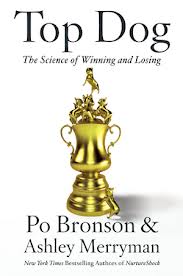
Top Dog: The Science of Winning and Losing
Author(s): Po Bronson and Ashley Merryman
ISBN: 978-1-4555-1515-8
APA Style Citation
Bronson, P., & Merryman, A. (2013). Top Dog the Science of Winning and Losing. New York, NY: Twelve.
Author(s): Po Bronson and Ashley Merryman
ISBN: 978-1-4555-1515-8
APA Style Citation
Bronson, P., & Merryman, A. (2013). Top Dog the Science of Winning and Losing. New York, NY: Twelve.

| open_your_class_with_this_tomorrow_topdog.pdf |
Book Description
The quote from President Dwight Eisenhower, “What counts is not necessarily the size of the dog in the fight – it's the size of the fight in the dog” sets the stage for the book Top Dog. This exciting new book was written by the same authors as Nurture Shock: new thinking about children (2009). The book provides insight into a wide range of research regarding the psychological and physiological factors involved in the differences between winning and losing. The book focuses on the importance of competition as the most significant motivating force in building excellence and the difference between adaptive and maladaptive competitiveness. Specific research regarding factors involving competition and success are provided from a wide range of fields including economics, politics, sports, ballroom dancing, business, and engineering. For example, the common sports analogy of the difference between playing to win and playing not to lose is explained in a case study showing how Swiss watchmakers committed themselves to risk tasking in the face of a huge loss of market share. Prior to the 1970’s almost all of the worlds watches were mechanical in nature, and manufactured in Switzerland. As a result of new technology however Swiss watchmakers were left with only 15% of the watch market when companies like Timex and Citizen began producing quartz based watches. The Swiss fought back by undercutting their competition and creating what would become a prime example of a fighter brand – Swatch watches. This is just one of many examples of how competition fueled achievement and success discussed in the book.
In Top Dog a variety of influences on success including expertise, the personality trait of competitiveness, social facilitation, rivalries, awards, prize structures, odds of success, gender, and biological and genetic differences are evaluated. The book discusses how teams and collaborative work situations often reduce productivity and creativity. Counterintuitively, Bronson and Merryman show how teams whose members are engaged in intense personal rivalries and persistent arguing are often more productive than harmonious ones. A variety of interesting research results related to competitive fire are discussed including:
- Why positive self-talk can backfire and how negative self-talk can actually inspire higher levels of achievement in athletes.
- The N-effect which states that when the number of participants taking part in a competitive task in the same location is higher, individual performance decreases. This can be seen in terms of SAT performance. Even after controlling for academic ability, Alabama, Arkansas, and Montana which have the fewest number of individual test takers present at each testing site also have the highest average SAT scores in the nation.
- How rivalry and physical proximity increases competition and spurs innovation and excellence in college football rivalries, Silicon Valley, and the dominance of the packaging industry by Bologna, Italy.
- The phenomenon of the near-miss bias or how risk taking increases following an event in which good luck impacted the outcome is explored in the near-disaster story about the founding of FedEx - How One Night of Blackjack Sped up the World Economy.
Other Related Resources
The video provided below is a 3-minute interview with one of the authors of Top Dog, Po Bronson who discuss how their research poses a challenge to the 10,000 hour theory presented by Malcom Gladwell in Outliers as well as other highlights from the book.
http://www.youtube.com/watch?v=GcNB5qwoKt0
This article from the New York Times written by Top Dog authors Po Bronson and Ashley Merryman explains how genetic tendencies influence differences in responses to high stakes testing among teens. Specifically, research in this article refers to differences in outcomes related to the COMT gene which explains the degree to which an individual is more likely to be a worrier or a warrior with regards to competition and performance.
http://www.nytimes.com/2013/02/10/magazine/why-can-some-kids-handle-pressure-while-others-fall-apart.html?_r=0
Psychological Figures and Concepts
Muzafer Sherif
Norman Triplett
Robert Zajonc
Arousal theory – zone of optimal arousal
Birth order and risk taking
Creativity and competition
Cognitive biases, overconfidence, and framing effect
Contact theory and superordinate goals
Effects of rewards and motivation on competition
Intrinsic and extrinsic motivation and competition
Mirror neurons/mirror processing
Personality traits and competitiveness
Social facilitation
Social loafing
Stress (fight-or-flight and tend-and-befriend)
Influence of brain regions (anterior cingulate cortex, amygdala, and hypothalamus), neurotransmitters (serotonin and dopamine), and hormones (cortisol, testosterone and oxytocin) on competition and performance.
Positive effects of adrenaline, testosterone, cortisol, and oxytocin on performance.
The quote from President Dwight Eisenhower, “What counts is not necessarily the size of the dog in the fight – it's the size of the fight in the dog” sets the stage for the book Top Dog. This exciting new book was written by the same authors as Nurture Shock: new thinking about children (2009). The book provides insight into a wide range of research regarding the psychological and physiological factors involved in the differences between winning and losing. The book focuses on the importance of competition as the most significant motivating force in building excellence and the difference between adaptive and maladaptive competitiveness. Specific research regarding factors involving competition and success are provided from a wide range of fields including economics, politics, sports, ballroom dancing, business, and engineering. For example, the common sports analogy of the difference between playing to win and playing not to lose is explained in a case study showing how Swiss watchmakers committed themselves to risk tasking in the face of a huge loss of market share. Prior to the 1970’s almost all of the worlds watches were mechanical in nature, and manufactured in Switzerland. As a result of new technology however Swiss watchmakers were left with only 15% of the watch market when companies like Timex and Citizen began producing quartz based watches. The Swiss fought back by undercutting their competition and creating what would become a prime example of a fighter brand – Swatch watches. This is just one of many examples of how competition fueled achievement and success discussed in the book.
In Top Dog a variety of influences on success including expertise, the personality trait of competitiveness, social facilitation, rivalries, awards, prize structures, odds of success, gender, and biological and genetic differences are evaluated. The book discusses how teams and collaborative work situations often reduce productivity and creativity. Counterintuitively, Bronson and Merryman show how teams whose members are engaged in intense personal rivalries and persistent arguing are often more productive than harmonious ones. A variety of interesting research results related to competitive fire are discussed including:
- Why positive self-talk can backfire and how negative self-talk can actually inspire higher levels of achievement in athletes.
- The N-effect which states that when the number of participants taking part in a competitive task in the same location is higher, individual performance decreases. This can be seen in terms of SAT performance. Even after controlling for academic ability, Alabama, Arkansas, and Montana which have the fewest number of individual test takers present at each testing site also have the highest average SAT scores in the nation.
- How rivalry and physical proximity increases competition and spurs innovation and excellence in college football rivalries, Silicon Valley, and the dominance of the packaging industry by Bologna, Italy.
- The phenomenon of the near-miss bias or how risk taking increases following an event in which good luck impacted the outcome is explored in the near-disaster story about the founding of FedEx - How One Night of Blackjack Sped up the World Economy.
Other Related Resources
The video provided below is a 3-minute interview with one of the authors of Top Dog, Po Bronson who discuss how their research poses a challenge to the 10,000 hour theory presented by Malcom Gladwell in Outliers as well as other highlights from the book.
http://www.youtube.com/watch?v=GcNB5qwoKt0
This article from the New York Times written by Top Dog authors Po Bronson and Ashley Merryman explains how genetic tendencies influence differences in responses to high stakes testing among teens. Specifically, research in this article refers to differences in outcomes related to the COMT gene which explains the degree to which an individual is more likely to be a worrier or a warrior with regards to competition and performance.
http://www.nytimes.com/2013/02/10/magazine/why-can-some-kids-handle-pressure-while-others-fall-apart.html?_r=0
Psychological Figures and Concepts
Muzafer Sherif
Norman Triplett
Robert Zajonc
Arousal theory – zone of optimal arousal
Birth order and risk taking
Creativity and competition
Cognitive biases, overconfidence, and framing effect
Contact theory and superordinate goals
Effects of rewards and motivation on competition
Intrinsic and extrinsic motivation and competition
Mirror neurons/mirror processing
Personality traits and competitiveness
Social facilitation
Social loafing
Stress (fight-or-flight and tend-and-befriend)
Influence of brain regions (anterior cingulate cortex, amygdala, and hypothalamus), neurotransmitters (serotonin and dopamine), and hormones (cortisol, testosterone and oxytocin) on competition and performance.
Positive effects of adrenaline, testosterone, cortisol, and oxytocin on performance.
 RSS Feed