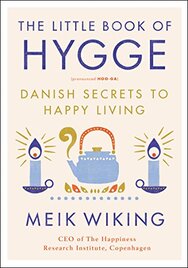
The Little Book of Hygge: Danish Secrets to Happy Living
Author: Meik Wiking
ISBN-10: 0062658808
ISBN-13: 978-0062658807
APA Style Citation
Wiking, M. (2017). The little book of hygge: Danish secrets to happy living. New York, NY: William Morrow.
Buy This Book
https://www.amazon.com/dp/B01GONJFZ2/ref=dp-kindle-redirect?_encoding=UTF8&btkr=1
Author: Meik Wiking
ISBN-10: 0062658808
ISBN-13: 978-0062658807
APA Style Citation
Wiking, M. (2017). The little book of hygge: Danish secrets to happy living. New York, NY: William Morrow.
Buy This Book
https://www.amazon.com/dp/B01GONJFZ2/ref=dp-kindle-redirect?_encoding=UTF8&btkr=1

| hygge_activity.pdf |
Book Description
What is the secret behind the happiest people on earth? The Danes have consistently ranked at the top of global surveys on happiness. But where does happiness come from? Is it genetics, relationships, health, money, employment, or a sense of purpose? Author Meik Wiking, who works at the Happiness Research Institute based in Denmark, believes one important but perhaps overlooked cultural component is hygge (pronounced hoo-ga). He offers tips to increase hygge. While many are stuck at home, this book might offer just the right inspiration to create a little happiness in your life.
Denmark consistently ranks as one of the happiest countries in the world. To be fair, Danes do not have the best weather and they pay some of the highest taxes in the world. However, there is wide support for paying such high taxes because it is seen as an investment in society and quality of life. There is a strong sense of trust between Danes. Perhaps a part of the recipe for happiness that sets Denmark apart from other countries is hygge- a Norwegian word for well-being. Hygge is that coziness and security that brings contentment. While many cultures have a similar term to describe this feeling of coziness, warmth, and togetherness, Danes are obsessed with it and believe it to be uniquely Danish. It is truly a part of their cultural identity. So how does one increase hygge? Candles, fireplaces, blankets, good food, and hanging with friends are just a few ways to build hygge. It doesn’t have to be expensive and it can happen anywhere.
Hygge can be achieved in many ways and take on many forms. It can be those slow weekends, the comfy pair of pants you slip into when you get home, the nook where you sit and relax, or a cozy conversation. One area of focus is a healthy work-life balance. Danes have figured out this balance. Individuals with children usually leave work at 4 p.m. and those without at 5 p.m. About 78% of Danes socialize with others a minimum of once per week. Equality is also an important element in hygge. For example, it is important that everyone helps prepare the food, instead of the host working alone in the kitchen. Time spent with others creates an atmosphere filled with warmth and fullness and a release of oxytocin. Basic living standards are essential for happiness. However, once the baseline has been met, happiness is more about the quality of social relationships. The best predictor of whether we are happy or not is our social relationships. In 2008, one study found that an increase in social involvement may produce an increase of life satisfaction equivalent to an extra $110,000 a year. There is a strong correlation that the more satisfied people are with their social relationships, the happier they are in general. We are social creatures. Danes prefer smaller groups of friends. Many believe the best number of people for hygge is 3 to 4. However, one drawback is Danes tend not to readily admit new friends to their friendship circles. On the flip side, hygge is the best thing for introverts. Those that seek smaller groups gain much from the qualities of hygge.
Light- Approximately 85% of Danes associate hygge with candles to create that cozy feeling. Each Dane burns an average of 13 pounds of candle wax per year. They also prefer natural and organic products over scented candles. In addition, lamps are carefully placed to create a soothing mood. The lower the temperature of the light, the more hygge. Usually, it is better to have several smaller lamps around the room rather than one big lamp from the ceiling.
Food and drink- Nordic cuisine has gained some popularity. Noma, a popular restaurant in Copenhagen, has attracted global attention. At a pop-up location in Japan, one dish consisting of live shrimp covered in ants made headlines. Danes love their meat, confectionery, and coffee; and all of these are directly linked to hygge. Denmark is at the top of the list of sweet-crazed nations, obsessed with cakes and pastries. Hot drinks are also popular. Approximately 86% of Danes associate hygge with their favorite drink of coffee. A common belief is “Live life today like there is no coffee tomorrow.” It is about giving yourself a treat, not indulging in the fancy and expensive. These treats are viewed as the same thing as happiness by the brain’s reward system. We associate a certain food with a feeling of pleasure that leaves us wanting more. When it comes to food, the rule of thumb is the longer a dish takes to cook, the more hygge it is. It is about the process, not the end product.
Clothing- The key to Danish dress code is casual. Scarves are a must and the golden rule is the bigger, the better. In Denmark, everyone wears black, layers, and woolen socks. To experience hygge, it is suggested to link purchases with positive experiences. For example, buy a sweater or nice pair of socks that will now be associated with a special event.
Home and Outside the Home- Danes are obsessed with interior design because the home is the heart of hygge. A wish list for hygge at home may include a nook, fireplace, candles, wood elements, nature, books, ceramics, tactile experiences, vintage pieces, blankets, and cushions. Having a comfortable home is about relaxation and finding that well-deserved break. Hygge is built on casualness. Connecting with nature enables you to relax and be present to savor the moment. Cabins include all the ingredients of hygge, such as the smells, sounds, and simplicity. If you need hygge at work, try organizing a potluck, setting up an office garden, bringing your dog to work, or making the office homier.
Year-Round and on the Cheap- The typical season for hygge is fall or winter. However, it can be experienced year-round. It can include orchards, barbecues, community gardens, picnics, or bike rides. Danes love their bikes and cycling. In Copenhagen, 45% cycle to their place of education or employment. It is an easy way to get a bit of exercise, but it also makes people happier. Riding a bike in your daily commute adds 3 to 14 months to your life expectancy. It’s also an indicator of community and trust. If a lot of people cycle, you probably live in a healthy neighborhood. Hygge is about being simple and modest. It does not have to be expensive. It is about appreciating the simple pleasures of life. The author offers a list of activities each month to inspire a feeling of coziness and a list of inexpensive activities that surround you.
Christmas- The Danish Christmas is first about family and friends. The quality of social relationships has been shown to predict our happiness. Second, are the traditions. The Christmas menu is usually pork or duck. There is also risalamande, a dish made of whipped cream, boiled rice, and finely chopped almonds topped with hot cherry sauce. Hidden in the bowl is one whole almond. Whoever finds the almond gets a present and good luck. There are also special decorations, such as woven paper hearts and a Christmas or Advent candle. The candle is painted like a tape measure with dates from December 1st to 24th. Each day the candle is lit with company and brings the family together. Most TV stations have Advent calendars that count down the days until Christmas. While the preparation for this holiday may sound overwhelming, some stress makes the hygge that follows all that more comforting.
Hygge encompasses all of the senses. The taste is familiar and sweet. The sound is silent or soft. The smell is individualized and relates to your past experiences. The sights are of slow movements, such as falling snow. The touch is of old, homemade belongings that take a long time to make. Finally, there is a sixth sense of feeling safe. The author takes the reader back to a Winnie the Pooh quote, “How do you spell love? You don’t spell it...you feel it.” Hygge is about all of the feelings of coziness and warmth wrapped around you.
Hygge is everyday happiness. It is about making the most of what we have each and every day. Savoring is about enjoying the moment now and hygge is all about the current moment. Evidence-based studies show that practicing gratitude also has many benefits. Those who are grateful are often happier, more helpful and forgiving, sleep better, recover faster, and are less likely to get stressed. Danes plan for hygge times and reminisce about them afterward. The author leaves us with a quote from Benjamin Franklin “Happiness consists more in the small conveniences or pleasures that occur every day, than in great pieces of good fortune that happened but seldom to a man in the course of his life.”
Other Related Resources
Author’s Websitehttps://www.meikwiking.com/
Author’s Instagramhttps://www.instagram.com/meikwiking/?hl=en
What Is Hygge? Everything You Need To Know About The Danish Lifestyle Trend
https://www.countryliving.com/life/a41187/what-is-hygge-things-to-know-about-the-danish-lifestyle-trend/
The Year of Hygge, the Danish Obsession with Getting Cozy
https://www.newyorker.com/culture/culture-desk/the-year-of-hygge-the-danish-obsession-with-getting-cozy
6 Ways to Practice Hygge, the Danish Secret to Happiness
https://www.health.com/mind-body/hygge
Psychological Concepts and Figures
Sigmund Freud
Abraham Maslow
Belongingness hypothesis
Cerebral cortex
Correlation
Cultural identity
Dopamine
Evolutionary psychology
Gratitude
Happiness
Health
Introverts
Life satisfaction
Nature
Nucleus accumbens
Oxytocin
Positive emotions
Senses
Social relationships
Tactile
Well-being
Book Description
What is the secret behind the happiest people on earth? The Danes have consistently ranked at the top of global surveys on happiness. But where does happiness come from? Is it genetics, relationships, health, money, employment, or a sense of purpose? Author Meik Wiking, who works at the Happiness Research Institute based in Denmark, believes one important but perhaps overlooked cultural component is hygge (pronounced hoo-ga). He offers tips to increase hygge. While many are stuck at home, this book might offer just the right inspiration to create a little happiness in your life.
Denmark consistently ranks as one of the happiest countries in the world. To be fair, Danes do not have the best weather and they pay some of the highest taxes in the world. However, there is wide support for paying such high taxes because it is seen as an investment in society and quality of life. There is a strong sense of trust between Danes. Perhaps a part of the recipe for happiness that sets Denmark apart from other countries is hygge- a Norwegian word for well-being. Hygge is that coziness and security that brings contentment. While many cultures have a similar term to describe this feeling of coziness, warmth, and togetherness, Danes are obsessed with it and believe it to be uniquely Danish. It is truly a part of their cultural identity. So how does one increase hygge? Candles, fireplaces, blankets, good food, and hanging with friends are just a few ways to build hygge. It doesn’t have to be expensive and it can happen anywhere.
Hygge can be achieved in many ways and take on many forms. It can be those slow weekends, the comfy pair of pants you slip into when you get home, the nook where you sit and relax, or a cozy conversation. One area of focus is a healthy work-life balance. Danes have figured out this balance. Individuals with children usually leave work at 4 p.m. and those without at 5 p.m. About 78% of Danes socialize with others a minimum of once per week. Equality is also an important element in hygge. For example, it is important that everyone helps prepare the food, instead of the host working alone in the kitchen. Time spent with others creates an atmosphere filled with warmth and fullness and a release of oxytocin. Basic living standards are essential for happiness. However, once the baseline has been met, happiness is more about the quality of social relationships. The best predictor of whether we are happy or not is our social relationships. In 2008, one study found that an increase in social involvement may produce an increase of life satisfaction equivalent to an extra $110,000 a year. There is a strong correlation that the more satisfied people are with their social relationships, the happier they are in general. We are social creatures. Danes prefer smaller groups of friends. Many believe the best number of people for hygge is 3 to 4. However, one drawback is Danes tend not to readily admit new friends to their friendship circles. On the flip side, hygge is the best thing for introverts. Those that seek smaller groups gain much from the qualities of hygge.
Light- Approximately 85% of Danes associate hygge with candles to create that cozy feeling. Each Dane burns an average of 13 pounds of candle wax per year. They also prefer natural and organic products over scented candles. In addition, lamps are carefully placed to create a soothing mood. The lower the temperature of the light, the more hygge. Usually, it is better to have several smaller lamps around the room rather than one big lamp from the ceiling.
Food and drink- Nordic cuisine has gained some popularity. Noma, a popular restaurant in Copenhagen, has attracted global attention. At a pop-up location in Japan, one dish consisting of live shrimp covered in ants made headlines. Danes love their meat, confectionery, and coffee; and all of these are directly linked to hygge. Denmark is at the top of the list of sweet-crazed nations, obsessed with cakes and pastries. Hot drinks are also popular. Approximately 86% of Danes associate hygge with their favorite drink of coffee. A common belief is “Live life today like there is no coffee tomorrow.” It is about giving yourself a treat, not indulging in the fancy and expensive. These treats are viewed as the same thing as happiness by the brain’s reward system. We associate a certain food with a feeling of pleasure that leaves us wanting more. When it comes to food, the rule of thumb is the longer a dish takes to cook, the more hygge it is. It is about the process, not the end product.
Clothing- The key to Danish dress code is casual. Scarves are a must and the golden rule is the bigger, the better. In Denmark, everyone wears black, layers, and woolen socks. To experience hygge, it is suggested to link purchases with positive experiences. For example, buy a sweater or nice pair of socks that will now be associated with a special event.
Home and Outside the Home- Danes are obsessed with interior design because the home is the heart of hygge. A wish list for hygge at home may include a nook, fireplace, candles, wood elements, nature, books, ceramics, tactile experiences, vintage pieces, blankets, and cushions. Having a comfortable home is about relaxation and finding that well-deserved break. Hygge is built on casualness. Connecting with nature enables you to relax and be present to savor the moment. Cabins include all the ingredients of hygge, such as the smells, sounds, and simplicity. If you need hygge at work, try organizing a potluck, setting up an office garden, bringing your dog to work, or making the office homier.
Year-Round and on the Cheap- The typical season for hygge is fall or winter. However, it can be experienced year-round. It can include orchards, barbecues, community gardens, picnics, or bike rides. Danes love their bikes and cycling. In Copenhagen, 45% cycle to their place of education or employment. It is an easy way to get a bit of exercise, but it also makes people happier. Riding a bike in your daily commute adds 3 to 14 months to your life expectancy. It’s also an indicator of community and trust. If a lot of people cycle, you probably live in a healthy neighborhood. Hygge is about being simple and modest. It does not have to be expensive. It is about appreciating the simple pleasures of life. The author offers a list of activities each month to inspire a feeling of coziness and a list of inexpensive activities that surround you.
Christmas- The Danish Christmas is first about family and friends. The quality of social relationships has been shown to predict our happiness. Second, are the traditions. The Christmas menu is usually pork or duck. There is also risalamande, a dish made of whipped cream, boiled rice, and finely chopped almonds topped with hot cherry sauce. Hidden in the bowl is one whole almond. Whoever finds the almond gets a present and good luck. There are also special decorations, such as woven paper hearts and a Christmas or Advent candle. The candle is painted like a tape measure with dates from December 1st to 24th. Each day the candle is lit with company and brings the family together. Most TV stations have Advent calendars that count down the days until Christmas. While the preparation for this holiday may sound overwhelming, some stress makes the hygge that follows all that more comforting.
Hygge encompasses all of the senses. The taste is familiar and sweet. The sound is silent or soft. The smell is individualized and relates to your past experiences. The sights are of slow movements, such as falling snow. The touch is of old, homemade belongings that take a long time to make. Finally, there is a sixth sense of feeling safe. The author takes the reader back to a Winnie the Pooh quote, “How do you spell love? You don’t spell it...you feel it.” Hygge is about all of the feelings of coziness and warmth wrapped around you.
Hygge is everyday happiness. It is about making the most of what we have each and every day. Savoring is about enjoying the moment now and hygge is all about the current moment. Evidence-based studies show that practicing gratitude also has many benefits. Those who are grateful are often happier, more helpful and forgiving, sleep better, recover faster, and are less likely to get stressed. Danes plan for hygge times and reminisce about them afterward. The author leaves us with a quote from Benjamin Franklin “Happiness consists more in the small conveniences or pleasures that occur every day, than in great pieces of good fortune that happened but seldom to a man in the course of his life.”
Other Related Resources
Author’s Websitehttps://www.meikwiking.com/
Author’s Instagramhttps://www.instagram.com/meikwiking/?hl=en
What Is Hygge? Everything You Need To Know About The Danish Lifestyle Trend
https://www.countryliving.com/life/a41187/what-is-hygge-things-to-know-about-the-danish-lifestyle-trend/
The Year of Hygge, the Danish Obsession with Getting Cozy
https://www.newyorker.com/culture/culture-desk/the-year-of-hygge-the-danish-obsession-with-getting-cozy
6 Ways to Practice Hygge, the Danish Secret to Happiness
https://www.health.com/mind-body/hygge
Psychological Concepts and Figures
Sigmund Freud
Abraham Maslow
Belongingness hypothesis
Cerebral cortex
Correlation
Cultural identity
Dopamine
Evolutionary psychology
Gratitude
Happiness
Health
Introverts
Life satisfaction
Nature
Nucleus accumbens
Oxytocin
Positive emotions
Senses
Social relationships
Tactile
Well-being
 RSS Feed