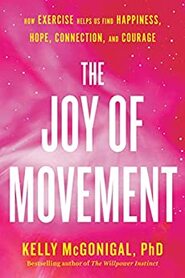
The Joy of Movement
Author: Kelly McGonigal
ISBN-10: 0525534105
ISBN-13: 978-0525534105
APA Style Citation
McGonigal. (2019). The joy of movement. San Francisco, CA: Avery.
Buy This Book
https://www.amazon.com/Joy-Movement-exercise-happiness-connection-ebook/dp/B07Q4LY2CV
Author: Kelly McGonigal
ISBN-10: 0525534105
ISBN-13: 978-0525534105
APA Style Citation
McGonigal. (2019). The joy of movement. San Francisco, CA: Avery.
Buy This Book
https://www.amazon.com/Joy-Movement-exercise-happiness-connection-ebook/dp/B07Q4LY2CV

| joy_of_movement_activity.pdf |
Book Description
If there was a pill to replace exercise and it provided the same benefits without the challenging work, would you take it? Ethicists have posed questions similar to this, and the book The Joy of Movement tries to help the reader understand why movement matters. The author, Kelly McGonigal, uses a blend of quotes, research studies, and storytelling to encourage readers to rethink the purpose of movement. Exercise offers many benefits, such as happiness, satisfaction, purpose, gratitude, love, hope, and connection. But the key focus of the book is on how physical activity contributes to joy.
How does the runner’s high connect to joy?
An extended period of physical activity may lead to a runner’s high, a feeling of euphoria and reduced pain. Some have even likened it to a spiritual experience or love. From an evolutionary perspective, humans have survived because physical activity was pleasurable. The reward of a runner’s high kept individuals hunting and gathering, and willing to cooperate and share. Natural selection has favored traits that allowed humans to run. Researchers have explored the positive correlation of elevated levels of endocannabinoids related to the runner’s high. The key to achieving a runner’s high is movement that consists of continuous and moderate intensity. Perhaps it should be known as the persistence high because doing something moderately difficult for twenty minutes gives the same feeling. The biology of the runner’s high also primes people to connect. Individuals report more positive interactions with their family and friends after exercise. In addition, a sort of cooperation high provides a reward for sharing and cooperating. The runner’s high and the helper’s high provide a powerful combination. One example is GoodGym, an organization in the UK, where you can “get fit by doing good.” Runners combine exercise while volunteering to help their community, such as running to a foodbank and then volunteering to distribute food packages to vulnerable people.
What about getting hooked on exercise?
One study found for regular exercisers who missed even a single workout, they experienced anxiety and irritability. Within three days, they also experienced symptoms of depression, and within one week, they had problems sleeping and severe mood changes. A popular analogy for exercise is addiction. When humans have a sensation in a context that is highly enjoyable, that sensation gets encoded in memory as pleasant. Individuals who exercise regularly have reported enjoying the smell of the pool or yoga mat, the sound of weights dropping, or their favorite running shirt. This is similar to how addicts have learned to enjoy the sight or smell of locations associated with getting a high. Thanks to operant conditioning and receiving positive reinforcement, the exercise behavior continues in the future. But the analogy to addiction is limited because most people who exercise do not experience the distress or dysfunction of addiction or substance abuse. Also, a big difference between the effects of exercise and the effects of drugs, such as cocaine, is timing. It takes longer to get hooked on exercise; for humans up to six weeks. Furthermore, exercise produces fewer extreme spikes in the feel-good chemicals and stimulates the reward system rather than overwhelming it. Perhaps the closest drug exercise could be compared to would be an antidepressant. And a better parallel for physical activity and the reward system might be continuous deep brain stimulation, rather than an addiction.
What about the human brain and genetics in relation to enjoying physical activity?
Researchers selectively bred mice to become super-runners that ran faster, farther, and more often. However, their anatomy wasn’t different than the average mice, instead, it was their brains. The super-runners had larger midbrains, including the reward system. Through natural selection, all humans are genetic super-runners. But why do some people like to exercise, while others do not? The tendency to be active has a heritability rate of 50%, but how much physical activity is enjoyed has a lower rate of 12-37%. Behavior geneticists have been exploring other connections of exercise and genetics. There appears to be a genetic predisposition to experience the mental health benefits of physical activity. Individuals with certain genetic variations are more sensitive to the benefits of regular exercise. There is a reduced risk of depression and suicidal thinking if individuals exercise at least 20 minutes per day. Exercise has also been found effective in treating anxiety disorders.
What is the key to collective joy?
The key to collective joy might be synchrony. Studies found students who danced in unison, felt more bonded. Music and physical exercise were important, but it was the synchrony that was essential and created a sense of group unity. Researchers also measured the ability of dancers to tolerate pain. Even calm, small, and synchronized gestures helped with pain tolerance and social bonding. When we move together, we build social ties and cooperation. It has been found that virtual reality can give the same rush as real synchrony. New apps allow individuals to exercise together and sync their rhythms. There is even a drone that will “run” with you to keep you company.
Think about the power of synchronized groups. As individuals in the armed services march in unison, they become strongly connected. This synchronous movement not only builds friendship networks, but has also been used to defend territory. Hearing synchronized steps, increases the perception of the group being stronger and bigger. Cancer walk/run events also provide a powerful example of group movement leading to a special bond. As individuals walk for 24 hours, they build community and feel like they are part of something bigger. Another example is communities recovering from natural disasters. When members dance to Zumba classes or go out to dance clubs, they connect and build their resilience.
What power does music have on physical movement and happiness?
The body has a natural instinct to move when it hears music. Even newborns can detect a beat. Adding a soundtrack to movement can shave seconds off performance times. Psychologists have helped create playlists for Olympic, national, and collegiate athletes. Even the ordinary exerciser feels more excitement when listening to music while working out. The most powerful songs have a strong beat, energetic feel, and tempo of 120-140 beats per minute. During moderate exercise, music reduces perceived effort and makes the work feel easier and more enjoyable. During higher intensities of excercise, music changes perception and adds a positive meaning to discomfort. The power of music is almost magical. It can help us activate mirror neurons for empathy, access memories, and build muscle memories for joy. So, get your groove on!
How does overcoming obstacles relate to movement and joy?
Obstacle courses, such as Tough Mudder, have individuals run through tear gas tunnels, glide down slides set on fire, cross though a maze of electrified wire, etc. The course focuses on common phobias and provokes just enough fear to push the participants to continue without causing them to quit. As individuals feel helpless, just a little control and the story of finishing motivates people to push forward. DPI gyms, specializing in training people with physical challenges, have a Wall of Greatness. Once someone completes a challenging goal, they can sign the wall and provide words of wisdom. Often their challenge is videotaped, and their friends and family are invited to celebrate when their name is added to the wall. It is important to have witnesses to your triumphs! Overcoming obstacles gives people hope. But hope needs a clear goal, a path to achieve the goal, and trust that one can follow that path. Empathy brings pleasure, but also a sense of what is possible for ourselves. Individuals can even catch hope by watching others move, thanks to mirror neurons. When depressed, watch others exercise, and it can evoke positive feelings.
What about nature and exercise?
Green exercise, physical activity in a natural environment, has a positive effect on one’s mood. Within five minutes of moving outside, individuals report a shift in mood and outlook. Unlike a runner’s high, you don’t have to wait for it. The green exercise high kicks in quickly. When at rest, the brain slips into a default mode where it replays the past and reflects on the future. The default mode often has a negative bias, and those with anxiety or depression are often stuck here. How does one quiet the default mode? One answer is meditation, but green exercise does the same thing with a lot less effort. In one study, after taking a scenic hike, as opposed to a walk on a busy road, participants reported less anxiety and negative self-focused thinking. In another study, after walking for 15 minutes in a nature preserve, people feel better equipped to handle life’s challenges. Globally, people who feel a strong connection to nature report greater life satisfaction, purpose, and happiness. The effect is stronger than the benefits of good health, and equal to being happily married or living with a partner. Furthermore, living in a neighborhood with green space, parks, and community gardens is linked to greater life satisfaction and less psychological distress. GreenGym is an organization where volunteers engage in conservation based on green exercise. Each season they do different tasks that lead to optimism and feeling useful.
What about endurance and the joy of movement?
In order for an activity to be considered ultra-endurance, it must last six hours. But how can pushing one’s body for hours be joyful? Most endurance athletes don’t overwhelm themselves by thinking ahead, instead they take it one step at a time and lean on their positive emotions, music, loved ones, or dedicate their effort to others. When you exercise your body produces myokines. They have been labeled as “hope molecules,” and with every step you contract over 200 myokine-releasing muscles. Have you ever noticed how most long-distance events take place outdoors? Perhaps this is a way for suffering to coexist with the joy created by the scenery. No one does it by themselves. Ultra-runners use a coach to help run at night or keep them eating. When asked to provide pictures, many chose a picture of themselves with other runners, not pictures of their shoes or medals. We need others, and endurance exercising is no different.
Physical activity can bring people together and bring out our best. It is through movement that we can experience joy. Kelly McGonigal recommends, “Move. Any kind, any amount, and any way that makes you happy.” So, if there was a pill to replace exercise, would you take it? Has your opinion changed about the power of movement?
Other Related Resources
Book website
http://kellymcgonigal.com/move
Author contact information
Follow on Twitter: http://twitter.com/kellymcgonigal
Instagram: http://instagram.com/kellymariemcgonigal
Facebook: http://www.facebook.com/kellymcgonigalauthor
Find me at: www.kellymcgonigal.com
Sign up for my email newsletter at: http://eepurl.com/glQxAP
151: Joy of Movement with Kelly McGonigal – Pivot Podcast with Jenny Blake
https://www.youtube.com/watch?v=1M6MYJur0aQ
How exercise can fight loneliness and depression
https://www.youtube.com/watch?v=F38WS6xdn_Y
Book- Born to Run: A Hidden Tribe, Superathletes, and the Greatest Race the World Has Never Seen
https://www.amazon.com/Born-Run-Hidden-Superathletes-Greatest/dp/0307279189
Psychological Concepts and Figures
Charles Darwin
Addiction
Adrenaline
Amygdala
Antidepressants
Anxiety
Attachments
Attentional capture
Behavioral genetics
Biological predisposition
Brain imaging
Collective effervescence
Collective joy
Conditioned response
Continuous deep brain stimulation
Cortisol awakening response
Culturally universal
Depression
Dopamine
Empathy
Endorphins
Evolutionary
Fear circuit
Genome
Green exercise
Habit formation
Happiness
Helper’s high
Heritability
Hope
Hormones
Instincts
Learned helplessness
Meta-analysis
Mindfulness
Mirror neurons
Motor cortex
Muscle memories
Myokines (proteins)
Natural selection
Neurobiology
Opioid system
Optimism
Parkinson’s disease
Pleasure gloss
Prefrontal lobe
Priming
Proprioception
Prosocial
Proximity
Resilience
Rubber hand illusion
Runner’s high
Selective breeding
Self-fulfilling prophecy
Sleep study
Stress
Sympathetic response
Synchrony
Temperament
Transcranial magnetic stimulation
If there was a pill to replace exercise and it provided the same benefits without the challenging work, would you take it? Ethicists have posed questions similar to this, and the book The Joy of Movement tries to help the reader understand why movement matters. The author, Kelly McGonigal, uses a blend of quotes, research studies, and storytelling to encourage readers to rethink the purpose of movement. Exercise offers many benefits, such as happiness, satisfaction, purpose, gratitude, love, hope, and connection. But the key focus of the book is on how physical activity contributes to joy.
How does the runner’s high connect to joy?
An extended period of physical activity may lead to a runner’s high, a feeling of euphoria and reduced pain. Some have even likened it to a spiritual experience or love. From an evolutionary perspective, humans have survived because physical activity was pleasurable. The reward of a runner’s high kept individuals hunting and gathering, and willing to cooperate and share. Natural selection has favored traits that allowed humans to run. Researchers have explored the positive correlation of elevated levels of endocannabinoids related to the runner’s high. The key to achieving a runner’s high is movement that consists of continuous and moderate intensity. Perhaps it should be known as the persistence high because doing something moderately difficult for twenty minutes gives the same feeling. The biology of the runner’s high also primes people to connect. Individuals report more positive interactions with their family and friends after exercise. In addition, a sort of cooperation high provides a reward for sharing and cooperating. The runner’s high and the helper’s high provide a powerful combination. One example is GoodGym, an organization in the UK, where you can “get fit by doing good.” Runners combine exercise while volunteering to help their community, such as running to a foodbank and then volunteering to distribute food packages to vulnerable people.
What about getting hooked on exercise?
One study found for regular exercisers who missed even a single workout, they experienced anxiety and irritability. Within three days, they also experienced symptoms of depression, and within one week, they had problems sleeping and severe mood changes. A popular analogy for exercise is addiction. When humans have a sensation in a context that is highly enjoyable, that sensation gets encoded in memory as pleasant. Individuals who exercise regularly have reported enjoying the smell of the pool or yoga mat, the sound of weights dropping, or their favorite running shirt. This is similar to how addicts have learned to enjoy the sight or smell of locations associated with getting a high. Thanks to operant conditioning and receiving positive reinforcement, the exercise behavior continues in the future. But the analogy to addiction is limited because most people who exercise do not experience the distress or dysfunction of addiction or substance abuse. Also, a big difference between the effects of exercise and the effects of drugs, such as cocaine, is timing. It takes longer to get hooked on exercise; for humans up to six weeks. Furthermore, exercise produces fewer extreme spikes in the feel-good chemicals and stimulates the reward system rather than overwhelming it. Perhaps the closest drug exercise could be compared to would be an antidepressant. And a better parallel for physical activity and the reward system might be continuous deep brain stimulation, rather than an addiction.
What about the human brain and genetics in relation to enjoying physical activity?
Researchers selectively bred mice to become super-runners that ran faster, farther, and more often. However, their anatomy wasn’t different than the average mice, instead, it was their brains. The super-runners had larger midbrains, including the reward system. Through natural selection, all humans are genetic super-runners. But why do some people like to exercise, while others do not? The tendency to be active has a heritability rate of 50%, but how much physical activity is enjoyed has a lower rate of 12-37%. Behavior geneticists have been exploring other connections of exercise and genetics. There appears to be a genetic predisposition to experience the mental health benefits of physical activity. Individuals with certain genetic variations are more sensitive to the benefits of regular exercise. There is a reduced risk of depression and suicidal thinking if individuals exercise at least 20 minutes per day. Exercise has also been found effective in treating anxiety disorders.
What is the key to collective joy?
The key to collective joy might be synchrony. Studies found students who danced in unison, felt more bonded. Music and physical exercise were important, but it was the synchrony that was essential and created a sense of group unity. Researchers also measured the ability of dancers to tolerate pain. Even calm, small, and synchronized gestures helped with pain tolerance and social bonding. When we move together, we build social ties and cooperation. It has been found that virtual reality can give the same rush as real synchrony. New apps allow individuals to exercise together and sync their rhythms. There is even a drone that will “run” with you to keep you company.
Think about the power of synchronized groups. As individuals in the armed services march in unison, they become strongly connected. This synchronous movement not only builds friendship networks, but has also been used to defend territory. Hearing synchronized steps, increases the perception of the group being stronger and bigger. Cancer walk/run events also provide a powerful example of group movement leading to a special bond. As individuals walk for 24 hours, they build community and feel like they are part of something bigger. Another example is communities recovering from natural disasters. When members dance to Zumba classes or go out to dance clubs, they connect and build their resilience.
What power does music have on physical movement and happiness?
The body has a natural instinct to move when it hears music. Even newborns can detect a beat. Adding a soundtrack to movement can shave seconds off performance times. Psychologists have helped create playlists for Olympic, national, and collegiate athletes. Even the ordinary exerciser feels more excitement when listening to music while working out. The most powerful songs have a strong beat, energetic feel, and tempo of 120-140 beats per minute. During moderate exercise, music reduces perceived effort and makes the work feel easier and more enjoyable. During higher intensities of excercise, music changes perception and adds a positive meaning to discomfort. The power of music is almost magical. It can help us activate mirror neurons for empathy, access memories, and build muscle memories for joy. So, get your groove on!
How does overcoming obstacles relate to movement and joy?
Obstacle courses, such as Tough Mudder, have individuals run through tear gas tunnels, glide down slides set on fire, cross though a maze of electrified wire, etc. The course focuses on common phobias and provokes just enough fear to push the participants to continue without causing them to quit. As individuals feel helpless, just a little control and the story of finishing motivates people to push forward. DPI gyms, specializing in training people with physical challenges, have a Wall of Greatness. Once someone completes a challenging goal, they can sign the wall and provide words of wisdom. Often their challenge is videotaped, and their friends and family are invited to celebrate when their name is added to the wall. It is important to have witnesses to your triumphs! Overcoming obstacles gives people hope. But hope needs a clear goal, a path to achieve the goal, and trust that one can follow that path. Empathy brings pleasure, but also a sense of what is possible for ourselves. Individuals can even catch hope by watching others move, thanks to mirror neurons. When depressed, watch others exercise, and it can evoke positive feelings.
What about nature and exercise?
Green exercise, physical activity in a natural environment, has a positive effect on one’s mood. Within five minutes of moving outside, individuals report a shift in mood and outlook. Unlike a runner’s high, you don’t have to wait for it. The green exercise high kicks in quickly. When at rest, the brain slips into a default mode where it replays the past and reflects on the future. The default mode often has a negative bias, and those with anxiety or depression are often stuck here. How does one quiet the default mode? One answer is meditation, but green exercise does the same thing with a lot less effort. In one study, after taking a scenic hike, as opposed to a walk on a busy road, participants reported less anxiety and negative self-focused thinking. In another study, after walking for 15 minutes in a nature preserve, people feel better equipped to handle life’s challenges. Globally, people who feel a strong connection to nature report greater life satisfaction, purpose, and happiness. The effect is stronger than the benefits of good health, and equal to being happily married or living with a partner. Furthermore, living in a neighborhood with green space, parks, and community gardens is linked to greater life satisfaction and less psychological distress. GreenGym is an organization where volunteers engage in conservation based on green exercise. Each season they do different tasks that lead to optimism and feeling useful.
What about endurance and the joy of movement?
In order for an activity to be considered ultra-endurance, it must last six hours. But how can pushing one’s body for hours be joyful? Most endurance athletes don’t overwhelm themselves by thinking ahead, instead they take it one step at a time and lean on their positive emotions, music, loved ones, or dedicate their effort to others. When you exercise your body produces myokines. They have been labeled as “hope molecules,” and with every step you contract over 200 myokine-releasing muscles. Have you ever noticed how most long-distance events take place outdoors? Perhaps this is a way for suffering to coexist with the joy created by the scenery. No one does it by themselves. Ultra-runners use a coach to help run at night or keep them eating. When asked to provide pictures, many chose a picture of themselves with other runners, not pictures of their shoes or medals. We need others, and endurance exercising is no different.
Physical activity can bring people together and bring out our best. It is through movement that we can experience joy. Kelly McGonigal recommends, “Move. Any kind, any amount, and any way that makes you happy.” So, if there was a pill to replace exercise, would you take it? Has your opinion changed about the power of movement?
Other Related Resources
Book website
http://kellymcgonigal.com/move
Author contact information
Follow on Twitter: http://twitter.com/kellymcgonigal
Instagram: http://instagram.com/kellymariemcgonigal
Facebook: http://www.facebook.com/kellymcgonigalauthor
Find me at: www.kellymcgonigal.com
Sign up for my email newsletter at: http://eepurl.com/glQxAP
151: Joy of Movement with Kelly McGonigal – Pivot Podcast with Jenny Blake
https://www.youtube.com/watch?v=1M6MYJur0aQ
How exercise can fight loneliness and depression
https://www.youtube.com/watch?v=F38WS6xdn_Y
Book- Born to Run: A Hidden Tribe, Superathletes, and the Greatest Race the World Has Never Seen
https://www.amazon.com/Born-Run-Hidden-Superathletes-Greatest/dp/0307279189
Psychological Concepts and Figures
Charles Darwin
Addiction
Adrenaline
Amygdala
Antidepressants
Anxiety
Attachments
Attentional capture
Behavioral genetics
Biological predisposition
Brain imaging
Collective effervescence
Collective joy
Conditioned response
Continuous deep brain stimulation
Cortisol awakening response
Culturally universal
Depression
Dopamine
Empathy
Endorphins
Evolutionary
Fear circuit
Genome
Green exercise
Habit formation
Happiness
Helper’s high
Heritability
Hope
Hormones
Instincts
Learned helplessness
Meta-analysis
Mindfulness
Mirror neurons
Motor cortex
Muscle memories
Myokines (proteins)
Natural selection
Neurobiology
Opioid system
Optimism
Parkinson’s disease
Pleasure gloss
Prefrontal lobe
Priming
Proprioception
Prosocial
Proximity
Resilience
Rubber hand illusion
Runner’s high
Selective breeding
Self-fulfilling prophecy
Sleep study
Stress
Sympathetic response
Synchrony
Temperament
Transcranial magnetic stimulation
 RSS Feed