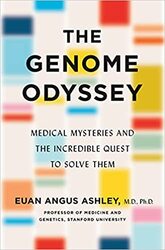
The Genome Odyssey: Medical Mysteries and the Incredible Quest to Solve Them
Author: Eaun Angus Ashley, M.D., Ph.D.
ISBN-10: 1250234999
ISBN-13: 978-1250234995
APA Style Citation
Ashley, E.A. (2021). The genome odyssey: Medical mysteries and the incredible quest to solve them. New York, NY: Celadon Books.
Buy This Book
https://www.amazon.com/Genome-Odyssey-Medical-Mysteries-Incredible/dp/1250234999
Author: Eaun Angus Ashley, M.D., Ph.D.
ISBN-10: 1250234999
ISBN-13: 978-1250234995
APA Style Citation
Ashley, E.A. (2021). The genome odyssey: Medical mysteries and the incredible quest to solve them. New York, NY: Celadon Books.
Buy This Book
https://www.amazon.com/Genome-Odyssey-Medical-Mysteries-Incredible/dp/1250234999

| genome_activity.pdf |
Book Description
The Genome Odyssey provides a summary of the human genome from the first genomes in the Human Genome Project to current work and research. The author, Euan Ashley, is a practicing cardiologist and the founding director of the Center for Inherited Cardiovascular Disease at Stanford University. In his book, he explains the early genomes with a short description of the timeline and price of genome sequencing (determining the DNA sequence of an organism’s genome at a single time). He goes on to share patient stories with unique diseases and his own patients within the cardiac field. Finally, he lays out the future of genomics. What exactly is your genome? Ashley states, “Your genome is three billion letter pairs, six billion data points, two meters of molecule compacted into twenty-three pairs of chromosomes that, if laid end to end with the DNA from the thirty trillion cells in your body, could stretch to the moon and back thousands of times: part of the literal embodiment of what it means to be human.” The genome is a tool to learn about disease, solve medical mysteries, and provide hope, protection and prevention for those with diseases.
First, the author explains the early genomes. He provides a little history on when and how much it cost for some of the first genomes to be sequenced. The Human Genome Project was a ten-year project that provided a genome in the early 2000s, costing multibillions, with multiple country contributors to identify the DNA from ten people. It was intended to have ten volunteers provide 10% each to the full genome to help protect confidentiality and prevent the press from discovering the donor. The approximate twenty thousand genes that account for the proteins that make up 2% of the genome were mapped out. The other 98% of the genome was commonly referred to as “junk DNA” because its function was unclear. It is now understood that this noncoding part of the genome is important in determining whether genes are turned on or off. And half of our genes have pseudogenes in this part of the genome and can regulate the function of other genes. A real human’s genome is diploid, meaning there are two copies of everything. The reference genome was monoploid, with just one copy of every human gene. The single copy genome would be the standard to which all other genomes would be compared to in the following years. Everything did not go as planned, instead the human reference genome comes from the DNA of only two people. It was also found that the reference genome actually contained a mutation, a DNA letter associated with disease. The 1000 Genomes Project, started in 2008, helped provide data to create three new human reference sequences, tuned to three major ethnicities.
The first genome sequence after the project cost around $100 million. In 2009, the author’s journey started by helping a Stanford colleague Steve Quake (patient zero) figure out his own genome and cardiac results (the author’s specialty). His genome cost a mere $40,000. In the eight years after the Human Genome Project, if the price of sequencing the genome could be compared to a Ferrari, then the $350,000 car dropped to forty cents. Steve invented the technology used to sequence the genome and became the first patient to walk into the doctor’s office with his genome. To help read Steve’s genome, the author put together a dream team. This team would list the variants, look at rare variants and diseases, look for common variants for common diseases, look at variants affecting drug responses, and be mindful of ethical considerations. Steve needed to provide informed consent and a genetic counselor was brought on the team. If you test for everything, you might find a lot of results you were not expecting and someone had to help navigate that process. This had never been done before. Steve was a researcher and patient, which made the process even more complex. Fortunately, the team did not find a rare heart disease in Steve’s heart or any genetic variants. However, they did find significant risk for a heart attack. While the price of sequencing the genome was dropping, what about the time to complete it? It took up to a year for one machine to sequence a human genome while running full-time. But if one was to map just the gene sequences and ignore the other 98 percent, then it would take less time and cost even less. In 2010, John West had sequenced his whole family after suffering a pulmonary embolism. It was the first nuclear family to have their genome sequenced and there was an unexplained medical mystery. Soon after the author started a company to move sequencing from academia into industry. The partnership between these fields continues to increase, but also remains far apart. They utilized genetic counselors to analyze and prioritize the genetic variants and explain the results to patients. The price for sequencing your genome was now under $1000.
The author goes on to compare genomic medicine to disease detective work. Traditional methods have included observing, examining, documenting, and analyzing. But now doctors can add another tool of reading one’s genome. Bill Gahl (from Waukesha, WI) became the real Gregory House from the Fox TV series House. He leads the National Institute of Health’s Undiagnosed Diseases Program, which officially opened in 2015. In three years, they found a diagnosis for 35% of cases and defined 31 new syndromes. Ashley shares some of the program’s patients and their rare stories. He also shares the case studies of some of his own cardiac patients. Mosaicism, the term for having more than one genome, happens when copied DNA accumulates mutations. Some people have visual indicators of mosaicism, such as skin with different pigmentations or different eye colors. There is also chimerism, a situation where a person has cells with genomes from completely different people. This happens during pregnancy, patients with organ transplants, or fraternal twins who share a placenta. Genome-wide mapping and using family trees for patients have also helped the disease detective work.
Finally, the author looks to the future. He describes how superhumans can help provide answers to help the typical genome. Genomes from the fittest athletes and those with rare abilities have helped find new treatments for those with heart, lung, blood, and muscle diseases. Also, the growth of biobanks and the value of these large databases is hopeful to better understand the genome. There are over sixty groups around the world that aim to enroll at least 100,000 people in their biobanks. As Ashley stated, “What all these studies have shown is that the larger the study, the greater power for discovery, and the greater our confidence in those discoveries.” Participants can enroll and give consent digitally through an app. Ashley also discusses advances in treatment, such as genetic therapy and improvements to drugs. Genetic therapy has been around since the 1970s, but the first human studies were performed in the 1990s. Many were problematic and the approach was criticized for moving too fast. The scientific community was tasked to go back to the laboratory and learn more. To be effective, the genetic therapy has to get to the cells that matter. Delivery is the biggest challenge. In the last few years there has been success with delivery and genetic therapy. A bacterial defense system called CRISPR has helped researchers target parts of the genome and repair them. In 2017, CRISPR was used to correct a mutation causative of hypertrophic cardiomyopathy in human embryos. A heated debate quickly arose about whether to intervene on human embryos. Then in 2018, a researcher announced the birth of the world’s first gene-edited babies. There is now universal agreement that there needs to be more research on the safety of gene editing before it is considered ethical to use on embryos. We are in the golden age of genetic therapy. Doctors can order a genome, health insurance companies are starting to list genomes as a covered benefit, and some systems are using genome sequencing as preventative care. The future also relies on real-time monitoring of our health. Smart watches can be set to assess your specific genetic risks and look for early detection of those diseases. We can also go beyond sequencing human genes and turn to pathogens as well. Genomics played a huge role in fighting the 2020 SARS-CoV-2 (coronavirus). It also jumpstarted the genomic age of vaccines.
Genome sequencing is getting cheaper and faster, while the data for comparison is becoming more robust. Genomes are often used for rare diseases, but they are also becoming more useful for everyday care. We need to urgently do more research with diverse populations so it can calculate the best scores. But prediction will become more powerful as we sequence more genomes. The question for you will be, do you want to have your genome sequenced?
Other Related Resources
Author's Website- The Ashley Lab
https://ashleylab.stanford.edu/
Health Matters The Genome Odyssey YouTube
https://www.youtube.com/watch?v=RcdqVqYx8_c
Commonwealth Club YouTube
https://www.youtube.com/watch?v=xZx0Kq5ipxo
Human Genome Project
https://www.genome.gov/human-genome-project
What is CRISPR? New Scientist
https://www.newscientist.com/definition/what-is-crispr/
Psychological Concepts and Figures
Antagonist vs. agonist
Anterograde amnesia
Biobank
Bioengineering
Chromosomes
Confidentiality
Congenital insensitivity to pain
Correlations
DNA
Dominant vs. recessive
Embryo
Epigenetics
Ethics
Genes
Genetic counselors
Genome
Hippocampus
Human Genome Project (HGP)
Immune system
Informed consent
MRI
Mutations
Nature vs. nurture
Nucleus
Opioids
Pharmacogenomics
Pituitary gland
Placebo
Pseudogenes
Random assignment
Stem cells
The Genome Odyssey provides a summary of the human genome from the first genomes in the Human Genome Project to current work and research. The author, Euan Ashley, is a practicing cardiologist and the founding director of the Center for Inherited Cardiovascular Disease at Stanford University. In his book, he explains the early genomes with a short description of the timeline and price of genome sequencing (determining the DNA sequence of an organism’s genome at a single time). He goes on to share patient stories with unique diseases and his own patients within the cardiac field. Finally, he lays out the future of genomics. What exactly is your genome? Ashley states, “Your genome is three billion letter pairs, six billion data points, two meters of molecule compacted into twenty-three pairs of chromosomes that, if laid end to end with the DNA from the thirty trillion cells in your body, could stretch to the moon and back thousands of times: part of the literal embodiment of what it means to be human.” The genome is a tool to learn about disease, solve medical mysteries, and provide hope, protection and prevention for those with diseases.
First, the author explains the early genomes. He provides a little history on when and how much it cost for some of the first genomes to be sequenced. The Human Genome Project was a ten-year project that provided a genome in the early 2000s, costing multibillions, with multiple country contributors to identify the DNA from ten people. It was intended to have ten volunteers provide 10% each to the full genome to help protect confidentiality and prevent the press from discovering the donor. The approximate twenty thousand genes that account for the proteins that make up 2% of the genome were mapped out. The other 98% of the genome was commonly referred to as “junk DNA” because its function was unclear. It is now understood that this noncoding part of the genome is important in determining whether genes are turned on or off. And half of our genes have pseudogenes in this part of the genome and can regulate the function of other genes. A real human’s genome is diploid, meaning there are two copies of everything. The reference genome was monoploid, with just one copy of every human gene. The single copy genome would be the standard to which all other genomes would be compared to in the following years. Everything did not go as planned, instead the human reference genome comes from the DNA of only two people. It was also found that the reference genome actually contained a mutation, a DNA letter associated with disease. The 1000 Genomes Project, started in 2008, helped provide data to create three new human reference sequences, tuned to three major ethnicities.
The first genome sequence after the project cost around $100 million. In 2009, the author’s journey started by helping a Stanford colleague Steve Quake (patient zero) figure out his own genome and cardiac results (the author’s specialty). His genome cost a mere $40,000. In the eight years after the Human Genome Project, if the price of sequencing the genome could be compared to a Ferrari, then the $350,000 car dropped to forty cents. Steve invented the technology used to sequence the genome and became the first patient to walk into the doctor’s office with his genome. To help read Steve’s genome, the author put together a dream team. This team would list the variants, look at rare variants and diseases, look for common variants for common diseases, look at variants affecting drug responses, and be mindful of ethical considerations. Steve needed to provide informed consent and a genetic counselor was brought on the team. If you test for everything, you might find a lot of results you were not expecting and someone had to help navigate that process. This had never been done before. Steve was a researcher and patient, which made the process even more complex. Fortunately, the team did not find a rare heart disease in Steve’s heart or any genetic variants. However, they did find significant risk for a heart attack. While the price of sequencing the genome was dropping, what about the time to complete it? It took up to a year for one machine to sequence a human genome while running full-time. But if one was to map just the gene sequences and ignore the other 98 percent, then it would take less time and cost even less. In 2010, John West had sequenced his whole family after suffering a pulmonary embolism. It was the first nuclear family to have their genome sequenced and there was an unexplained medical mystery. Soon after the author started a company to move sequencing from academia into industry. The partnership between these fields continues to increase, but also remains far apart. They utilized genetic counselors to analyze and prioritize the genetic variants and explain the results to patients. The price for sequencing your genome was now under $1000.
The author goes on to compare genomic medicine to disease detective work. Traditional methods have included observing, examining, documenting, and analyzing. But now doctors can add another tool of reading one’s genome. Bill Gahl (from Waukesha, WI) became the real Gregory House from the Fox TV series House. He leads the National Institute of Health’s Undiagnosed Diseases Program, which officially opened in 2015. In three years, they found a diagnosis for 35% of cases and defined 31 new syndromes. Ashley shares some of the program’s patients and their rare stories. He also shares the case studies of some of his own cardiac patients. Mosaicism, the term for having more than one genome, happens when copied DNA accumulates mutations. Some people have visual indicators of mosaicism, such as skin with different pigmentations or different eye colors. There is also chimerism, a situation where a person has cells with genomes from completely different people. This happens during pregnancy, patients with organ transplants, or fraternal twins who share a placenta. Genome-wide mapping and using family trees for patients have also helped the disease detective work.
Finally, the author looks to the future. He describes how superhumans can help provide answers to help the typical genome. Genomes from the fittest athletes and those with rare abilities have helped find new treatments for those with heart, lung, blood, and muscle diseases. Also, the growth of biobanks and the value of these large databases is hopeful to better understand the genome. There are over sixty groups around the world that aim to enroll at least 100,000 people in their biobanks. As Ashley stated, “What all these studies have shown is that the larger the study, the greater power for discovery, and the greater our confidence in those discoveries.” Participants can enroll and give consent digitally through an app. Ashley also discusses advances in treatment, such as genetic therapy and improvements to drugs. Genetic therapy has been around since the 1970s, but the first human studies were performed in the 1990s. Many were problematic and the approach was criticized for moving too fast. The scientific community was tasked to go back to the laboratory and learn more. To be effective, the genetic therapy has to get to the cells that matter. Delivery is the biggest challenge. In the last few years there has been success with delivery and genetic therapy. A bacterial defense system called CRISPR has helped researchers target parts of the genome and repair them. In 2017, CRISPR was used to correct a mutation causative of hypertrophic cardiomyopathy in human embryos. A heated debate quickly arose about whether to intervene on human embryos. Then in 2018, a researcher announced the birth of the world’s first gene-edited babies. There is now universal agreement that there needs to be more research on the safety of gene editing before it is considered ethical to use on embryos. We are in the golden age of genetic therapy. Doctors can order a genome, health insurance companies are starting to list genomes as a covered benefit, and some systems are using genome sequencing as preventative care. The future also relies on real-time monitoring of our health. Smart watches can be set to assess your specific genetic risks and look for early detection of those diseases. We can also go beyond sequencing human genes and turn to pathogens as well. Genomics played a huge role in fighting the 2020 SARS-CoV-2 (coronavirus). It also jumpstarted the genomic age of vaccines.
Genome sequencing is getting cheaper and faster, while the data for comparison is becoming more robust. Genomes are often used for rare diseases, but they are also becoming more useful for everyday care. We need to urgently do more research with diverse populations so it can calculate the best scores. But prediction will become more powerful as we sequence more genomes. The question for you will be, do you want to have your genome sequenced?
Other Related Resources
Author's Website- The Ashley Lab
https://ashleylab.stanford.edu/
Health Matters The Genome Odyssey YouTube
https://www.youtube.com/watch?v=RcdqVqYx8_c
Commonwealth Club YouTube
https://www.youtube.com/watch?v=xZx0Kq5ipxo
Human Genome Project
https://www.genome.gov/human-genome-project
What is CRISPR? New Scientist
https://www.newscientist.com/definition/what-is-crispr/
Psychological Concepts and Figures
Antagonist vs. agonist
Anterograde amnesia
Biobank
Bioengineering
Chromosomes
Confidentiality
Congenital insensitivity to pain
Correlations
DNA
Dominant vs. recessive
Embryo
Epigenetics
Ethics
Genes
Genetic counselors
Genome
Hippocampus
Human Genome Project (HGP)
Immune system
Informed consent
MRI
Mutations
Nature vs. nurture
Nucleus
Opioids
Pharmacogenomics
Pituitary gland
Placebo
Pseudogenes
Random assignment
Stem cells
 RSS Feed