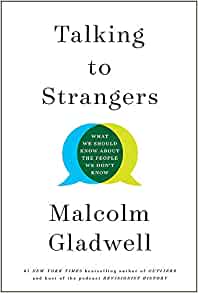
Talking to Strangers
Author: Malcolm Gladwell
ISBN-13: 978-0-316-53562-5
APA Style Citation
Gladwell, M. (2019). Talking to Strangers. Little Brown and Company, Hachette Book Group, New York, N.Y.
Buy this Book
https://www.amazon.com/Talking-Strangers-Should-about-People/dp/0316478520
Author: Malcolm Gladwell
ISBN-13: 978-0-316-53562-5
APA Style Citation
Gladwell, M. (2019). Talking to Strangers. Little Brown and Company, Hachette Book Group, New York, N.Y.
Buy this Book
https://www.amazon.com/Talking-Strangers-Should-about-People/dp/0316478520

| activity_talking_to_strangers_4.pdf |
Book Description
Malcolm Gladwell’s latest foray into the investigation of human behavior explores how implicit biases can lead us astray when evaluating someone’s intentions and behaviors. Most of the stories that Gladwell features are those in which something went wrong, and someone was misjudged because of their charisma, work ethic or skin color. Gladwell opens with the story of Sandra Bland, who was pulled over for a simple traffic stop in Houston, Texas in 2015 and in a series of misjudgments and misunderstandings wound up dead in a Texas jail. Gladwell addresses how Adolf Hitler was able to convince Neville Chamberlin and other world leaders in the 1930s that he was simply trying to unify German speakers who were split apart after WWI, not take over all of Europe. Gladwell addresses judges doling out sentences or determining who will be “high risk” when setting bail. He contends that we often think that we can “see into the hearts of others based on the flimsiest of clues.”
In most cases, people will default to truth, when we are unsure about others intentions, we assume they are being truthful. When we know a little bit about someone else and especially when that little bit is good, “they went to Harvard,” “they are a hard worker,” we tend to demonstrate the halo effect. When this happens, we assume that people with one positive characteristic also have other positive characteristics. This phenomenon allowed Ana Montes to rise through the ranks of the CIA to become known as, “The Queen of Cuba.” Montes was hard-working, attractive, and articulate. When questioned about an American plane that was shot down over Cuba, Montes had answers at the ready, and the CIA agent who interviewed her was satisfied she had nothing to do with the event despite a number of unusual coincidences between her connections in Cuba and the events surrounding the plane incident. As psychological researchers have long known, people are generally terrible at spotting a liar. We are also far more likely to believe that people are telling the truth rather than lying. Tim Levine of the University of Alabama labels this the Truth-Default Theory (TDT). Ana Montes was a spy for the Cubans and had a direct connection to Fidel Castro, but she fooled her co-workers, siblings, and boyfriend (all of whom were in the intelligence community) for years. Once people found out that Montes had been secretly funneling information to Cuba for years, they demonstrated hindsight bias and began to question her earlier behavior, but nobody raised questions at the time. As intelligence officers, they felt guilt about not being able to detect a spy in their ranks, and tried to reflect back on events in which they had suspicions about Montes’ behavior. This rationalization likely helped to alleviate the cognitive dissonance of those who knew and worked with Montes, but Gladwell suggests that we are still likely to default to the truth and believe people even when we should not.
In other examples, Bernie Madoff embezzled hundreds of millions of dollars in a Ponzi scheme, which went on for years undetected despite multiple people raising questions about his returns and the amount of market share he supposedly managed. Jerry Sandusky took advantage of his high-profile status as a football coach to abuse young boys who were in his care. In other cases, we can assume that someone is lying when, in fact, they are telling the truth. Amanda Knox was accused of killing her roommate in a strange sex triangle gone wrong because she did not act “how a grieving roommate should” in her interactions with police and others after the crime occurred. She spent seven years in an Italian prison until it was demonstrated that a drifter with a record was the true perpetrator. Even then, some Italian officials claimed that Knox was the killer because they had become convinced that she committed the crime, and their belief perseverance would not let them change their mind.
One might think that this default to truth is a dangerous way to live as we can be duped into believing people who are lying to us. Levine suggests otherwise, he indicates that in general lies are fairly rare and told by a small subset of people. As such, our default to truth might serve a purpose of social connection because if we questioned everyone’s intentions all of the time, we would often accuse people of lying when they were telling the truth and we would ostracize ourselves for the accusation. We overestimate our ability to judge others behaviors, but according to Gladwell, we may be wrong more often than we think.
Other Related Resources
Malcolm Gladwell website
https://www.gladwellbooks.com
Malcolm Gladwell Revisionist History podcast
http://revisionisthistory.com
Malcolm Gladwell on Taking to Strangers
https://www.youtube.com/watch?v=Is8_0cJx82w
Malcolm Gladwell on C-Span
https://www.c-span.org/video/?464128-1/qa-malcolm-gladwell
Psychological Figures and Concepts
Charles Darwin
Paul Ekman
Tim Levine
Stanley Milgram
Claude Steele
Actor-observer effect
Amygdala
Availability heuristic
Belief perseverance
Cerebellum
Cognitive dissonance
Discrimination
Displacement
Duchenne smile
Frontal lobe
Fundamental attribution error
Halo effect
Hindsight bias
Implicit bias
Just world phenomenon
Overconfidence
Prefrontal cortex
Prejudice
Self-serving bias
Stereotypes
Malcolm Gladwell’s latest foray into the investigation of human behavior explores how implicit biases can lead us astray when evaluating someone’s intentions and behaviors. Most of the stories that Gladwell features are those in which something went wrong, and someone was misjudged because of their charisma, work ethic or skin color. Gladwell opens with the story of Sandra Bland, who was pulled over for a simple traffic stop in Houston, Texas in 2015 and in a series of misjudgments and misunderstandings wound up dead in a Texas jail. Gladwell addresses how Adolf Hitler was able to convince Neville Chamberlin and other world leaders in the 1930s that he was simply trying to unify German speakers who were split apart after WWI, not take over all of Europe. Gladwell addresses judges doling out sentences or determining who will be “high risk” when setting bail. He contends that we often think that we can “see into the hearts of others based on the flimsiest of clues.”
In most cases, people will default to truth, when we are unsure about others intentions, we assume they are being truthful. When we know a little bit about someone else and especially when that little bit is good, “they went to Harvard,” “they are a hard worker,” we tend to demonstrate the halo effect. When this happens, we assume that people with one positive characteristic also have other positive characteristics. This phenomenon allowed Ana Montes to rise through the ranks of the CIA to become known as, “The Queen of Cuba.” Montes was hard-working, attractive, and articulate. When questioned about an American plane that was shot down over Cuba, Montes had answers at the ready, and the CIA agent who interviewed her was satisfied she had nothing to do with the event despite a number of unusual coincidences between her connections in Cuba and the events surrounding the plane incident. As psychological researchers have long known, people are generally terrible at spotting a liar. We are also far more likely to believe that people are telling the truth rather than lying. Tim Levine of the University of Alabama labels this the Truth-Default Theory (TDT). Ana Montes was a spy for the Cubans and had a direct connection to Fidel Castro, but she fooled her co-workers, siblings, and boyfriend (all of whom were in the intelligence community) for years. Once people found out that Montes had been secretly funneling information to Cuba for years, they demonstrated hindsight bias and began to question her earlier behavior, but nobody raised questions at the time. As intelligence officers, they felt guilt about not being able to detect a spy in their ranks, and tried to reflect back on events in which they had suspicions about Montes’ behavior. This rationalization likely helped to alleviate the cognitive dissonance of those who knew and worked with Montes, but Gladwell suggests that we are still likely to default to the truth and believe people even when we should not.
In other examples, Bernie Madoff embezzled hundreds of millions of dollars in a Ponzi scheme, which went on for years undetected despite multiple people raising questions about his returns and the amount of market share he supposedly managed. Jerry Sandusky took advantage of his high-profile status as a football coach to abuse young boys who were in his care. In other cases, we can assume that someone is lying when, in fact, they are telling the truth. Amanda Knox was accused of killing her roommate in a strange sex triangle gone wrong because she did not act “how a grieving roommate should” in her interactions with police and others after the crime occurred. She spent seven years in an Italian prison until it was demonstrated that a drifter with a record was the true perpetrator. Even then, some Italian officials claimed that Knox was the killer because they had become convinced that she committed the crime, and their belief perseverance would not let them change their mind.
One might think that this default to truth is a dangerous way to live as we can be duped into believing people who are lying to us. Levine suggests otherwise, he indicates that in general lies are fairly rare and told by a small subset of people. As such, our default to truth might serve a purpose of social connection because if we questioned everyone’s intentions all of the time, we would often accuse people of lying when they were telling the truth and we would ostracize ourselves for the accusation. We overestimate our ability to judge others behaviors, but according to Gladwell, we may be wrong more often than we think.
Other Related Resources
Malcolm Gladwell website
https://www.gladwellbooks.com
Malcolm Gladwell Revisionist History podcast
http://revisionisthistory.com
Malcolm Gladwell on Taking to Strangers
https://www.youtube.com/watch?v=Is8_0cJx82w
Malcolm Gladwell on C-Span
https://www.c-span.org/video/?464128-1/qa-malcolm-gladwell
Psychological Figures and Concepts
Charles Darwin
Paul Ekman
Tim Levine
Stanley Milgram
Claude Steele
Actor-observer effect
Amygdala
Availability heuristic
Belief perseverance
Cerebellum
Cognitive dissonance
Discrimination
Displacement
Duchenne smile
Frontal lobe
Fundamental attribution error
Halo effect
Hindsight bias
Implicit bias
Just world phenomenon
Overconfidence
Prefrontal cortex
Prejudice
Self-serving bias
Stereotypes
 RSS Feed