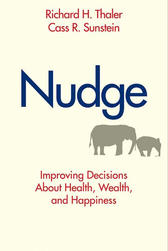
Nudge: Improving Decisions About Health, Wealth, and Happiness
Richard H. Thaler and Cass S. Sunstein
ISBN: 978-0-300-12223-7
APA Style Citation
Thaler, R. and Sunstein, C (2008). Nudge: Improving Decisions About Health, Wealth, and Happiness. New York: Penguin Group.
Richard H. Thaler and Cass S. Sunstein
ISBN: 978-0-300-12223-7
APA Style Citation
Thaler, R. and Sunstein, C (2008). Nudge: Improving Decisions About Health, Wealth, and Happiness. New York: Penguin Group.

| activity_key_nudge.docx |
| nudgehandout1.docx |
| nudgehandout2.docx |
Book Description
Richard H. Thaler and Cass S. Sunstein were both professors of Economics at the University of Chicago at the time of the publication of Nudge. Sunstein went on the work at the White House as the Administer of Information and Regulatory Affairs while Thaler remains at University of Chicago. The authors use Nudge to pose the idea of Libertarian Paternalism, which they describe as a type of choice architecture. They combine the fields of Economics and Psychology to describe how anyone from cafeteria workers to governmental agencies can present choices in such a way to help guide (nudge) people towards better choices while still giving them complete control over those same choices.
Thaler and Sunstein begin with a cafeteria manager who realized students purchase more of items presented close to the beginning of the cafeteria line. If desserts were presented first, students ate more desserts, if fruit was presented first, students ate more fruit. The manager could use this knowledge to make more profit for herself, but Thaler and Sunstein suggest that the paternalism component of libertarian paternalism should provoke her to arrange the healthiest food items first to encourage students to eat as healthy as possible. Students are not forced to choose the first items presented and the manager has not limited the student’s choices, but she found that the arrangement of food items changed the sales of items by up to 25%. Hopefully this finding will be used by others to encourage students to make healthy decisions regarding their food selections.
Thaler and Sunstein recognize that many people will oppose this type of paternalism because it does exert some control over people’s choices and may not always be used in ways that are in the best interests of the average American. They counter by indicating that libertarian paternalism is only intended to look out for the best interests of as many people as possible. They explain the difference between “econs” who would always look at the world objectively without emotion to make the best decisions for themselves and their families and “humans” who are impacted by emotions and busy lives and as a result do not always make the best choices for themselves or their families. Because most of us are “humans”, they argue, libertarian paternalism becomes a helpful necessity.
In many cases libertarian paternalism attempts to encourage humans to make good financial choices. Thaler and Sunstein describe how their University retirement system had individuals opt in each year even if they had been in the system the prior year. Many employees did not think about retirement during the year and forgot to opt in for the upcoming year during the open period. They then had to wait until the following year to opt in again. By speaking with school administrators (none of whom had remembered to opt in) they were able to change the default to remain in the system and only to opt out if they wanted to make a change to their retirement contributions. With this type of choice architecture, far more people participated in the retirement plan at the University. They recommend the same type of programs for new hires who will be automatically entered into a savings system unless they decide to take action and opt out. The idea is that people know they should be saving for retirement but often do not get around to actually taking the action necessary to get started. The State of Illinois has created a default program to become an organ donor and saw a dramatic increase in those donating, presumably saving thousands of lives each year.
Thaler and Sunstein credit Daniel Kahneman for his work with biases and heuristics in which people use a rule of thumb based on prior experiencing or knowledge to make decisions, which often turn out to be erroneous. They use an example of an anchoring heuristic in which people attempt to guess the population of the city of Milwaukee. It is unlikely that people know this answer outright so they will use their own frames or reference to determine the best response. If someone from Chicago were asked the question, they might know that Milwaukee is the largest city in Wisconsin but not as big as Chicago, so they may say about a million since Chicago has about 3 million and it is perhaps about 1/3rd the size. People from Green Bay Wisconsin might estimate that Milwaukee is about three times as large as Green Bay causing them to guess around 300,000. The actual population is about 580,000 but the anchoring bias of each person’s hometown caused them to guess either too high or too low. Thaler and Sunstein explain how these and other heuristics such as the availability and representiveness heuristics can lead to overconfidence in any types of choices and decisions.
Some of the most important decisions we make in our lives are often the result of little thought or effort. Most people never change the accounts in their retirement savings or their prescription drug plan even as their lives or health change. Thaler and Sunstein examined individuals on Medicare and found that most people would have been better served by a different plan, but the people either found the change too complicated or had not given much thought to making a change because they “had health insurance” even if it was not doing them much good. The libertarian paternalism model would create a system in which those running the system would examine each person’s health and prescription needs for the past few months to determine the best plan. This would become their default plan and at least would be correct until their health needs changed.
Conformity also plays a role in the decisions we make. By following what everyone else does, we assume what everyone else does must indicate the best restaurant or the best concert often without giving much thought to what we believe. We can see this evidenced by watching people who eat together match how much they eat to the others they are with. In another study, college roommates often study as much as one another. People recycle more if they are informed that most others do the same and pay their taxes if their tax bill indicates that a high percentage of people also pay their taxes. Energy bills have taken this lead and now often compare each bill payer to their neighbors along with a smiley or frowny face to indicate their level of efficiency. Thaler and Sunstein cite the work of Solomon Asch who tested whether individuals would conform to the perception of line length falsely reported by confederates. Asch found that participants would often go along with a clearly incorrect response if they majority of others in the group did. Asch also found that once a person committed to a response in writing, they were more likely to stand by that response. Campaign officials have replicated this by demonstrating that if people sign a pledge card regarding their intention to vote, they are far more likely to follow through. This method has also worked with blood drives and commitments to healthy eating.
Even human factors psychology plays a role in the design of products that can keep people safe and help them interact with products in a healthier fashion such as stove tops that clearly indicate which on/off knob goes with which burner.
Thaler and Sunstein believe that we need nudges most when the choices we are faced with are complex or ambiguous. Credit card statements do not use nudge tactics and often wind up a poor option for people because the anchoring heuristic is the minimum balance on the payment slip without any indication of how much one will pay in the long run if they only pay the minimum payment. By including this information, Thaler and Sunstein suggest that credit card debt could be substantially decreased. They are convinced that by implementing paternalistic libertarianism, people can do good and do well.
Other Related Resources
Nudge Blog: For sharing ideas about Libertarian Paternalism
http://nudges.org
Forbes: What it Really Means to Nudge
http://www.forbes.com/sites/peterubel/2015/02/20/q-a-with-richard-thaler-on-what-it-really-means-to-be-a-nudge/
The Observer: Has Push Come to Shove for a Fashionable Theory?
http://www.theguardian.com/science/2014/jun/01/nudge-economics-freakonomics-daniel-kahneman-debunked
The Economist: The Limits of Nudging
http://www.economist.com/blogs/freeexchange/2015/07/behavioural-economics
Nudge Theory Explanation: Business Balls
http://www.businessballs.com/nudge-theory.htm
Psychological Figures and Concepts
Solomon Asch
Muzafer Sherif
Availability Heuristic
Anchoring Heuristic
Commoner’s Dilemma
Conformity
Elimination by aspects
Framing
Human Factors Psychology
Incentives
Loss Aversion
Mere-Exposure Effect
Overconfidence
Peripheral Route to Persuasion
Positive
Priming
Representativeness Heuristic
Self-Serving Bias
Richard H. Thaler and Cass S. Sunstein were both professors of Economics at the University of Chicago at the time of the publication of Nudge. Sunstein went on the work at the White House as the Administer of Information and Regulatory Affairs while Thaler remains at University of Chicago. The authors use Nudge to pose the idea of Libertarian Paternalism, which they describe as a type of choice architecture. They combine the fields of Economics and Psychology to describe how anyone from cafeteria workers to governmental agencies can present choices in such a way to help guide (nudge) people towards better choices while still giving them complete control over those same choices.
Thaler and Sunstein begin with a cafeteria manager who realized students purchase more of items presented close to the beginning of the cafeteria line. If desserts were presented first, students ate more desserts, if fruit was presented first, students ate more fruit. The manager could use this knowledge to make more profit for herself, but Thaler and Sunstein suggest that the paternalism component of libertarian paternalism should provoke her to arrange the healthiest food items first to encourage students to eat as healthy as possible. Students are not forced to choose the first items presented and the manager has not limited the student’s choices, but she found that the arrangement of food items changed the sales of items by up to 25%. Hopefully this finding will be used by others to encourage students to make healthy decisions regarding their food selections.
Thaler and Sunstein recognize that many people will oppose this type of paternalism because it does exert some control over people’s choices and may not always be used in ways that are in the best interests of the average American. They counter by indicating that libertarian paternalism is only intended to look out for the best interests of as many people as possible. They explain the difference between “econs” who would always look at the world objectively without emotion to make the best decisions for themselves and their families and “humans” who are impacted by emotions and busy lives and as a result do not always make the best choices for themselves or their families. Because most of us are “humans”, they argue, libertarian paternalism becomes a helpful necessity.
In many cases libertarian paternalism attempts to encourage humans to make good financial choices. Thaler and Sunstein describe how their University retirement system had individuals opt in each year even if they had been in the system the prior year. Many employees did not think about retirement during the year and forgot to opt in for the upcoming year during the open period. They then had to wait until the following year to opt in again. By speaking with school administrators (none of whom had remembered to opt in) they were able to change the default to remain in the system and only to opt out if they wanted to make a change to their retirement contributions. With this type of choice architecture, far more people participated in the retirement plan at the University. They recommend the same type of programs for new hires who will be automatically entered into a savings system unless they decide to take action and opt out. The idea is that people know they should be saving for retirement but often do not get around to actually taking the action necessary to get started. The State of Illinois has created a default program to become an organ donor and saw a dramatic increase in those donating, presumably saving thousands of lives each year.
Thaler and Sunstein credit Daniel Kahneman for his work with biases and heuristics in which people use a rule of thumb based on prior experiencing or knowledge to make decisions, which often turn out to be erroneous. They use an example of an anchoring heuristic in which people attempt to guess the population of the city of Milwaukee. It is unlikely that people know this answer outright so they will use their own frames or reference to determine the best response. If someone from Chicago were asked the question, they might know that Milwaukee is the largest city in Wisconsin but not as big as Chicago, so they may say about a million since Chicago has about 3 million and it is perhaps about 1/3rd the size. People from Green Bay Wisconsin might estimate that Milwaukee is about three times as large as Green Bay causing them to guess around 300,000. The actual population is about 580,000 but the anchoring bias of each person’s hometown caused them to guess either too high or too low. Thaler and Sunstein explain how these and other heuristics such as the availability and representiveness heuristics can lead to overconfidence in any types of choices and decisions.
Some of the most important decisions we make in our lives are often the result of little thought or effort. Most people never change the accounts in their retirement savings or their prescription drug plan even as their lives or health change. Thaler and Sunstein examined individuals on Medicare and found that most people would have been better served by a different plan, but the people either found the change too complicated or had not given much thought to making a change because they “had health insurance” even if it was not doing them much good. The libertarian paternalism model would create a system in which those running the system would examine each person’s health and prescription needs for the past few months to determine the best plan. This would become their default plan and at least would be correct until their health needs changed.
Conformity also plays a role in the decisions we make. By following what everyone else does, we assume what everyone else does must indicate the best restaurant or the best concert often without giving much thought to what we believe. We can see this evidenced by watching people who eat together match how much they eat to the others they are with. In another study, college roommates often study as much as one another. People recycle more if they are informed that most others do the same and pay their taxes if their tax bill indicates that a high percentage of people also pay their taxes. Energy bills have taken this lead and now often compare each bill payer to their neighbors along with a smiley or frowny face to indicate their level of efficiency. Thaler and Sunstein cite the work of Solomon Asch who tested whether individuals would conform to the perception of line length falsely reported by confederates. Asch found that participants would often go along with a clearly incorrect response if they majority of others in the group did. Asch also found that once a person committed to a response in writing, they were more likely to stand by that response. Campaign officials have replicated this by demonstrating that if people sign a pledge card regarding their intention to vote, they are far more likely to follow through. This method has also worked with blood drives and commitments to healthy eating.
Even human factors psychology plays a role in the design of products that can keep people safe and help them interact with products in a healthier fashion such as stove tops that clearly indicate which on/off knob goes with which burner.
Thaler and Sunstein believe that we need nudges most when the choices we are faced with are complex or ambiguous. Credit card statements do not use nudge tactics and often wind up a poor option for people because the anchoring heuristic is the minimum balance on the payment slip without any indication of how much one will pay in the long run if they only pay the minimum payment. By including this information, Thaler and Sunstein suggest that credit card debt could be substantially decreased. They are convinced that by implementing paternalistic libertarianism, people can do good and do well.
Other Related Resources
Nudge Blog: For sharing ideas about Libertarian Paternalism
http://nudges.org
Forbes: What it Really Means to Nudge
http://www.forbes.com/sites/peterubel/2015/02/20/q-a-with-richard-thaler-on-what-it-really-means-to-be-a-nudge/
The Observer: Has Push Come to Shove for a Fashionable Theory?
http://www.theguardian.com/science/2014/jun/01/nudge-economics-freakonomics-daniel-kahneman-debunked
The Economist: The Limits of Nudging
http://www.economist.com/blogs/freeexchange/2015/07/behavioural-economics
Nudge Theory Explanation: Business Balls
http://www.businessballs.com/nudge-theory.htm
Psychological Figures and Concepts
Solomon Asch
Muzafer Sherif
Availability Heuristic
Anchoring Heuristic
Commoner’s Dilemma
Conformity
Elimination by aspects
Framing
Human Factors Psychology
Incentives
Loss Aversion
Mere-Exposure Effect
Overconfidence
Peripheral Route to Persuasion
Positive
Priming
Representativeness Heuristic
Self-Serving Bias
 RSS Feed