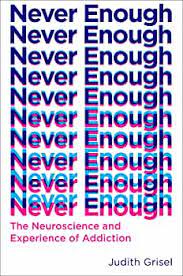
Never Enough: The Neuroscience and Experience of Addiction
Author: Judith Grisel
ISBN-10: 0525434909
ISBN-13: 978-0525434900
APA Style Citation
Grisel, J. (2020). Never enough: The neuroscience and experience of addiction. Anchor.
Buy This Book
https://www.amazon.com/Never-Enough-Neuroscience-Experience-Addiction/dp/0385542844
Author: Judith Grisel
ISBN-10: 0525434909
ISBN-13: 978-0525434900
APA Style Citation
Grisel, J. (2020). Never enough: The neuroscience and experience of addiction. Anchor.
Buy This Book
https://www.amazon.com/Never-Enough-Neuroscience-Experience-Addiction/dp/0385542844

| never_enough_activity.pdf |
Book Description
Never Enough: The Neuroscience and Experience of Addiction talks of the epidemic and catastrophic effects of addiction. Author, Judith Grisel, shares her story as someone with a substance use disorder and a behavioral neuroscientist. She went from addiction in 7th grade, to using drugs for about a decade, to being clean for decades, to earning her Ph.D. in behavioral neuroscience. She is now an expert in neurobiology, chemistry, genetics, and addictive behavior.
Dr. Grisel defines drug addiction and provides a strong biological explanation for the reader. She explains how drugs of abuse stimulate both the mesolimbic dopamine system and nigrostriatal pathways. This is what makes the experience pleasurable and why drugs of abuse are sought after. There is also an explanation of endorphins and how they are released in response to a wide range of environmental signals. In addition, the more predictable and frequent the dosing, the more addictive a drug will be.
The three general laws of psychopharmacology that apply to drugs are explained in detail. First, all drugs change the rate of what is already going on. They either speed up or slow down neural activity and act similarly to neurotransmitters at the receptor site. Second, all drugs have side effects. Unlike natural neurotransmitters, they are not targeted in their delivery but are delivered in the bloodstream and found in mostly uniform levels throughout the nervous system. For example, natural serotonin release targets particular cells to influence sleep, eating, etc. However, a drug enhancing serotonin acts in all these places simultaneously, often producing side effects in other motivated behaviors than its intended use. Third, the brain adapts to all drugs by counteracting the drug's effects. When drugs are used regularly, the brain adapts to compensate for the changes made by the drug. The brain responds to a drug by doing the opposite and returning to homeostasis. An addict doesn't drink coffee because she is tired. She is tired because she drinks coffee. For regular users to feel normal, they need to take the drug.
Richard Solomon and his student John Corbitt explained how the concept of homeostasis could be applied to emotion in what is known as the opponent-process theory. This theory helps the current understanding of addiction. Any feeling (e.g., good, bad, happy, depressed) that disrupts our balance will elicit a response by the brain that is exactly opposite to the effect of that stimulus. The brain counteracts the stimulus by producing its own opposite effect. The brain’s ability to respond and anticipate events is part of plasticity. For addiction, this is known as “acute tolerance.” The first cigarette of the day can be the most pleasing because after the brain site activates for nicotine, they become insensitive to additional exposures. For some drugs, such as SSRIs, adaptation is the point. The goal is to change the set point so that being depressed is no longer the patient’s normal state.
The middle part of the book devotes a specific chapter to each of the main drugs of abuse, including THC, opiates, alcohol, tranquilizers, stimulants, psychedelics, and others. Each chapter provides specifics while tying the drug to neuroscience. It is readable and relevant. While many other sources provide a great overview of symptoms and statistics, Dr. Grisel provides the connections many teachers want for a psychology class.
As the book draws to a close, Dr. Grisel explores how drug addictions form. There are numerous genetic and environmental contributions involved. She explains genetics, epigenetics, early exposure, and addictive personalities. However, some factors are vague and hard to quantify. Furthermore, because multiple influences interact, it is challenging to identify a root cause. In addition, there is no current objective measure to use for addiction. The Diagnostic Statistic Manual (DSM) has changed the name and criteria, but we still have a long way to go to understand drug addiction.
Dr. Grisel provides this bottom line, "Despite small advances in understanding addiction, rates of addictive disorders are increasing." The field of neuroscience is still in its infancy. The author feels that recovery is a process of expansion and freedom, not restriction. She believes treatment is most effective when it combines a slow reduction and social support. The answer may be in the brain and social contacts. What caused Dr. Grisel to change her behavior was not a tragedy but rather human love and connection. Dr. Grisel states, "While we are at it, instead of wringing our hands, we might try reaching for another's."
Other Related Resources
NPR- A Neuroscientist Explores The Biology Of Addiction In 'Never Enough' https://www.npr.org/sections/health-shots/2019/02/12/693814827/a-neuroscientists-explores-the-biology-of-addiction-in-never-enough
Never Enough: The Neuroscience and Experience of Addiction / Judy Grisel /
https://www.youtube.com/watch?v=rnt1eb9vQxA&t=8s
Judith Grisel, Ph.D.: "Never Enough: The Neuroscience and Experience of Addiction" (02/25/19)
https://www.youtube.com/watch?v=pOkh9xC-dSg
Chemistry World- Never Enough: The Neuroscience and Experience of Addiction
https://www.chemistryworld.com/review/never-enough-the-neuroscience-and experience-of-addiction/4011008.article
Psychological Concepts and Figures
Walter Cannon
James Olds and Peter Milner
Richard Solomon and John Corbitt
ADHD
Alcohol
Amphetamines
Analgesia
Antagonists
Barbiturates
Benzodiazepines
Caffeine
Cocaine
Cognitive dissonance
Dependence
Dopamine
Ecstasy (MDMA)
Endorphins
Epigenetics
Evolutionary perspective
Fetal alcohol syndrome (FAS)
GABA
GHB
Glutamate
Homeostasis
Human Genome Project (HGP)
LSD
Psilocybin
Marijuana
Medical model of addiction
Mescaline
Mesolimbic pathway
Methadone
Methamphetamine
Nicotine
Nucleus accumbens
Opiates
Opponent-process theory
Placebo
Plasticity
Polymorphic genes
Positive and negative punishment
Positive and negative reinforcement
Psychedelics
Psychopharmacology
Selective serotonin reuptake inhibitors (SSRIs)
Serotonin
Set-point
Spice
Suboxone
Synapse
THC
Tolerance
Tranquilizers
Vesicles
Withdrawal
Never Enough: The Neuroscience and Experience of Addiction talks of the epidemic and catastrophic effects of addiction. Author, Judith Grisel, shares her story as someone with a substance use disorder and a behavioral neuroscientist. She went from addiction in 7th grade, to using drugs for about a decade, to being clean for decades, to earning her Ph.D. in behavioral neuroscience. She is now an expert in neurobiology, chemistry, genetics, and addictive behavior.
Dr. Grisel defines drug addiction and provides a strong biological explanation for the reader. She explains how drugs of abuse stimulate both the mesolimbic dopamine system and nigrostriatal pathways. This is what makes the experience pleasurable and why drugs of abuse are sought after. There is also an explanation of endorphins and how they are released in response to a wide range of environmental signals. In addition, the more predictable and frequent the dosing, the more addictive a drug will be.
The three general laws of psychopharmacology that apply to drugs are explained in detail. First, all drugs change the rate of what is already going on. They either speed up or slow down neural activity and act similarly to neurotransmitters at the receptor site. Second, all drugs have side effects. Unlike natural neurotransmitters, they are not targeted in their delivery but are delivered in the bloodstream and found in mostly uniform levels throughout the nervous system. For example, natural serotonin release targets particular cells to influence sleep, eating, etc. However, a drug enhancing serotonin acts in all these places simultaneously, often producing side effects in other motivated behaviors than its intended use. Third, the brain adapts to all drugs by counteracting the drug's effects. When drugs are used regularly, the brain adapts to compensate for the changes made by the drug. The brain responds to a drug by doing the opposite and returning to homeostasis. An addict doesn't drink coffee because she is tired. She is tired because she drinks coffee. For regular users to feel normal, they need to take the drug.
Richard Solomon and his student John Corbitt explained how the concept of homeostasis could be applied to emotion in what is known as the opponent-process theory. This theory helps the current understanding of addiction. Any feeling (e.g., good, bad, happy, depressed) that disrupts our balance will elicit a response by the brain that is exactly opposite to the effect of that stimulus. The brain counteracts the stimulus by producing its own opposite effect. The brain’s ability to respond and anticipate events is part of plasticity. For addiction, this is known as “acute tolerance.” The first cigarette of the day can be the most pleasing because after the brain site activates for nicotine, they become insensitive to additional exposures. For some drugs, such as SSRIs, adaptation is the point. The goal is to change the set point so that being depressed is no longer the patient’s normal state.
The middle part of the book devotes a specific chapter to each of the main drugs of abuse, including THC, opiates, alcohol, tranquilizers, stimulants, psychedelics, and others. Each chapter provides specifics while tying the drug to neuroscience. It is readable and relevant. While many other sources provide a great overview of symptoms and statistics, Dr. Grisel provides the connections many teachers want for a psychology class.
As the book draws to a close, Dr. Grisel explores how drug addictions form. There are numerous genetic and environmental contributions involved. She explains genetics, epigenetics, early exposure, and addictive personalities. However, some factors are vague and hard to quantify. Furthermore, because multiple influences interact, it is challenging to identify a root cause. In addition, there is no current objective measure to use for addiction. The Diagnostic Statistic Manual (DSM) has changed the name and criteria, but we still have a long way to go to understand drug addiction.
Dr. Grisel provides this bottom line, "Despite small advances in understanding addiction, rates of addictive disorders are increasing." The field of neuroscience is still in its infancy. The author feels that recovery is a process of expansion and freedom, not restriction. She believes treatment is most effective when it combines a slow reduction and social support. The answer may be in the brain and social contacts. What caused Dr. Grisel to change her behavior was not a tragedy but rather human love and connection. Dr. Grisel states, "While we are at it, instead of wringing our hands, we might try reaching for another's."
Other Related Resources
NPR- A Neuroscientist Explores The Biology Of Addiction In 'Never Enough' https://www.npr.org/sections/health-shots/2019/02/12/693814827/a-neuroscientists-explores-the-biology-of-addiction-in-never-enough
Never Enough: The Neuroscience and Experience of Addiction / Judy Grisel /
https://www.youtube.com/watch?v=rnt1eb9vQxA&t=8s
Judith Grisel, Ph.D.: "Never Enough: The Neuroscience and Experience of Addiction" (02/25/19)
https://www.youtube.com/watch?v=pOkh9xC-dSg
Chemistry World- Never Enough: The Neuroscience and Experience of Addiction
https://www.chemistryworld.com/review/never-enough-the-neuroscience-and experience-of-addiction/4011008.article
Psychological Concepts and Figures
Walter Cannon
James Olds and Peter Milner
Richard Solomon and John Corbitt
ADHD
Alcohol
Amphetamines
Analgesia
Antagonists
Barbiturates
Benzodiazepines
Caffeine
Cocaine
Cognitive dissonance
Dependence
Dopamine
Ecstasy (MDMA)
Endorphins
Epigenetics
Evolutionary perspective
Fetal alcohol syndrome (FAS)
GABA
GHB
Glutamate
Homeostasis
Human Genome Project (HGP)
LSD
Psilocybin
Marijuana
Medical model of addiction
Mescaline
Mesolimbic pathway
Methadone
Methamphetamine
Nicotine
Nucleus accumbens
Opiates
Opponent-process theory
Placebo
Plasticity
Polymorphic genes
Positive and negative punishment
Positive and negative reinforcement
Psychedelics
Psychopharmacology
Selective serotonin reuptake inhibitors (SSRIs)
Serotonin
Set-point
Spice
Suboxone
Synapse
THC
Tolerance
Tranquilizers
Vesicles
Withdrawal
 RSS Feed