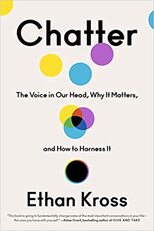
Chatter: The Voice in Our Head, Why It Matters, and How to Harness It
Author: Ethan Kross
ISBN-10: 0525575235
ISBN-13: 978-0525575238
APA Style Citation
Kross, E. (2021). Chatter: The voice in our head, why it matters, and how to harness it. New York, NY: Crown.
Buy This Book
https://www.amazon.com/Chatter-Voice-Head-Matters-Harness/dp/0525575235
Author: Ethan Kross
ISBN-10: 0525575235
ISBN-13: 978-0525575238
APA Style Citation
Kross, E. (2021). Chatter: The voice in our head, why it matters, and how to harness it. New York, NY: Crown.
Buy This Book
https://www.amazon.com/Chatter-Voice-Head-Matters-Harness/dp/0525575235

| chatter_activity.pdf |
Book Description
Do you ever want that inner voice that plays in your head to stop? While introspective thoughts can be beneficial, the inner critic can quickly rear its ugly head when the thoughts turn to chatter, which consists of cyclical negative thoughts and emotions. Ethan Kross, author of Chatter: The Voice in Our Head, Why It Matters, and How to Harness It, studies how those internal conversations can be used to improve your life. He compares his job to being a mind mechanic. When internal thoughts turn negative, individuals need to recognize when they become problematic and have the proper tools to quiet the chatter.
Talking to oneself is a normal part of life, but it also has its downfalls. Language lets us identify our emotions and discover how to handle a situation. As humans, it allows us the powerful ability to mentally travel in time. It also allows us to control ourselves and our emotions. So how does talking to oneself go wrong? Anyone who has become skilled at a learned task can fall victim to chatter. Kross shares stories of athletes that have fallen victim to that inner critic. The internal conversation influences attention and causes what was once an involuntary action to become the focus of our attention, which can then lead to overanalysis. When we ruminate, we end up focusing our attention on that negative inner voice AND what we are doing. The author points out how challenging it is to read after getting into a fight. It doesn’t seem to work well for anyone! We also want to talk to others about our negative experiences. The more intense the emotion, the more we want to talk about it. Unless in involves shame, then we want to keep in confidential. But it is sharing those negative experiences that pushes sympathetic listeners away because we tend to miss the warning signs of how annoying we are. The chatter can lead to talking too much, which can then alienate those we confide in the most. Social media provides a positive experience, but can also become problematic for several reasons. In real life we can manage emotions with the passage of time. However, when we are at the peak of frustration, our connectivity allows us to share those negative experiences in the moment before we have a moment to calm down. It is also human nature to compare ourselves to others. As we passively scroll through others’ filtered versions of themselves posted online, we can start to become envious and negative emotions take over. This emotional pain registers the same way in our brain as physical pain.
Perspective taking is key to quieting our inner voice. Kross uses the analogy of your mind being a lens and the inner voice being a button that can zoom either in or out. He explains how when we get stressed or the inner voice starts to ruminate, we lose the ability to zoom out. By adding some distance to our thoughts, we can then change those thoughts. The author shared Walter Mischel’s famous marshmallow research, where waiting for two marshmallows led to positive results rather than having a lack of impulse control and immediately eating the marshmallow. This research led to the understanding that people have tools to control themselves. Kross also mentioned Aaron Beck’s therapy technique known as “distancing” where individuals are taught to scrutinize their thoughts. While some people have negatively associated this with avoidance, the key is to actively explore the thought from a distance. The recommendation is to imaginatively visualize oneself from afar. Research has explored the impact of immersion versus distancing. Immersers who viewed an event from the first-person perspective got stuck in their emotions. While, distancers who viewed an event from a broad perspective, had more positive feelings and were better able to control their stress response. By teaching people to see the big picture, it reduced their chatter. Mental distancing also led to increased wisdom regardless of age. Even journaling for a 15-minute time period about a negative experience was helpful. While narrating the story, the author created distance. The point of view is also key to quieting chatter. Using the first-person singular pronouns signaled negative emotions. Instead using third person or saying your name can force you to step back and refocus more objectively. Examples of LeBron James or Malala talking in third person during interviews helped provide distance from the event. Even shifting to the generic or universal second-person “you” can help provide the necessary psychological distance.
Those around you can influence chatter as well. Sharing emotions can often hurt more than it helps. Research has found that talking to others about negative experiences doesn’t help us recover in any meaningful way. Co-rumination can quickly change from support to inciting the inner voice. Advice at the wrong time from others can propel inner talk and undermine self-efficacy. Instead, Kross recommends invisible support. Rather than making someone feel like they can’t cope on their own, providing invisible support could be doing housework to ease their stress or offering broadening advice that is not explicitly directed at the person experiencing the negative thoughts. This invisible support is especially helpful when the person with negative thoughts is under evaluation or preparing to be. Affectionate touch or comforting objects can be beneficial as well.
It is not just the people that surround you, but also the physical environment that influences chatter. Kross references trees and grass as mental vitamins that help manage our stressors. Research has found attention improved after taking a walk with nature as opposed to an urban landscape. And it doesn’t matter the time of year! If access to nature is problematic, photos and videos work too. One study even found that nature sounds helped enhance attention. Uplifting emotional awe occurs when we come across something powerful that we can’t really explain. It has been linked to physical and psychological benefits. Another interesting finding involves how order in our physical environment can quiet the chatter even though there is no direct connection between creating an organized world and the cause of the inner chaotic thoughts. Just reading about the world described as an orderly place has been found to reduce anxiety.
The mind is a powerful thing. Placebos help with chatter. Even nondeceptive placebos have worked for allergy symptoms, lower back pain, ADHD, and depression. Superstitions and rituals also help quiet the chatter. Rituals can come from culture, but can also be personalized. To become a ritual there needs to be a rigid sequence of behaviors that are performed in the same order. They appear to work because they divert attention, provide a sense of order and control. Rituals also make us feel connected, provide us with awe, and activate the placebo effect. Many engage in rituals without even knowing.
Kross makes it clear that he is not advocating for an avoidance of negative states. They just can’t consume you. Not all introspection is bad, but individuals need to recognize when they become problematic and have the proper tools to quiet the chatter. He points out that chatter is a part of our culture. Parents provide children with chatter support and create the culture they are immersed in at home. He also recognizes the need to teach these tools to children, after a college student pointed out learning them in college seems a little too late. Kross has created a toolbox for middle school and high school curriculum, but leaves the reader with their own toolbox that can be used right away to quiet the chatter.
Other Related Resources
Author's Website
https://www.ethankross.com/chatter/
Center for Positive Organizations- Michigan Ross. Chatter: The Voice in Our Head, Why it Matters, and How to Harness It
https://www.youtube.com/watch?v=3V33_f3yVn8
ISR Insights Speaker Series: The Voice in Our Head, Why It Matters, and How to Harness It
https://www.youtube.com/watch?v=jleW_eTWVHA
Next Big Idea Club
https://nextbigideaclub.com/magazine/chatter-voice-head-matters-harness-bookbite/26713/
Psychological Concepts and Figures
Aristotle
Aaron Beck
Joseph Breuer
Sigmund Freud
William James
Daniel Kahneman
Franz Anton Mesmer
Walter Mischel
Lev Vygotsky
Active listening
Adrenaline
Animal magnetism
Anxiety
Associative connections
Attention
Attention restoration therapy
Catharsis
Contact
Cortisol
Dreams
EEG
Empathy
Evolution
Free association
Frequency illusion
Gene expression
Hippocampus
Hypothalamus
Hysteria
Identity
Inner speech
Introspection
Loss aversion
Magic number
MRI
Neurons
Neuroscience
OCD
Oxytocin
Parkinson’s disease
Placebo
Polygraph
Prefrontal brain
Reciprocity
Rumination
Self-control
Self-efficacy
Stress
Temporal distancing
Tend and befriend
Wisdom
Working memory
Do you ever want that inner voice that plays in your head to stop? While introspective thoughts can be beneficial, the inner critic can quickly rear its ugly head when the thoughts turn to chatter, which consists of cyclical negative thoughts and emotions. Ethan Kross, author of Chatter: The Voice in Our Head, Why It Matters, and How to Harness It, studies how those internal conversations can be used to improve your life. He compares his job to being a mind mechanic. When internal thoughts turn negative, individuals need to recognize when they become problematic and have the proper tools to quiet the chatter.
Talking to oneself is a normal part of life, but it also has its downfalls. Language lets us identify our emotions and discover how to handle a situation. As humans, it allows us the powerful ability to mentally travel in time. It also allows us to control ourselves and our emotions. So how does talking to oneself go wrong? Anyone who has become skilled at a learned task can fall victim to chatter. Kross shares stories of athletes that have fallen victim to that inner critic. The internal conversation influences attention and causes what was once an involuntary action to become the focus of our attention, which can then lead to overanalysis. When we ruminate, we end up focusing our attention on that negative inner voice AND what we are doing. The author points out how challenging it is to read after getting into a fight. It doesn’t seem to work well for anyone! We also want to talk to others about our negative experiences. The more intense the emotion, the more we want to talk about it. Unless in involves shame, then we want to keep in confidential. But it is sharing those negative experiences that pushes sympathetic listeners away because we tend to miss the warning signs of how annoying we are. The chatter can lead to talking too much, which can then alienate those we confide in the most. Social media provides a positive experience, but can also become problematic for several reasons. In real life we can manage emotions with the passage of time. However, when we are at the peak of frustration, our connectivity allows us to share those negative experiences in the moment before we have a moment to calm down. It is also human nature to compare ourselves to others. As we passively scroll through others’ filtered versions of themselves posted online, we can start to become envious and negative emotions take over. This emotional pain registers the same way in our brain as physical pain.
Perspective taking is key to quieting our inner voice. Kross uses the analogy of your mind being a lens and the inner voice being a button that can zoom either in or out. He explains how when we get stressed or the inner voice starts to ruminate, we lose the ability to zoom out. By adding some distance to our thoughts, we can then change those thoughts. The author shared Walter Mischel’s famous marshmallow research, where waiting for two marshmallows led to positive results rather than having a lack of impulse control and immediately eating the marshmallow. This research led to the understanding that people have tools to control themselves. Kross also mentioned Aaron Beck’s therapy technique known as “distancing” where individuals are taught to scrutinize their thoughts. While some people have negatively associated this with avoidance, the key is to actively explore the thought from a distance. The recommendation is to imaginatively visualize oneself from afar. Research has explored the impact of immersion versus distancing. Immersers who viewed an event from the first-person perspective got stuck in their emotions. While, distancers who viewed an event from a broad perspective, had more positive feelings and were better able to control their stress response. By teaching people to see the big picture, it reduced their chatter. Mental distancing also led to increased wisdom regardless of age. Even journaling for a 15-minute time period about a negative experience was helpful. While narrating the story, the author created distance. The point of view is also key to quieting chatter. Using the first-person singular pronouns signaled negative emotions. Instead using third person or saying your name can force you to step back and refocus more objectively. Examples of LeBron James or Malala talking in third person during interviews helped provide distance from the event. Even shifting to the generic or universal second-person “you” can help provide the necessary psychological distance.
Those around you can influence chatter as well. Sharing emotions can often hurt more than it helps. Research has found that talking to others about negative experiences doesn’t help us recover in any meaningful way. Co-rumination can quickly change from support to inciting the inner voice. Advice at the wrong time from others can propel inner talk and undermine self-efficacy. Instead, Kross recommends invisible support. Rather than making someone feel like they can’t cope on their own, providing invisible support could be doing housework to ease their stress or offering broadening advice that is not explicitly directed at the person experiencing the negative thoughts. This invisible support is especially helpful when the person with negative thoughts is under evaluation or preparing to be. Affectionate touch or comforting objects can be beneficial as well.
It is not just the people that surround you, but also the physical environment that influences chatter. Kross references trees and grass as mental vitamins that help manage our stressors. Research has found attention improved after taking a walk with nature as opposed to an urban landscape. And it doesn’t matter the time of year! If access to nature is problematic, photos and videos work too. One study even found that nature sounds helped enhance attention. Uplifting emotional awe occurs when we come across something powerful that we can’t really explain. It has been linked to physical and psychological benefits. Another interesting finding involves how order in our physical environment can quiet the chatter even though there is no direct connection between creating an organized world and the cause of the inner chaotic thoughts. Just reading about the world described as an orderly place has been found to reduce anxiety.
The mind is a powerful thing. Placebos help with chatter. Even nondeceptive placebos have worked for allergy symptoms, lower back pain, ADHD, and depression. Superstitions and rituals also help quiet the chatter. Rituals can come from culture, but can also be personalized. To become a ritual there needs to be a rigid sequence of behaviors that are performed in the same order. They appear to work because they divert attention, provide a sense of order and control. Rituals also make us feel connected, provide us with awe, and activate the placebo effect. Many engage in rituals without even knowing.
Kross makes it clear that he is not advocating for an avoidance of negative states. They just can’t consume you. Not all introspection is bad, but individuals need to recognize when they become problematic and have the proper tools to quiet the chatter. He points out that chatter is a part of our culture. Parents provide children with chatter support and create the culture they are immersed in at home. He also recognizes the need to teach these tools to children, after a college student pointed out learning them in college seems a little too late. Kross has created a toolbox for middle school and high school curriculum, but leaves the reader with their own toolbox that can be used right away to quiet the chatter.
Other Related Resources
Author's Website
https://www.ethankross.com/chatter/
Center for Positive Organizations- Michigan Ross. Chatter: The Voice in Our Head, Why it Matters, and How to Harness It
https://www.youtube.com/watch?v=3V33_f3yVn8
ISR Insights Speaker Series: The Voice in Our Head, Why It Matters, and How to Harness It
https://www.youtube.com/watch?v=jleW_eTWVHA
Next Big Idea Club
https://nextbigideaclub.com/magazine/chatter-voice-head-matters-harness-bookbite/26713/
Psychological Concepts and Figures
Aristotle
Aaron Beck
Joseph Breuer
Sigmund Freud
William James
Daniel Kahneman
Franz Anton Mesmer
Walter Mischel
Lev Vygotsky
Active listening
Adrenaline
Animal magnetism
Anxiety
Associative connections
Attention
Attention restoration therapy
Catharsis
Contact
Cortisol
Dreams
EEG
Empathy
Evolution
Free association
Frequency illusion
Gene expression
Hippocampus
Hypothalamus
Hysteria
Identity
Inner speech
Introspection
Loss aversion
Magic number
MRI
Neurons
Neuroscience
OCD
Oxytocin
Parkinson’s disease
Placebo
Polygraph
Prefrontal brain
Reciprocity
Rumination
Self-control
Self-efficacy
Stress
Temporal distancing
Tend and befriend
Wisdom
Working memory
 RSS Feed