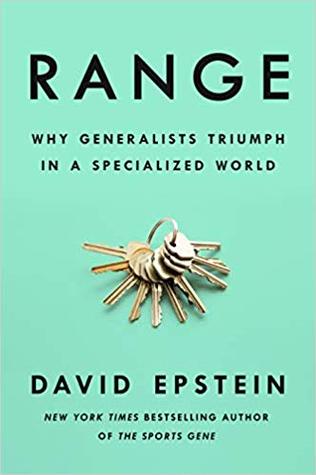
Range: Why Generalists Triumph in A Specialized World
Author: David Epstein
ISBN:978-0735214491
APA Style Citation
Epstein, D. (2019). Range: Why Generalists triumph in a specialized world. New York, NY: Riverhead books.
Buy This Book
https://www.amazon.com/Range-Generalists-Triumph-Specialized-World/dp/0735214484/ref=sr_1_1?keywords=range&qid=1578144141&sr=8-1
Author: David Epstein
ISBN:978-0735214491
APA Style Citation
Epstein, D. (2019). Range: Why Generalists triumph in a specialized world. New York, NY: Riverhead books.
Buy This Book
https://www.amazon.com/Range-Generalists-Triumph-Specialized-World/dp/0735214484/ref=sr_1_1?keywords=range&qid=1578144141&sr=8-1

| range_activity.pdf |
Book Description
We live in a world of hyper specialization. Children often start their violin or piano lessons as young as age 3 or 4. They start their preferred sports often just as young, and by the time they reach high school, teenagers are told they must concentrate on what they want to do in the future and focus all of their effort in one particular area. If people realize they have gone down the wrong path, they are often told that they must persevere for fear of “being behind” if they switch areas of study or they just stick with it because of all of the work they have already put in. David Epstein, the author of Range, believes that this advice is misguided. Epstein argues that the greatest triumphs come from having experience in multiple fields and casting one’s net widely so as to draw upon different sources when trying to solve a problem. Epstein believes the benefit of Range rather than hyper specialization is that it can give people a different perspective and approach that those in a single area of specialization are not able to see. This can result in great insight and more thorough and complete decision-making.
Those who specialize later are often better suited for the careers they eventually select, and as a result, they are also generally more passionate and productive in their roles. Epstein presents many examples of how experience in a single field can limit how one approaches a new problem. The need for conformity and groupthink can limit consideration of all possible outcomes in a situation and can, in cases such as NASA's space shuttle Challenger explosion, lead to deadly results. Epstein cites examples of fire firefighters who lost their lives fighting fires because their specialized training taught them never to drop their equipment, but when fighting a fast-moving fire, dropping one’s equipment might actually save their life.
Epstein points to Tiger Woods, who seemed to be a child prodigy at golf, as an example of early and focused practice. Many parents use this example to apply to their own children, but they overlook other athletes such as Tom Brady, who participated in football, baseball, basketball, and karate as a child and then had to choose between playing college football or basketball. Often those with specialized early training peak early or move away from their area of specialization because their parents selected their instrument/sport/activity for them rather than the child selecting their specialty based on experimentation in many different fields. Epstein challenges the 10,000-hour rule by arguing that the amount of practice time is not a good measure of exceptionality, in music, for example, those who know how to play multiple instruments can draw on their knowledge from their different experiences to add depth to their performance. Epstein argues that the “sampling period” in which one explores many different interests will serve people well in future unknown situations. Many jazz musicians or musical improv masters never had formal training in music but learned from watching others and then experimenting. This experimentation necessitated intense and conscious thought about what was working (or not), but because of the lack (at least initially) of formal training, there was never a single “correct” way of doing things which allowed for more creativity later in their work.
Epstein does not dismiss the importance of expertise but rather presents situation after situation in which someone with a different perspective who challenged the conventional wisdom. Individuals with diverse backgrounds are often able to see a situation in a new light and offer a solution that in many cases is successful and one that the “experts” could not see. Epstein points out that scientists who have been inducted into the highest national academies are likely to have hobbies and interests outside of their field of study. “Nobel laureates are at least twenty-two times more likely to partake as an amateur actor, dancer, magician, or other type of performer.” This breath can support new insights that those obsessively focused on a single area may miss. Epstein cites Steve Jobs, who took calligraphy courses, which ultimately informed his design aesthetics and fonts that would become part of the now infamous Mac design. These individuals avoid cognitive entrenchment by applying their knowledge in one area and applying it creatively to another.
Nearly 75% of today’s college students will go into a career unrelated to what they studied in college. Epstein’s argument takes on more importance as those with a wide array of experiences should allow them to be better equipped to adapt and adjust to novel problems and situations. Epstein applies his findings to classroom environments and suggests that in many classrooms, teachers are making learning “too easy” by giving students hints towards the right answer without having them work through the frustration of not knowing and having to figure something out on their own. Epstein also recommends ‘interleaving’ in which instructors demonstrate (or ask students to) look for connections between different units of study or even across disciplines.
Epstein refutes the old adage of “winners never quit," he believes that if something is not interesting or if one is not passionate about a particular area, they should pursue something new. The “late bloomers” may actually prove to be the most well-suited for the area they finally land on, and their earlier experiences may give them a leg up even on those whose sole focus has been single-mindedly on one area of study.
Other Related Resources
Book website
https://www.davidepstein.com/the-range/
An introduction to Range by David Epstein
https://www.youtube.com/watch?v=FmoMmK7qKt4
Epstein and Gladwell discuss Range at MIT
https://www.youtube.com/watch?v=8cQJH3aj4YY
Psychological Concepts and Figures
Charles Darwin
Angela Duckworth
James Flynn
Daniel Gilbert
Daniel Kahneman
Walter Mischel
Amos Tversky
Analytical thinking
Catharsis
Chunking
Cognitive bias
Conformity
Congruence
Creativity
Distributed practice
Functional fixedness
Groupthink
Incongruence
Lateral thinking
Raven’s Progressive Matrices
Statistical significance
Tabula rasa (blank slate)
The Ebbinghaus illusion
The Flynn effect
The Marshmallow Test
Trial and error
Savants
We live in a world of hyper specialization. Children often start their violin or piano lessons as young as age 3 or 4. They start their preferred sports often just as young, and by the time they reach high school, teenagers are told they must concentrate on what they want to do in the future and focus all of their effort in one particular area. If people realize they have gone down the wrong path, they are often told that they must persevere for fear of “being behind” if they switch areas of study or they just stick with it because of all of the work they have already put in. David Epstein, the author of Range, believes that this advice is misguided. Epstein argues that the greatest triumphs come from having experience in multiple fields and casting one’s net widely so as to draw upon different sources when trying to solve a problem. Epstein believes the benefit of Range rather than hyper specialization is that it can give people a different perspective and approach that those in a single area of specialization are not able to see. This can result in great insight and more thorough and complete decision-making.
Those who specialize later are often better suited for the careers they eventually select, and as a result, they are also generally more passionate and productive in their roles. Epstein presents many examples of how experience in a single field can limit how one approaches a new problem. The need for conformity and groupthink can limit consideration of all possible outcomes in a situation and can, in cases such as NASA's space shuttle Challenger explosion, lead to deadly results. Epstein cites examples of fire firefighters who lost their lives fighting fires because their specialized training taught them never to drop their equipment, but when fighting a fast-moving fire, dropping one’s equipment might actually save their life.
Epstein points to Tiger Woods, who seemed to be a child prodigy at golf, as an example of early and focused practice. Many parents use this example to apply to their own children, but they overlook other athletes such as Tom Brady, who participated in football, baseball, basketball, and karate as a child and then had to choose between playing college football or basketball. Often those with specialized early training peak early or move away from their area of specialization because their parents selected their instrument/sport/activity for them rather than the child selecting their specialty based on experimentation in many different fields. Epstein challenges the 10,000-hour rule by arguing that the amount of practice time is not a good measure of exceptionality, in music, for example, those who know how to play multiple instruments can draw on their knowledge from their different experiences to add depth to their performance. Epstein argues that the “sampling period” in which one explores many different interests will serve people well in future unknown situations. Many jazz musicians or musical improv masters never had formal training in music but learned from watching others and then experimenting. This experimentation necessitated intense and conscious thought about what was working (or not), but because of the lack (at least initially) of formal training, there was never a single “correct” way of doing things which allowed for more creativity later in their work.
Epstein does not dismiss the importance of expertise but rather presents situation after situation in which someone with a different perspective who challenged the conventional wisdom. Individuals with diverse backgrounds are often able to see a situation in a new light and offer a solution that in many cases is successful and one that the “experts” could not see. Epstein points out that scientists who have been inducted into the highest national academies are likely to have hobbies and interests outside of their field of study. “Nobel laureates are at least twenty-two times more likely to partake as an amateur actor, dancer, magician, or other type of performer.” This breath can support new insights that those obsessively focused on a single area may miss. Epstein cites Steve Jobs, who took calligraphy courses, which ultimately informed his design aesthetics and fonts that would become part of the now infamous Mac design. These individuals avoid cognitive entrenchment by applying their knowledge in one area and applying it creatively to another.
Nearly 75% of today’s college students will go into a career unrelated to what they studied in college. Epstein’s argument takes on more importance as those with a wide array of experiences should allow them to be better equipped to adapt and adjust to novel problems and situations. Epstein applies his findings to classroom environments and suggests that in many classrooms, teachers are making learning “too easy” by giving students hints towards the right answer without having them work through the frustration of not knowing and having to figure something out on their own. Epstein also recommends ‘interleaving’ in which instructors demonstrate (or ask students to) look for connections between different units of study or even across disciplines.
Epstein refutes the old adage of “winners never quit," he believes that if something is not interesting or if one is not passionate about a particular area, they should pursue something new. The “late bloomers” may actually prove to be the most well-suited for the area they finally land on, and their earlier experiences may give them a leg up even on those whose sole focus has been single-mindedly on one area of study.
Other Related Resources
Book website
https://www.davidepstein.com/the-range/
An introduction to Range by David Epstein
https://www.youtube.com/watch?v=FmoMmK7qKt4
Epstein and Gladwell discuss Range at MIT
https://www.youtube.com/watch?v=8cQJH3aj4YY
Psychological Concepts and Figures
Charles Darwin
Angela Duckworth
James Flynn
Daniel Gilbert
Daniel Kahneman
Walter Mischel
Amos Tversky
Analytical thinking
Catharsis
Chunking
Cognitive bias
Conformity
Congruence
Creativity
Distributed practice
Functional fixedness
Groupthink
Incongruence
Lateral thinking
Raven’s Progressive Matrices
Statistical significance
Tabula rasa (blank slate)
The Ebbinghaus illusion
The Flynn effect
The Marshmallow Test
Trial and error
Savants
 RSS Feed