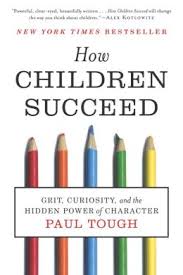
How Children Succeed
Author(s): Paul Tough
ISBN: 978-0544104402
APA Style Citation:
Tough, P. (2013). How children succeed: Grit, curiosity, and the hidden power of character: Mariner books.
Author(s): Paul Tough
ISBN: 978-0544104402
APA Style Citation:
Tough, P. (2013). How children succeed: Grit, curiosity, and the hidden power of character: Mariner books.

| open_your_class_with_this_tomorrow_how_children_succeed.pdf |
Book Description
In How Children Succeed, author Paul Tough challenges the idea that cognitive ability is the most important determinant of one’s future success. He cites research conducted by Angela Duckworth at the University of Pennsylvania which proposes that optimism, character, and what is described in the book as “Grit” are far better predictors of success in the future than exam scores. Tough questions the outlook for the future of many upper middle class children who have not experienced failure and cannot regroup in the face of setbacks. He suggests that experiencing failure and learning how to persevere in the face of it is one of the greatest lessons children can learn.
Tough features Elizabeth Spiegel, a chess teacher at IS 318, a low income public middle school in Brooklyn, as an example of an individual who focuses on teaching perseverance to her students. Ms. Spiegel has built one of the best chess teams in the nation and recently swept all middle school categories at the national competition. These are not students who come from advantaged backgrounds, they do not have the highest of IQ scores, and often they struggle in their classes, but they love and thrive in chess. What Spiegel does at first seems to be cruel to the preadolescents. She forces each player to walk through each step of a chess match after a failure to determine what they have done wrong in the hopes that they will learn from their mistakes. She prepares her chess team for failure and focuses on these experiences as a learning opportunity rather than as an end point.
Another important factor featured by Tough is the attachment between parents and children, which is formed early on in life. Attachment has long been studied by researchers such as John Bowlby, Harry Harlow, and Mary Ainsworth who determined that early attachment and nurturing from parents actually helps children to become more emotionally healthy later in life (see the review for Love at Goon Park for more on Harry Harlow). A secure attachment is developed when a child is confident their caregiver will be there in a time of need. If this develops, it (a secure attachment) allows infants to safely explore the world and become more independent and curious. This research-based evidence seems to support the importance of parenting in helping to encourage independent exploration by the child.
Tough describes a program called “One Step”, which has been implemented on the South Side of Chicago in what was formerly the area of the Robert Taylor homes. The program enrolls disadvantaged children who are shooting for the ”One Goal” of graduating from college. The are many obstacles which may hinder the success of these children. Students were selected for this group because of the particular challenges they faced and were tutored after school and given assistance on college applications in addition to their academic courses. In one featured case study, Tough follows a student named Kewauna who faced tough middle school years and was often in trouble. As she goes through the “One Step” program she is determined to gain admission to the University of Illinois. While she is not accepted to the U of I, she is accepted to Western Illinois University and in her first year she learns to take advantage of her professor’s office hours. Although she had a low ACT score, she was successful because she attended extra tutoring sessions and sought out additional supports and at the conclusion of her freshman year in college Kewauna earned a 3.8 GPA. Time will tell if Kewauna reaches her goal of graduating from college, but she has already fared far better than many might have predicted, in large part due to her “Grit”.
Tough acknowledges that much more research needs to be conducted and that there is still much to learn regarding how to teach these skills to children. He advises parents to be conscious of how important early childhood years can be for forming a strong attachment with a child and encourages educators to examine programs such as “One Goal” or “KIPP” which emphasize character rather than being solely focused on academic success to truly help children find their own way. This is a great read for parents and teachers and provides thought provoking material to consider not how help children be better test takers, but to help them be more successful in all of their respective pursuits.
Other Related Resources
Book website
http://www.paultough.com/the-books/how-children-succeed/
TED talk Angela Duckworth
http://www.huffingtonpost.com/tedtalks/angela-lee-duckworth-tedtalk_b_4277459.html?ir=Parents
What sets High Achievers apart? (APA Monitor: December 2013)
https://www.apa.org/monitor/2013/12/high-achievers.aspx
Interview with Paul Tough
https://www.youtube.com/watch?v=RRSBz69ubRY
NPR Podcast
http://www.npr.org/2012/09/04/160258240/children-succeed-with-character-not-test-scores
Does Teaching Grit Really Work? (NPR)
http://www.npr.org/2014/03/17/290089998/does-teaching-kids-to-get-gritty-help-them-get-ahead?ft=1&f=1013
Psychological Figures and Concepts
Alfred Binet
Angela Duckworth
Carol Dweck
Charles Murray
Martin Seligman
Attachment
Character
Dopamine reward pathways
Grit
IQ scores
Mindset (growth vs. fixed)
Optimism
Social Intelligence
In How Children Succeed, author Paul Tough challenges the idea that cognitive ability is the most important determinant of one’s future success. He cites research conducted by Angela Duckworth at the University of Pennsylvania which proposes that optimism, character, and what is described in the book as “Grit” are far better predictors of success in the future than exam scores. Tough questions the outlook for the future of many upper middle class children who have not experienced failure and cannot regroup in the face of setbacks. He suggests that experiencing failure and learning how to persevere in the face of it is one of the greatest lessons children can learn.
Tough features Elizabeth Spiegel, a chess teacher at IS 318, a low income public middle school in Brooklyn, as an example of an individual who focuses on teaching perseverance to her students. Ms. Spiegel has built one of the best chess teams in the nation and recently swept all middle school categories at the national competition. These are not students who come from advantaged backgrounds, they do not have the highest of IQ scores, and often they struggle in their classes, but they love and thrive in chess. What Spiegel does at first seems to be cruel to the preadolescents. She forces each player to walk through each step of a chess match after a failure to determine what they have done wrong in the hopes that they will learn from their mistakes. She prepares her chess team for failure and focuses on these experiences as a learning opportunity rather than as an end point.
Another important factor featured by Tough is the attachment between parents and children, which is formed early on in life. Attachment has long been studied by researchers such as John Bowlby, Harry Harlow, and Mary Ainsworth who determined that early attachment and nurturing from parents actually helps children to become more emotionally healthy later in life (see the review for Love at Goon Park for more on Harry Harlow). A secure attachment is developed when a child is confident their caregiver will be there in a time of need. If this develops, it (a secure attachment) allows infants to safely explore the world and become more independent and curious. This research-based evidence seems to support the importance of parenting in helping to encourage independent exploration by the child.
Tough describes a program called “One Step”, which has been implemented on the South Side of Chicago in what was formerly the area of the Robert Taylor homes. The program enrolls disadvantaged children who are shooting for the ”One Goal” of graduating from college. The are many obstacles which may hinder the success of these children. Students were selected for this group because of the particular challenges they faced and were tutored after school and given assistance on college applications in addition to their academic courses. In one featured case study, Tough follows a student named Kewauna who faced tough middle school years and was often in trouble. As she goes through the “One Step” program she is determined to gain admission to the University of Illinois. While she is not accepted to the U of I, she is accepted to Western Illinois University and in her first year she learns to take advantage of her professor’s office hours. Although she had a low ACT score, she was successful because she attended extra tutoring sessions and sought out additional supports and at the conclusion of her freshman year in college Kewauna earned a 3.8 GPA. Time will tell if Kewauna reaches her goal of graduating from college, but she has already fared far better than many might have predicted, in large part due to her “Grit”.
Tough acknowledges that much more research needs to be conducted and that there is still much to learn regarding how to teach these skills to children. He advises parents to be conscious of how important early childhood years can be for forming a strong attachment with a child and encourages educators to examine programs such as “One Goal” or “KIPP” which emphasize character rather than being solely focused on academic success to truly help children find their own way. This is a great read for parents and teachers and provides thought provoking material to consider not how help children be better test takers, but to help them be more successful in all of their respective pursuits.
Other Related Resources
Book website
http://www.paultough.com/the-books/how-children-succeed/
TED talk Angela Duckworth
http://www.huffingtonpost.com/tedtalks/angela-lee-duckworth-tedtalk_b_4277459.html?ir=Parents
What sets High Achievers apart? (APA Monitor: December 2013)
https://www.apa.org/monitor/2013/12/high-achievers.aspx
Interview with Paul Tough
https://www.youtube.com/watch?v=RRSBz69ubRY
NPR Podcast
http://www.npr.org/2012/09/04/160258240/children-succeed-with-character-not-test-scores
Does Teaching Grit Really Work? (NPR)
http://www.npr.org/2014/03/17/290089998/does-teaching-kids-to-get-gritty-help-them-get-ahead?ft=1&f=1013
Psychological Figures and Concepts
Alfred Binet
Angela Duckworth
Carol Dweck
Charles Murray
Martin Seligman
Attachment
Character
Dopamine reward pathways
Grit
IQ scores
Mindset (growth vs. fixed)
Optimism
Social Intelligence
 RSS Feed