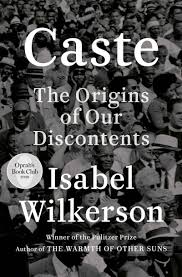
Caste: The Origins of Our Discontents
Author: Isabel Wilkerson
ISBN-13: 978-0-593-23025-1
APA Style Citation
Wilkerson, I. (2020). Caste: The origins of our discontents. New York, NY: Random House.
Buy This Book
https://www.amazon.com/Caste-Origins-Discontents-Isabel-Wilkerson/dp/0593230256
Author: Isabel Wilkerson
ISBN-13: 978-0-593-23025-1
APA Style Citation
Wilkerson, I. (2020). Caste: The origins of our discontents. New York, NY: Random House.
Buy This Book
https://www.amazon.com/Caste-Origins-Discontents-Isabel-Wilkerson/dp/0593230256

| activity_caste_.pdf |
Book Description
Isabel Wilkerson's follow-up to her epic first book, The Warmth of Other Suns about the migration of American blacks out of the South, tackles the long history of race in America. It is clear from the title that Wilkerson contends that race in America is comparable to the longstanding caste system in India. Wilkerson defines caste as "the granting or withholding of respect, status, honor, attention, privileges, resources, benefit of the doubt, and human kindness to someone based on their perceived rank or standing in the hierarchy of order and a justification for the classification of people." Wilkerson describes the eight pillars of a caste system, which provide a sense of entitlement and ingrains this into people's subconscious so that the system perpetuates itself generation after generation. While the untouchables in India still face discrimination and oppression despite the official eradication of the caste system, so do blacks in America despite many laws and court cases that propose all people are treated equally.
Wilkerson traces the origins of the American caste system back to colonial times in which America invented this system to benefit the dominant caste and then created laws and customs to ensure that the system remained intact. Wilkerson describes that Europeans were initially considered Italian or German, etc. Africans were Igbo or Yoruba, etc. It was not until all of these individuals came to America that they were considered "white" or "black." Wilkerson describes how Paul Broca tried to use thirty-four shades of skin color to delineate the races but could make no conclusion because of the many variations in skin tones within a given culture. Even the name Caucasian is a socially constructed term. German medical professor Johann Friedrich studied human skulls. He deemed the skull from the Caucasus Mountains of Russia to be the most beautiful, thereby associating "better" characteristics to white skulls and associating the name far more broadly than it was initially intended. Jane Elliott explains how an arbitrary division can create a sense of superiority or inferiority as she did in her famous Brown-Eyes, Blue-Eyes study. She first told her class that all of those with brown eyes were lazy and not smart, and within hours they were ostracized by their classmates.
Black bodies became dehumanized, deemed as property in the courts, and inspected as if cattle at slave auctions. Even the father of gynecology came to his discoveries by conducting unnecessary surgeries on enslaved women without the use of anesthetic. Psychological research from Stanley Milgram to Philip Zimbardo tells us that dehumanization makes violence more likely. Many in the dominant caste even convinced themselves that what they were doing was righteous and "noble." Even after the Civil War, in which enslaved people were free by law, the caste system, as well as a series of Jim Crow laws, made the caste system as strong as ever for African-Americans. This system of subordination was passed through many generations, and those in the dominant caste consoled themselves by placing child-like qualities on African-Americans and believed the system they had created was somehow "just."
Acts that were intended to protect Americans mistreatment at work and provide for a secure retirement with the Wagner and Social Security Acts often excluded black workers who were in the 1930’s still often farm laborers and domestics based on the jobs available to their caste. Even as some African-Americans came to be well-known, certain careers were deemed acceptable such as athletes or entertainers. Many well-known African-Americans today still fit this profile. These separate worlds created an implicit bias demonstrated by the association of "good" with white dolls and "bad" with black dolls demonstrated by psychology professors Kenneth and Mamie Clark. This work was used as part of the 1954 Supreme Court case of Brown vs. Board of Education, which demonstrated that separate educational facilities for black and white children were inherently unequal.
Wilkerson sets out to understand how the hierarchy of class continues to oppress African-Americans today. She recounts one instance in which she arrives at a shop to interview the owner as a journalist for the New York Times. He is running late, and Wilkerson looks around the shop until he arrives. When she approaches him, he indicates that he cannot talk because he is late for an interview with the New York Times. Wilkerson indicates that she is the journalist, but the man cannot seem to understand that a black woman could be the journalist, and he demands to see her credentials. She leaves without the interview but with a clear message that he believes her to be an imposter in her own career.
Wilkerson explains the health implications that come with keeping one's head constantly on a swivel and dealing with the daily slight or blindness that comes with one's placement: the stewardess's expectation that you are sitting in coach, the person who grasps their purse as you pass by, the interview you do not get because of your African sounding name, the low expectations that teachers may place on you because of skin color. While Wilkerson does provide examples of moving beyond this system to find common ground with those who may hold stereotypes, she provides ample evidence that we are not living in a post-racial America and that the acceptance and understanding of this is a step towards compassion and understanding.
Other Related Resources
Authors website
https://www.isabelwilkerson.com
Isabel Wilkerson interview with NPR
https://www.npr.org/transcripts/898574852
Muck Rack: Articles by Isabel Wilkerson
https://muckrack.com/isabel-wilkerson/articles
Armchair Expert: Dax Shepard podcast with Isabel Wilkerson
https://armchairexpertpod.com/pods/isabel-wilkerson
Psychological Concepts and Figures
Paul Broca
Kenneth and Mamie Clark
Jane Elliott
Stanley Milgram
Philip Zimbardo
Dehumanization
Discrimination
Heritability
Implicit bias
In-group
Narcissism
Out-group
Out-group homogeneity
Prejudice
Scapegoat theory
Stereotype
Stereotype threat
Stockholm syndrome
Isabel Wilkerson's follow-up to her epic first book, The Warmth of Other Suns about the migration of American blacks out of the South, tackles the long history of race in America. It is clear from the title that Wilkerson contends that race in America is comparable to the longstanding caste system in India. Wilkerson defines caste as "the granting or withholding of respect, status, honor, attention, privileges, resources, benefit of the doubt, and human kindness to someone based on their perceived rank or standing in the hierarchy of order and a justification for the classification of people." Wilkerson describes the eight pillars of a caste system, which provide a sense of entitlement and ingrains this into people's subconscious so that the system perpetuates itself generation after generation. While the untouchables in India still face discrimination and oppression despite the official eradication of the caste system, so do blacks in America despite many laws and court cases that propose all people are treated equally.
Wilkerson traces the origins of the American caste system back to colonial times in which America invented this system to benefit the dominant caste and then created laws and customs to ensure that the system remained intact. Wilkerson describes that Europeans were initially considered Italian or German, etc. Africans were Igbo or Yoruba, etc. It was not until all of these individuals came to America that they were considered "white" or "black." Wilkerson describes how Paul Broca tried to use thirty-four shades of skin color to delineate the races but could make no conclusion because of the many variations in skin tones within a given culture. Even the name Caucasian is a socially constructed term. German medical professor Johann Friedrich studied human skulls. He deemed the skull from the Caucasus Mountains of Russia to be the most beautiful, thereby associating "better" characteristics to white skulls and associating the name far more broadly than it was initially intended. Jane Elliott explains how an arbitrary division can create a sense of superiority or inferiority as she did in her famous Brown-Eyes, Blue-Eyes study. She first told her class that all of those with brown eyes were lazy and not smart, and within hours they were ostracized by their classmates.
Black bodies became dehumanized, deemed as property in the courts, and inspected as if cattle at slave auctions. Even the father of gynecology came to his discoveries by conducting unnecessary surgeries on enslaved women without the use of anesthetic. Psychological research from Stanley Milgram to Philip Zimbardo tells us that dehumanization makes violence more likely. Many in the dominant caste even convinced themselves that what they were doing was righteous and "noble." Even after the Civil War, in which enslaved people were free by law, the caste system, as well as a series of Jim Crow laws, made the caste system as strong as ever for African-Americans. This system of subordination was passed through many generations, and those in the dominant caste consoled themselves by placing child-like qualities on African-Americans and believed the system they had created was somehow "just."
Acts that were intended to protect Americans mistreatment at work and provide for a secure retirement with the Wagner and Social Security Acts often excluded black workers who were in the 1930’s still often farm laborers and domestics based on the jobs available to their caste. Even as some African-Americans came to be well-known, certain careers were deemed acceptable such as athletes or entertainers. Many well-known African-Americans today still fit this profile. These separate worlds created an implicit bias demonstrated by the association of "good" with white dolls and "bad" with black dolls demonstrated by psychology professors Kenneth and Mamie Clark. This work was used as part of the 1954 Supreme Court case of Brown vs. Board of Education, which demonstrated that separate educational facilities for black and white children were inherently unequal.
Wilkerson sets out to understand how the hierarchy of class continues to oppress African-Americans today. She recounts one instance in which she arrives at a shop to interview the owner as a journalist for the New York Times. He is running late, and Wilkerson looks around the shop until he arrives. When she approaches him, he indicates that he cannot talk because he is late for an interview with the New York Times. Wilkerson indicates that she is the journalist, but the man cannot seem to understand that a black woman could be the journalist, and he demands to see her credentials. She leaves without the interview but with a clear message that he believes her to be an imposter in her own career.
Wilkerson explains the health implications that come with keeping one's head constantly on a swivel and dealing with the daily slight or blindness that comes with one's placement: the stewardess's expectation that you are sitting in coach, the person who grasps their purse as you pass by, the interview you do not get because of your African sounding name, the low expectations that teachers may place on you because of skin color. While Wilkerson does provide examples of moving beyond this system to find common ground with those who may hold stereotypes, she provides ample evidence that we are not living in a post-racial America and that the acceptance and understanding of this is a step towards compassion and understanding.
Other Related Resources
Authors website
https://www.isabelwilkerson.com
Isabel Wilkerson interview with NPR
https://www.npr.org/transcripts/898574852
Muck Rack: Articles by Isabel Wilkerson
https://muckrack.com/isabel-wilkerson/articles
Armchair Expert: Dax Shepard podcast with Isabel Wilkerson
https://armchairexpertpod.com/pods/isabel-wilkerson
Psychological Concepts and Figures
Paul Broca
Kenneth and Mamie Clark
Jane Elliott
Stanley Milgram
Philip Zimbardo
Dehumanization
Discrimination
Heritability
Implicit bias
In-group
Narcissism
Out-group
Out-group homogeneity
Prejudice
Scapegoat theory
Stereotype
Stereotype threat
Stockholm syndrome
 RSS Feed